
Runway Alternatives 2026: 9 AI Video Tools, Prices Checked
Runway's plans as of October 15, 2026, what the 125 free credits really cover, and nine Runway alternatives matched to the job you would use Runway for.
 Marcus Tan 11 min read
Runway sits at the expensive end of AI video. Its Free plan is a one-time deposit of 125 credits, its cheapest subscription is $12 a month, and its best tools, Aleph 2.0 for editing footage and Gen-4.5 for generating it, are the reason most people search for runway alternatives rather than runway tutorials. This guide starts with what Runway actually charges on October 15, 2026, read from runway.com and its help centre, then lines up nine alternatives by the job you would use Runway for: generate a clip, edit a clip, animate a photo, or run a whole workflow through an agent. LazyKiwi is first in the table because it is ours. Every other price comes from that vendor's own pricing page, opened the same day. We did not benchmark the models against each other, so you will not find quality rankings here.
What does Runway cost in October 2026?
Runway's pricing page carries four individual plans. With the yearly toggle on (the page shows "2 months free" for annual billing), the cards read as follows; monthly-billing prices are in brackets.
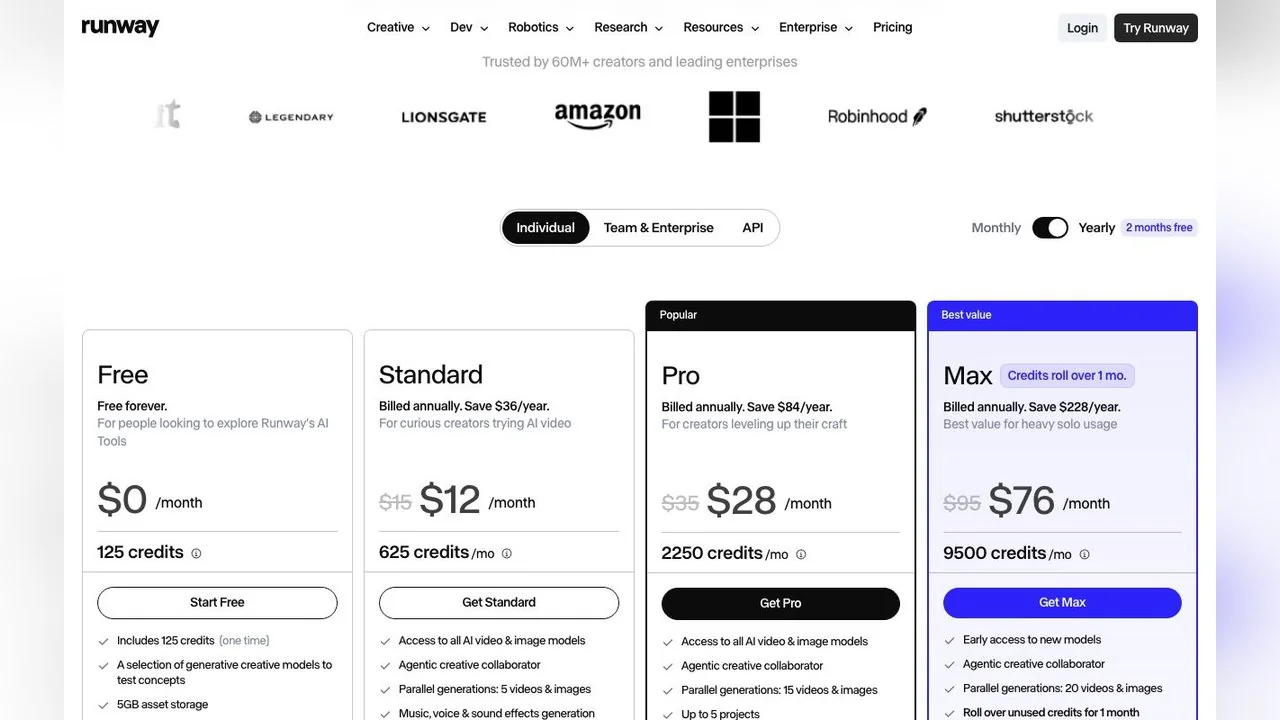
| Runway plan | Price a month (monthly billing) | Credits | What the card adds |
|---|---|---|---|
| Free | $0 | 125, granted once | A limited model selection for testing; 5 GB storage |
| Standard | $12 ($15) | 625 a month | Access to all AI video and image models; 5 parallel generations; up to 3 projects; 4K upscaling; 20 GB |
| Pro | $28 ($35) | 2,250 a month | 15 parallel generations; 1 Brand Kit; 1 custom voice clone; 4K video upscaling without a cap; Runway MCP; 100 GB |
| Max | $76 ($95) | 9,500 a month | 20 parallel generations; 3 Brand Kits; early access to new models; HDR, ProRes and image sequences; credits roll over one month; 500 GB |
The models behind those plans, as named on the pricing and product pages that day: Gen-4.5, Gen-4 and Gen-4 Turbo, Aleph 2.0, Act-Two, plus third-party models including Seedance 2.5, Kling 3.0 and Nano Banana Pro. Standard and above get "Access to all AI video & image models"; the Free plan does not.
Three cost details worth knowing before you compare. Standard and Pro credits do not roll over; only Max keeps unused credits for a month. Uncapped 4K upscaling is a Pro feature. And the runway pricing page quotes the annual rate as the headline, so Standard's $12 means $144 paid up front for the year, or $15 month to month.
Is Runway AI free? What the 125 credits cover
Yes, there is a Free plan, and Runway's own Free plan details article is unusually candid about it. The plan is "designed for those looking to explore Runway's AI models before committing to a paid tier"; it holds "125 credits (one time)", 5 GB of asset storage and "a limited set of generative AI tools". Those credits never expire, but once spent they are gone, with no monthly refresh. Any model or tool that shows an upgrade prompt is outside the Free plan.
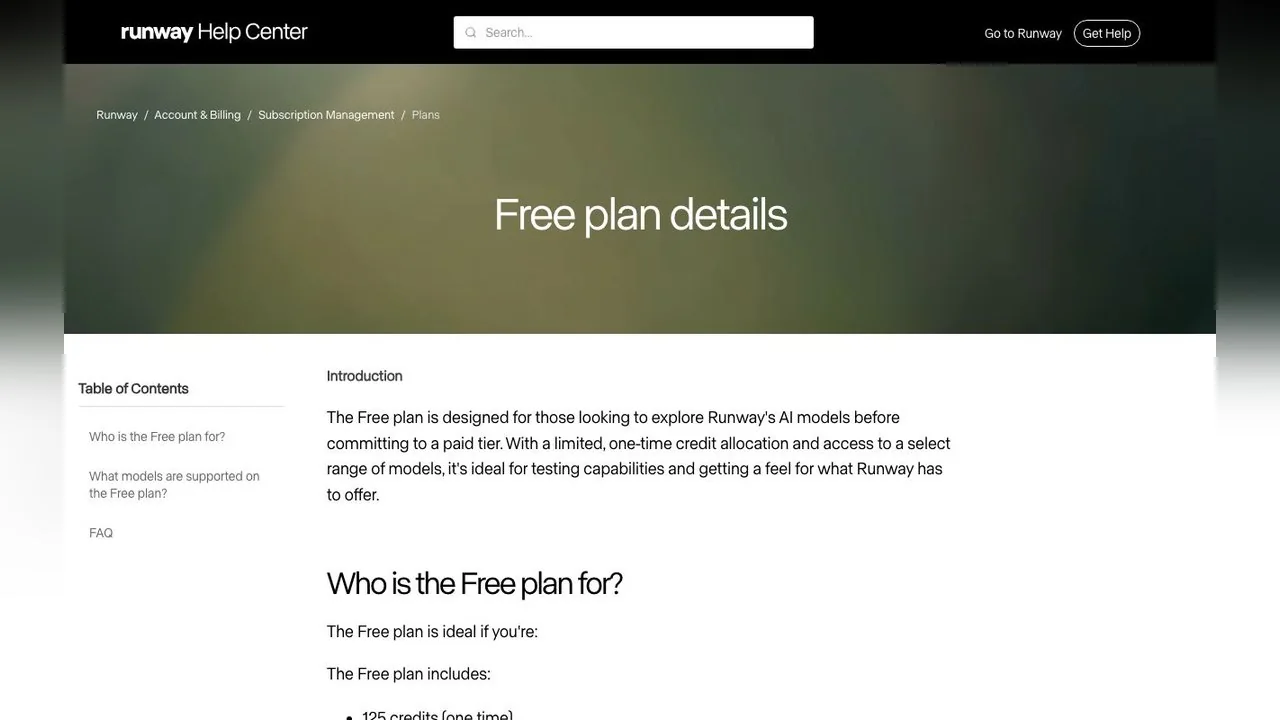
The article's FAQ headings tell the rest of the story: "Why does a model I used before now require an upgrade?", "Why do my videos have a Watermark?" and "Why am I prompted to upgrade when trying to generate?". So the honest reading of "runway ai free" is: a one-time taste, with the current models and watermark-free export behind Standard. That is why the search for a Runway AI alternative is usually a search for a free tier that renews, or a cheaper first paid step.
How we picked these Runway alternatives
Each tool below was chosen because it replaces at least one specific Runway job: text or image to video generation (Gen-4.5), editing an existing clip (Aleph 2.0 and Edit Studio), performance or motion transfer (Act-Two), or an agent that plans and renders for you (Runway Agent). For each, we loaded the vendor's own plan page from a clean browser with no account on October 15, 2026, and noted three things: the entry paid price with annual billing, whether any free route exists, and the feature that maps to Runway.
API-only services, tools without public pricing and sites that would not load without a login were left out. Treat the table as a map from Runway feature to where else it lives, not as a ranking.
9 Runway alternatives, side by side
| Tool | Replaces which Runway job | Entry paid price (Oct 15, 2026) | Free route | One thing to know |
|---|---|---|---|---|
| LazyKiwi | Generation (Gen-4.5), clip edits (Aleph-style tools), one-photo templates | Listed on its pricing page | Credits on sign-up, no card, price per render | Seedance, Kling, Hailuo plus Wan and Veo-class models behind one login |
| Kling AI | Generation; Motion Control for performance transfer | Standard: $6.99 for month one, $8.80 after | $0 Basic tier, heavily limited | 4.0 Flash early access requires the top annual tier |
| Pika | Generation with third-party models | Starter: $8/mo on the yearly plan, $10 monthly | $0 plan with pack purchases, no monthly credits | You need Creator for a commercial licence |
| Luma | Editing and motion transfer (Ray3.2), agent workflows | $30 a month (Plus, 10,000 credits) | Try-for-free button; no free plan card | Agent-first interface; third-party models included |
| Hailuo | Generation with MiniMax H3 and Hailuo models | Standard: $8.40/mo on the yearly plan | $0 plan with a single grant of trial credits | Per-second prices printed on the plan cards |
| PixVerse | Generation, effects templates, extend and expand tools | Standard: $8/mo on the yearly plan | Free tier not documented publicly | Every paid tier adds 60 credits that refresh each day |
| Vidu | Reference-to-video with consistent characters | Standard: $8.25/mo on the yearly plan | $0 plan plus trial and login credits | Off-peak quotas from Premium up |
| Google Flow | Generation with Veo 3.1 inside Google AI plans | $4.99 a month (AI Plus, 200 Flow credits) | None listed | Pro gives 1,000 Flow credits; Ultra 10,000 or 25,000 |
| Krea | Generation, upscaling, training; suite-style | Pro: $21/mo on the yearly plan | 100 units daily | Video concurrency on the free tier is zero |
Read down the entry-price column and the pattern is plain: most alternatives open between $5 and $12 a month, at or below Runway's Standard, and several top up credits every day. Read across the job column and the pattern is the opposite: nobody but Luma offers a single tool that maps onto Aleph 2.0, and nobody offers Runway's Premiere Pro and After Effects plugins.
LazyKiwi: a Runway AI alternative without the subscription
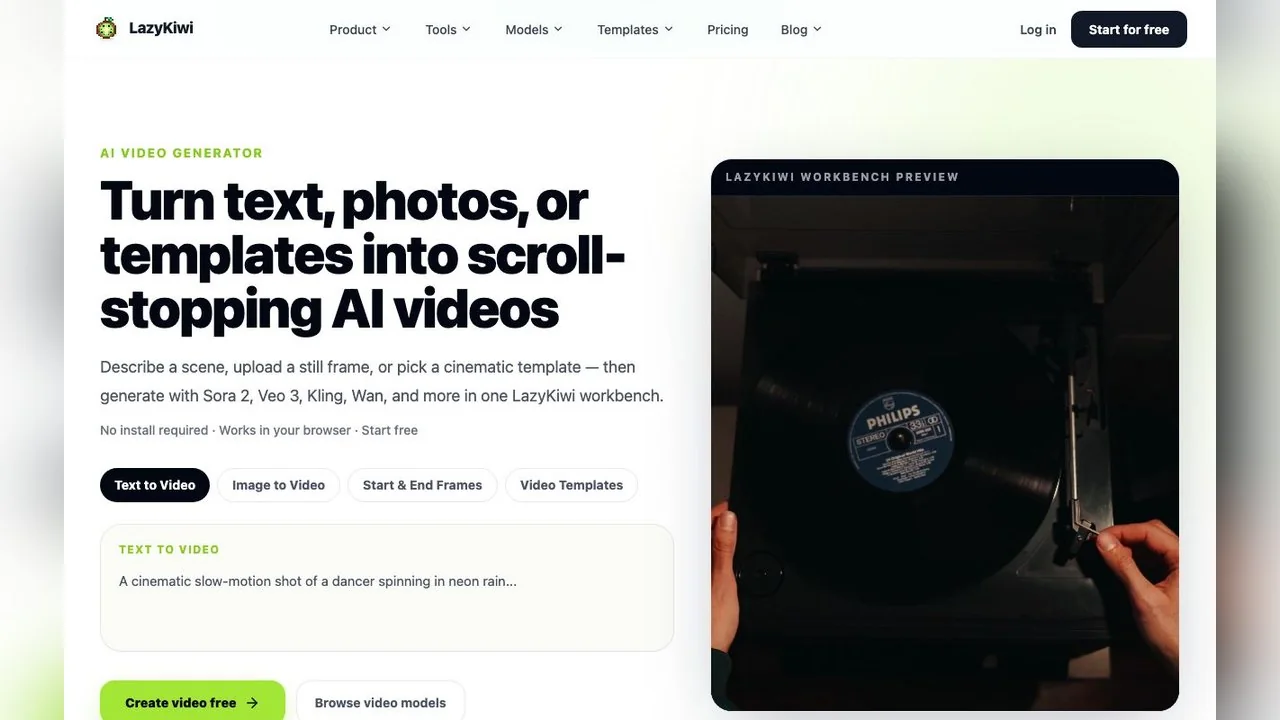
LazyKiwi's video generator puts third-party models side by side in a browser: Seedance 2.5 when you need a wide frame or a 30-second take, Kling v3 Omni when you want to pin a start frame and an end frame and let the model fill a minute at 1080p, and Hailuo 2.3 Fast when a still photo needs motion at 768p or 1080p. New accounts receive credits without a card, and each render displays its price before it starts.
For the editing jobs Aleph is known for, LazyKiwi offers single-purpose tools instead of one chat box: Add Object to Video drops a described prop into the scene and holds it steady as the camera moves, Video Background Changer swaps the backdrop behind a person, and Character Swap changes who is performing while the performance itself is untouched. Each takes one upload and one instruction.

The third difference is the template category: 140 effects that start from a single photo, from bullet time and dolly zoom to Clone Yourself, where one portrait divides into a grid of identical copies. If what you did in Runway was "animate this photo and make it look produced", a template gets there with no prompt at all.
What is missing on LazyKiwi: Runway's in-house models (Gen-4.5, Aleph 2.0, Act-Two) exist only on Runway, there are no NLE plugins, and there is no ProRes or HDR export tier.
Kling AI: the Runway Gen-4 alternative for cinematic generation
If you used Runway mainly for Gen-4 or Gen-4.5 generation, Kling is the model most people name as the runway gen-4 alternative, and buying from the source means you see new versions first. On October 15, 2026 the plan page headlined Kling 3.0 and 3.0 Omni (synchronised audio and video, storyboarding, element references), Kling Image 3.0 with direct 2K and 4K output, Kling Motion Control for recreating complex movement from motion capture, and native 4K video, with a banner promising 4.0 Flash early access to Ultra annual subscribers.
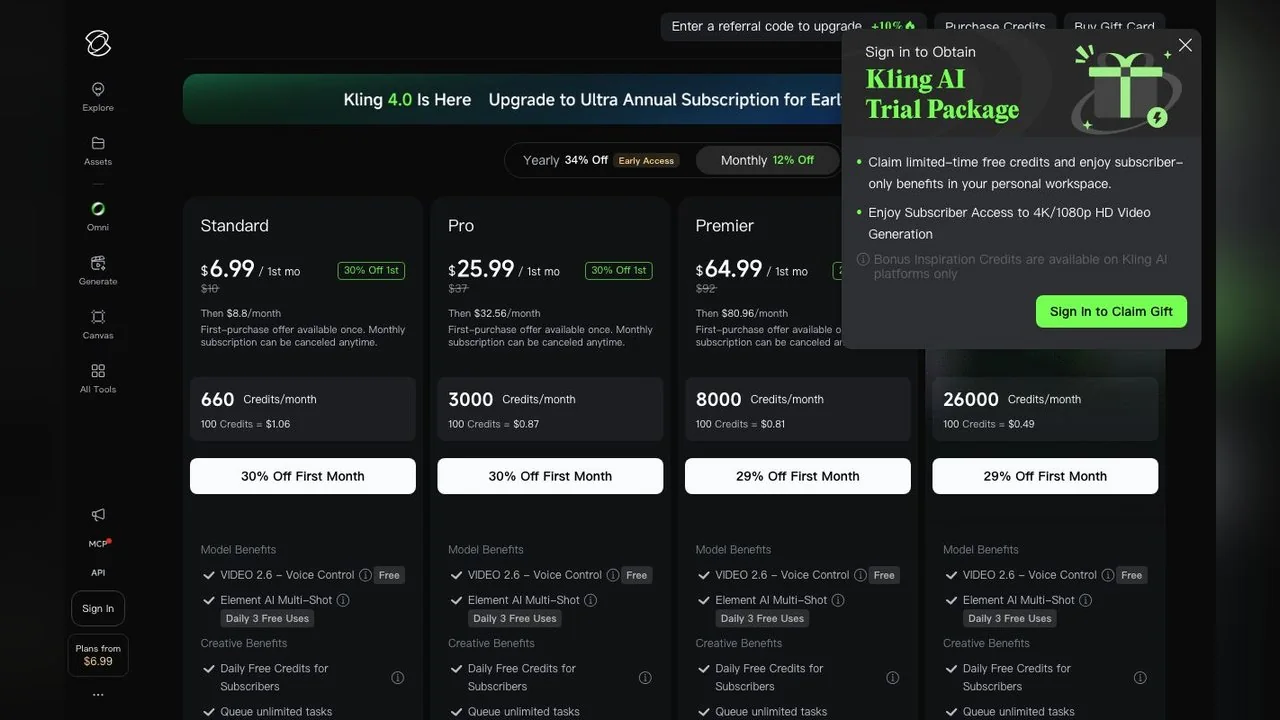
Month-to-month prices after the discounted first month are $8.80 for Standard (660 credits), $32.56 for Pro (3,000), $80.96 for Premier (8,000) and $159.99 for Ultra (26,000), and the cost per 100 credits falls from $1.06 to $0.49 as you climb. A $0 Basic tier exists, limited to a single video per generation and watermarked. Motion Control is the overlap with Runway's Act-Two: a reference performance drives a new character.
Pika: pay per pack instead of per month
Pika is the pick if you dislike subscriptions on principle. A free account holds no monthly credits but can purchase one-off packs (1,500 credits for $25 is the smallest), and pack credits stay valid for 365 days. Subscriptions, if you prefer them, run Starter $10 ($8 on annual), Creator $35 ($28) and Fancy from $95; exports are watermark-free on every tier including Free, and commercial use begins at Creator.
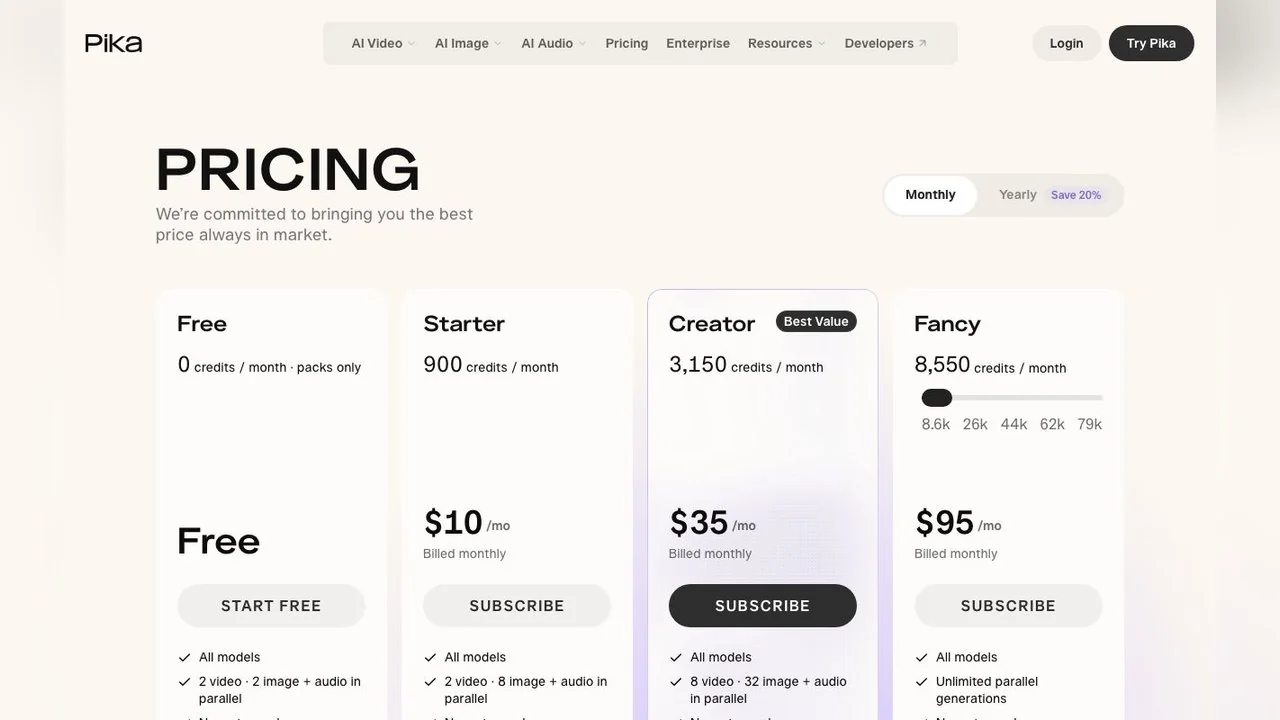
Pika's credit table prices third-party models (Seedance 2.5 and Wan 3.0 clips, Nano Banana 2 images), and nothing on the page points to an editing tool. That makes it a generation alternative, not an editing one.
Luma: Ray3.2 for the Aleph-style edits
Luma's plans page now leads with an agent-first product ("Creative agents for creative professionals"), but the model that matters for a Runway ML alternative is Ray3.2, which the page lists with four edit-type demos: performance and motion transfer, product swap, character transformation and relighting. Those are the closest public matches to what Aleph 2.0 and Act-Two do, and Luma also exposes third-party models (Seedance, Kling, Veo, MiniMax) through the same interface.
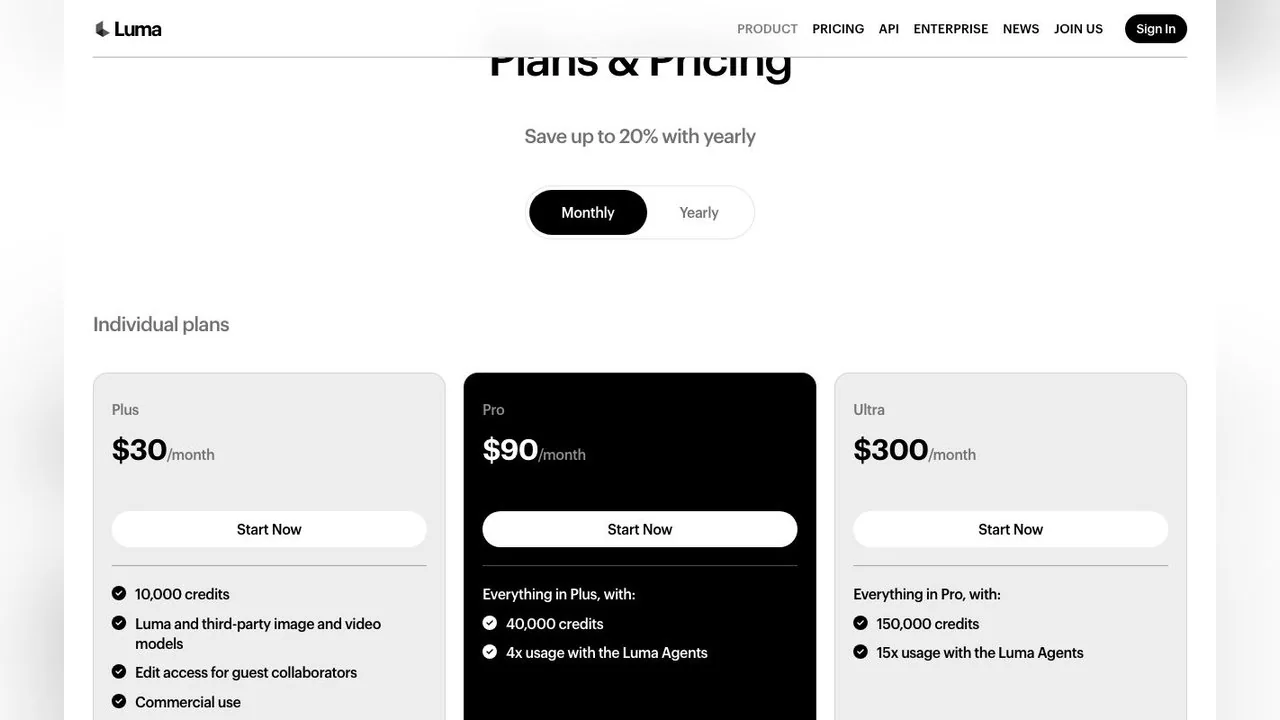
The price is the catch. Plus is $30 a month for 10,000 credits with commercial use; Pro is $90 for 40,000 and four times the agent usage; Ultra is $300 for 150,000. There is a try-for-free button but no free plan card, so treat Luma as a paid Runway alternative for teams that need the edit tools, not as a budget option.
Hailuo and PixVerse: per-second pricing and daily credits
Hailuo, the consumer front end for MiniMax's video models, prints per-second prices on its plan cards, which is rare and useful. On October 15, 2026 the pricing modal at hailuoai.video listed Standard at $8.40 per month on the yearly plan with 1,000 credits, pricing MiniMax H3 at $0.101 a second for 2K and $0.059 for 768p; Pro ($30.40, 4,500 credits) lowers those to $0.081 and $0.047. A $0 plan exists with a single grant of trial credits, restricted to Hailuo models. If your Runway use was straightforward text or image to video, this is the cheapest way to buy MiniMax H3 time.
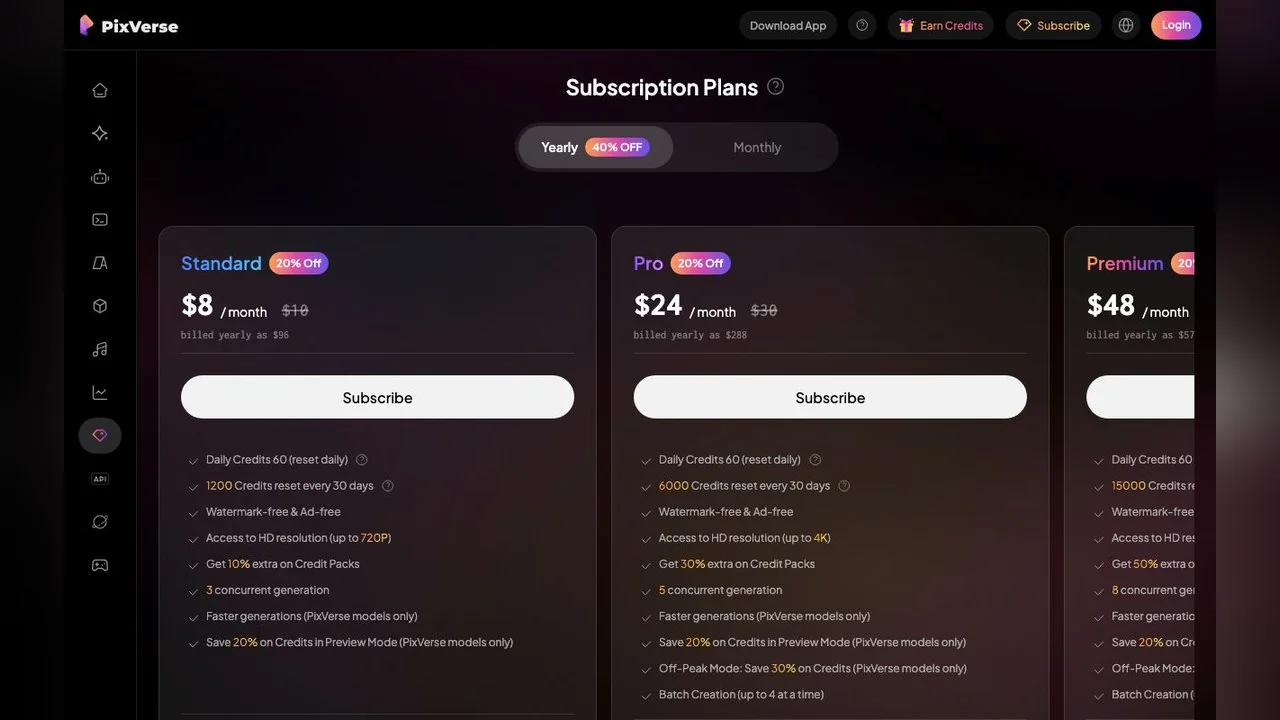
PixVerse is the effects-and-templates house. Standard costs $8 per month on the yearly plan ($96 up front) for 1,200 monthly credits and 60 more that refresh each day, capped at 720p; Pro ($24) adds 4K, batch creation and an off-peak discount, and its model list includes Seedance 2.5, MiniMax H3, Wan 3.0 and Kling 3.0. Magic Extend and Video Expand in the app cover Runway's extend and outpaint jobs. Free-tier details appear only after login.
Vidu: reference-to-video for consistent characters
Vidu leads with a reference-to-video mode: upload up to several subject references and keep the same character across clips, which is the job Runway users often reach for Gen-4's references to do. Its English pricing page on October 15, 2026 showed a $0 plan limited to ten references a month and 540p Q4 output, Standard at $8.25 per month on the yearly plan with 800 credits and clips of 3 to 16 seconds, Premium at $35.42 with 3,500 credits and an off-peak allowance of 20 videos a day, and Ultimate at $191.67 with a 200-video allowance. The paid rows are the ones that tick watermark-free downloads and commercial use.
Vidu's FAQ mentions a sign-up bonus and credits for logging in each day, so the free route is real if small. The off-peak quotas are the distinctive feature: a fixed number of videos a day outside busy hours that do not draw on your credits.
Google Flow: Veo 3.1 inside a Google AI plan
Google does not sell Flow on its own; it comes with a Google AI plan. On October 15, 2026 the plan table listed Google Flow credits at 200 a month on AI Plus ($4.99), 1,000 on AI Pro ($19.99), 10,000 on AI Ultra ($99.99) and 25,000 on the Ultra 20x tier ($199.99), with Veo 3.1 and Flow available in more than 140 countries. There is no free Flow allowance on that page.
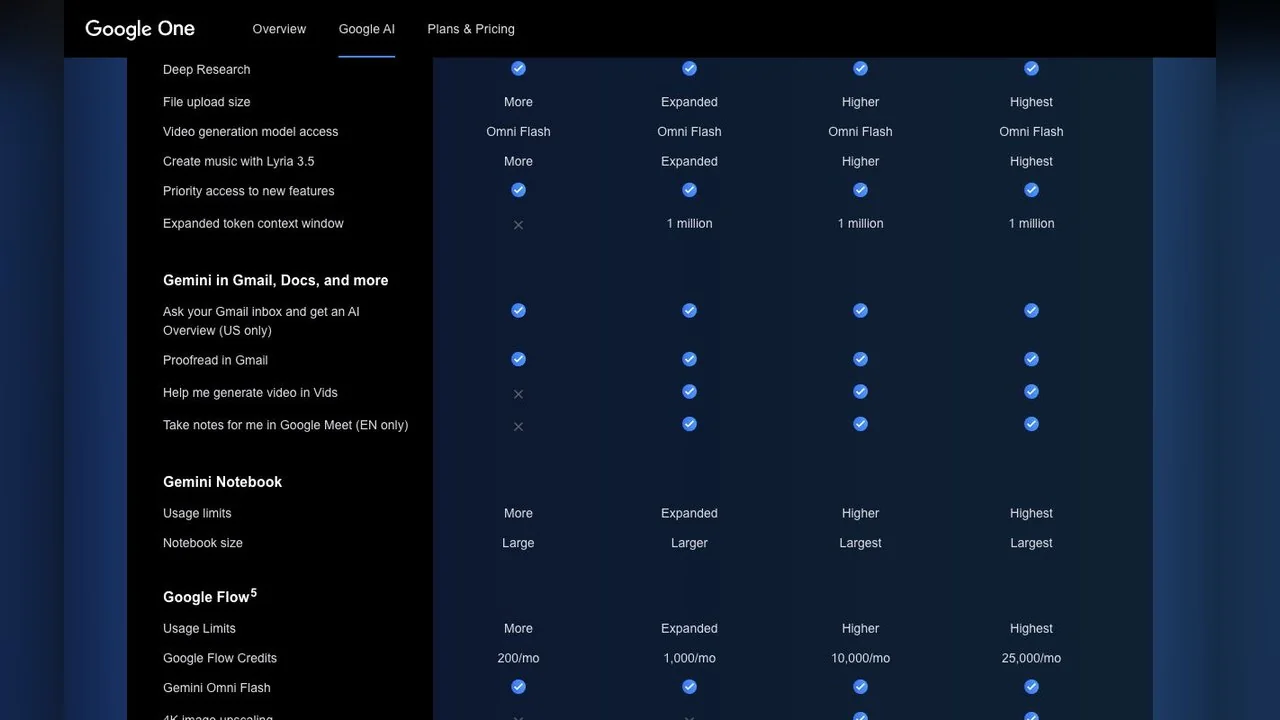
Flow is the right Runway alternative if Veo is the model you want and you already pay for Google storage or Gemini. It is a generation studio with scene-building tools, not an editor for footage you shot, so it does not replace Aleph. For a fuller comparison, see our Google Flow alternatives guide in the related posts.
Krea: the all-in-one Runway ML alternative
Krea matches Runway's breadth more than any other entry: image and video generation, upscaling to 22K, motion transfer, video style transfer, 3D generation and LoRA training under one subscription. Pro costs $21 per month on the annual plan (or $35 monthly) and includes 20,000 compute units, roughly 83 Seedance 2.0 clips by the page's own estimate; Max is $63 for 60,000. The $0 plan hands out 100 units daily but lists video concurrency as zero, so video rendering starts with a paid plan.
Krea's in-house models are image models (Krea 2 was flagged as new). Its video models are third-party, like Pika's and LazyKiwi's, so against Runway the comparison is tooling and price rather than a frontier video model.
Which Runway alternative for which Runway feature?
| If you used Runway for | Try first | Then |
|---|---|---|
| Gen-4.5 text or image to video | Kling (source), LazyKiwi (Seedance, Kling, Hailuo in one place) | Pika, Hailuo, PixVerse |
| Aleph 2.0 clip edits (add, remove, restyle) | Luma Ray3.2 | LazyKiwi's Add Object, Background Changer and Character Swap tools |
| Act-Two performance transfer | Kling Motion Control | Luma Ray3.2 motion transfer; LazyKiwi Character Swap for the swap half |
| Consistent characters across clips | Vidu references | Kling elements; Seedance 2.5 multi-reference on LazyKiwi |
| Veo quality specifically | Google Flow | Runway itself (it hosts third-party models too) |
| Agent that plans and renders | Luma Agent | Krea Agent; Runway Agent on a paid plan |
| Animate one photo with no prompt | LazyKiwi templates | PixVerse templates, Hailuo templates |
Notice that no single row says "everything". The realistic plan for most people is two logins: one model host for generation (LazyKiwi, Kling or Pika) and one edit tool when a clip needs surgery (Luma, or LazyKiwi's single-job tools).
When Runway is still the right choice
- You edit footage more than you generate it. Aleph 2.0 and Edit Studio (change one frame, apply it to the clip) have no exact equivalent at the budget end.
- You work inside Premiere Pro or After Effects. Runway's plugins generate, edit and extend inside the NLE; none of the nine alternatives offers that.
- You need ProRes, HDR or image-sequence delivery for a broadcast pipeline. That is the Max plan's territory.
- You want MCP access to drive Runway from Claude or ChatGPT, which starts on Pro.
- You generate a lot and can commit to Max, where credits roll over and parallel generations reach 20.
If two or more of those apply, the alternatives above will cost you time rather than save you money. If none apply, the entry prices in the table are the argument.
Key takeaways
- Runway as of October 15, 2026: Free with a one-time 125-credit grant, Standard $12 per month on the annual plan ($15 monthly) for 625 credits, Pro $28 for 2,250, Max $76 for 9,500 with one-month roll-over.
- The Free plan is a one-time taste: credits never renew, upgrade-prompt models are excluded, and the help centre has a watermark FAQ for free videos.
- Entry prices for most of the nine run from $5 to $12 a month, and Kling, Vidu, Krea and PixVerse (once paid) top up credits every day.
- Nothing cheap replaces Aleph 2.0 or the Premiere and After Effects plugins; Luma Ray3.2 is the nearest edit tool, at $30 a month.
- To generate without subscribing, LazyKiwi offers Seedance, Kling and Hailuo with credits at sign-up, a price per render and a 140-template library that starts from one photo.
Tools & Reviews Editor
Marcus Tan
I open every competitor's pricing page myself before writing a comparison, and I say plainly when another tool is the better pick.
FAQ
Common questions
Is Runway free to use?
There is a Free plan: 125 credits granted once, 5 GB for assets and a short model list, per Runway's help centre as read on October 15, 2026. The grant never expires but never refreshes, upgrade-prompt models are excluded, and free videos fall under a watermark FAQ. Standard, $12 per month on the annual plan, is the first tier with every model.
What is the best free Runway alternative?
If you want free credits that keep coming, Kling's Basic tier, Vidu's login bonuses and Krea's 100 daily units are the routes that renew. For several models plus one-photo templates in one place, LazyKiwi grants credits at sign-up without a card and prices each render up front. Pika's $0 plan has no monthly credits but sells packs without a subscription.
Is Kling better than Runway?
We did not benchmark them, so this answer is about access, not quality. Kling's newest models (3.0, 3.0 Omni, 4.0 Flash early access) appear on kling.ai first, and its Standard plan costs $8.80 a month after a discounted first month. Runway also hosts Kling 3.0 on paid plans, alongside its own Gen-4.5 and Aleph 2.0, which Kling does not have.
Which Runway alternative has Aleph-style video editing?
Luma's Ray3.2 lists performance and motion transfer, product swap, character transformation and relighting, which is the nearest public match, from $30 a month. LazyKiwi covers the common edits as separate tools: add an object, change the background, swap the character. Kling Motion Control handles the performance-transfer part.
How much do Runway alternatives cost?
Entry paid plans with annual billing, October 15, 2026: Google AI Plus $4.99, Pika $8, PixVerse $8, Vidu $8.25, Hailuo $8.40, Kling $8.80 after month one, Krea $21, Luma $30. LazyKiwi's plans sit on its pricing page and move with promotions. Runway Standard is $12 on the annual plan or $15 monthly.
Generate with several models, pay per run
Open the LazyKiwi video generator, pick Seedance, Kling or Hailuo, and render with the credits granted at sign-up. Each run shows its price up front.
Related reading

Google Flow Alternatives: 10 AI Video Tools, Prices Checked
Google Flow alternatives sorted by what you need: Veo without Flow, multi-model studios, free plans and open models, with prices read on 7 October 2026.
12 min read
Kling vs Veo 3 in 2026: Which Video Model Wins?
Kling vs Veo 3 on the two tiers LazyKiwi runs: Kling v3 Omni for start-end frames, 1:1 and 60-second takes, Veo 3.1 Lite for silent 16:9 clips.
8 min read
Sora 2 vs Veo 3.1 in 2026: Which Video Model Should You Use?
Sora 2 vs Veo 3 with dated sources: Sora 2's API ends September 24, 2026, Veo 3.1 Lite runs in LazyKiwi at 1080p, no audio, and four models fill the gap.
9 min read
Best AI Video Editor in 2026: 7 Picks, Free and Paid
Seven of the best AI video editors compared on prices checked today, free tiers, captions, text-based cuts and generative tools, plus where LazyKiwi fits.
10 min read