
Couple Photo Poses: 20 That Do Not Look Stiff
Twenty couple photo poses grouped by contact level, height difference and setting, plus the instructions that get two people moving instead of posing.
 Maya Chen 9 min read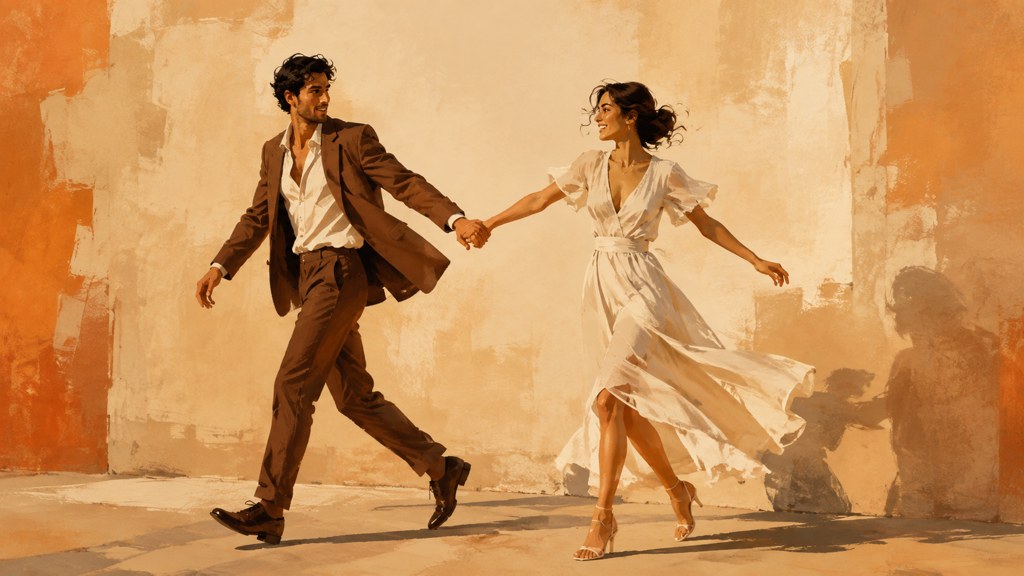
Stiff couple photos nearly always share one cause: both people stood still, faced the lens and waited. The twenty setups below are sorted by contact level and by how much movement they need, because those are the two dials that decide whether a frame reads as a hug or a handshake. There are fixes for a big height gap, instructions that get two people moving instead of holding a pose, and an honest look at the composite route for when you cannot both be in the room.
What makes a couple photo look natural instead of staged?
Three variables do the work. Everything else is decoration.
- Movement. A pose held still photographs as a pose. Walking, turning, leaning in and pulling back all produce frames that look unplanned, because the moment between two positions genuinely was.
- Contact points. Count them. Hands linked is one; hands linked plus a shoulder touching is two; a full embrace is four or five. More contact reads as more intimacy, and mismatched contact is what makes a photo feel awkward.
- Eye lines. Both looking at the lens is the formal option. One looking at the other is the warm one. Both looking somewhere else together is the cinematic one. Pick per frame rather than defaulting to the first.
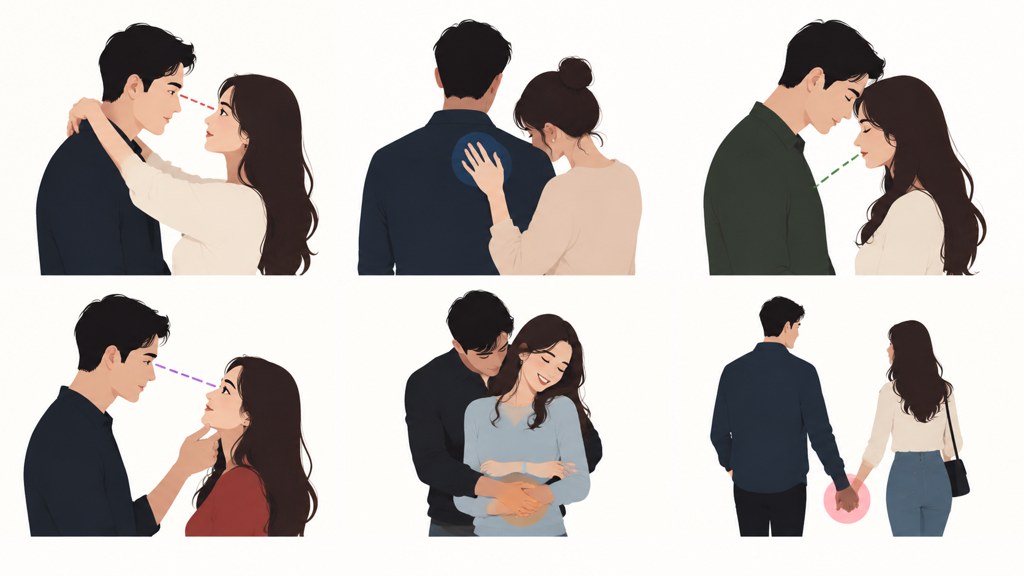
The quickest diagnostic on a photo you already have: cover the faces with your thumb. If the two bodies still tell you these people know each other, the pose worked. If they read as two strangers queueing, no expression is going to rescue it.
How do you pose a couple with a big height difference?
A gap of 20 centimetres or more turns most standard poses into a parent-and-child arrangement. Four fixes, ranked by how little attention they draw to themselves.
- 1
Change the ground, not the people
A kerb, a step, a slope or a low wall closes the gap without anyone standing on tiptoe. This is the invisible fix and it should always be the first attempt.
- 2
Sit one, stand one
The seated person leans forward, the standing person leans in from behind or rests a hand on the shoulder. The eye lines end up close together and the difference stops registering.
- 3
Lean the taller one
Weight onto the far foot, hip out, head tilted toward the shorter person. It costs a few centimetres and it also fixes the stiffness of a tall person standing at full height.
- 4
Drop the camera and get closer
A lens at the shorter person's eye level equalises the frame. Combine it with a tighter crop from the waist up and the height gap simply leaves the picture.
Watch the hands, not the heads
With a big gap the linked hands end up at an odd height and the taller arm goes rigid. Have the taller person put an arm around the shoulder instead and let the shorter one hold the waist.
What are the best couple poses for standing shots?
Six standing setups, ordered from least to most physical contact. Work down the list during a session rather than starting at the intimate end, because people loosen up as they go, never before.
| Setup | Contact | Best for | What goes wrong |
|---|---|---|---|
| Side by side, hands linked | One point | First shoots, formal occasions, families watching | Both bodies square to the lens, arms locked straight |
| Shoulder to shoulder, angled in | One point | Small spaces and doorways | Heads tilting toward each other at the same angle, which reads as a greetings card |
| One in front, one behind | Two points | Height gaps and shy partners | The back person disappearing entirely behind the front one |
| Facing each other, foreheads close | Two to three | Engagements and anniversaries | Noses colliding, and both faces hidden in profile |
| Walking hand in hand toward the camera | One point, in motion | Streets, beaches, anywhere with room | Marching in step, which looks military |
| Full embrace, one head on a shoulder | Four or five | The last five minutes of a session | Squeezing hard enough to change the shape of both faces |
Two adjustments improve every one of them. Turn both bodies about 30 degrees toward each other rather than toward the camera, and give the outside arms something to do so they do not hang flat.
What couple poses work when one person is camera-shy?
Camera shyness is almost always about being looked at, not about being photographed. Poses that remove the eye contact remove the problem, and they tend to produce the better pictures anyway.
- Backs to camera, walking away, hands linked. No faces, no performance, and the frame still says everything.
- Profile facing each other. The shy person is looking at someone they know instead of a lens.
- One looking down or away while the other looks at them. Gives the reluctant half something to do with their eyes.
- Silhouette against a bright window or sky. Reads as deliberate and hides every expression.
- Detail frames: hands, rings, a shoulder, the back of a head. Shoot four of these first and the session warms up on its own.
Say out loud that the first ten frames are throwaways. It is true, it takes the pressure off, and the frame where somebody laughs at how forced this all feels is usually the one that gets printed.
What prompts get a couple to move naturally?
Stop naming poses and start giving tasks. A pose is something to hold; a task is something to do, and the camera catches the by-product.
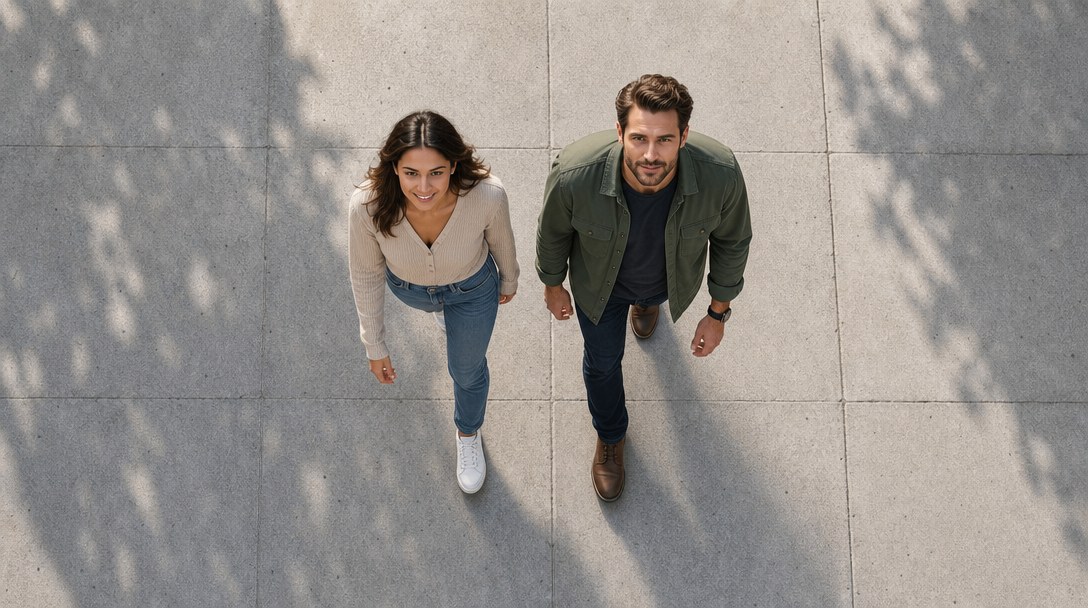
- Walk toward me and talk about what you are having for dinner. Nobody can walk and argue about dinner and look stiff at the same time.
- Whisper something you would not say out loud. Produces a real reaction from the person listening, which is the frame you want.
- Count down from three together, then hug on zero. The hug at zero beats any hug you asked for directly.
- Push each other gently, then catch. Movement plus contact plus a genuine laugh in one instruction.
- Look at each other, then both look at me on my count. The turn is the shot, not the arrival.
Shoot through the whole instruction rather than at the end of it. Three frames per task is normal, and the useful one is rarely the last. If you want the tasks agreed before the day, an AI pose generator will build a single described frame from one full-body photo, which makes a workable planning sheet.
What are good couple picture ideas by setting?
What people actually type shows how much the setting drives this: couple photo poses ideas for a first shoot, couple photo poses on beach for a holiday, couple photo poses in saree for a wedding, couple photo poses funny for something that has to survive a group chat. The setting changes the frame more than the pose does.
- Home. The one that works: sitting on the floor with backs against the sofa, knees overlapping. The one that does not: standing in the middle of a room with nothing to lean on.
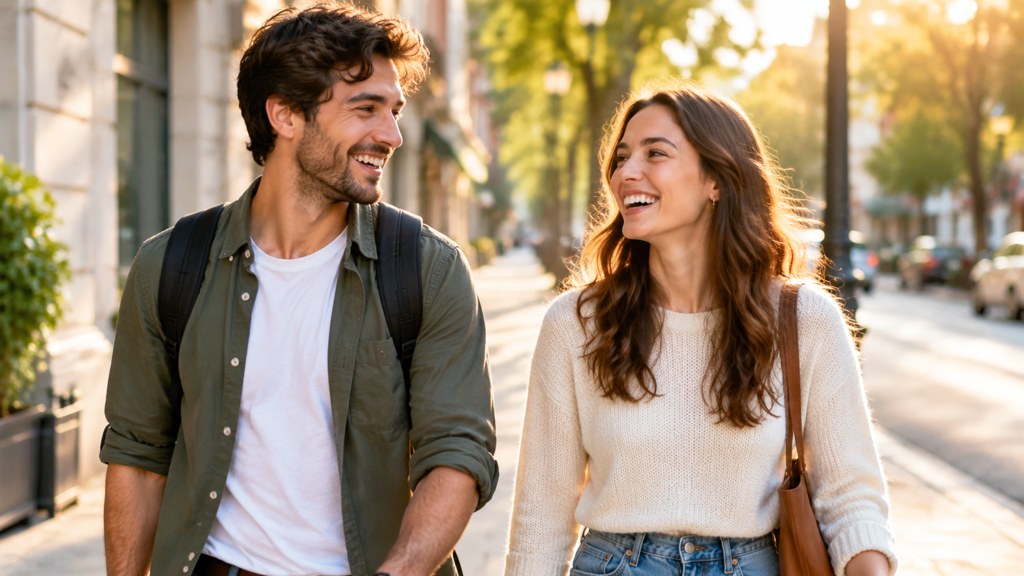
- Street. The one that works: walking together with the background compressed by stepping back and zooming in. The one that does not: standing still in a doorway while people walk past behind you.
- Beach. The one that works: facing each other at the water line in the hour before sunset, low camera, feet in the frame. The one that does not: midday sun, which puts hard shadows under both sets of eyes.
- Studio or plain wall. The one that works: close crop, one light to the side, all attention on contact and expression. The one that does not: full length against a blank wall, which leaves nothing to look at but posture.
Most couple picture ideas that circulate on Pinterest were shot in one specific light at one specific location. Take the pose and the contact level from them; do not expect the same result in a different room.
How do you take couple photos with just a phone and a timer?
- 1
Get the phone off the ground
Chest height on a wall, a bag or a small tripod. A phone on the floor pointing up makes both of you look like statues seen from below.
- 2
Use the rear camera and interval mode
Burst or interval beats a single timed shot, because it covers the walk-in, the settle and the moment after somebody speaks. A single ten-second timer catches exactly the wrong second.
- 3
Frame wider than feels right
Leave room to move into. The crop can come later; the movement cannot.
- 4
Give yourselves a task, not a pose
The same instructions from the previous section work when the photographer is a phone on a wall. Walk in, hug, turn, laugh.
Check the first set before you commit to the location. Photography sites such as PetaPixel and camera-maker guides including Nikon's lens explainer, which recommends the 85mm as a medium telephoto ideal for portraits, are worth reading on why standing further back and zooming in changes proportion so much.
How do you make a couple portrait when you cannot shoot together?
Long distance, a missed flight, a shift that never lines up. Compositing two separate photos into one frame is possible, and it is worth being clear about what it does and does not do well. The instant couple portrait template is built for exactly this job; the run below used the two-upload polaroid template from the same library to show how the mechanics work.
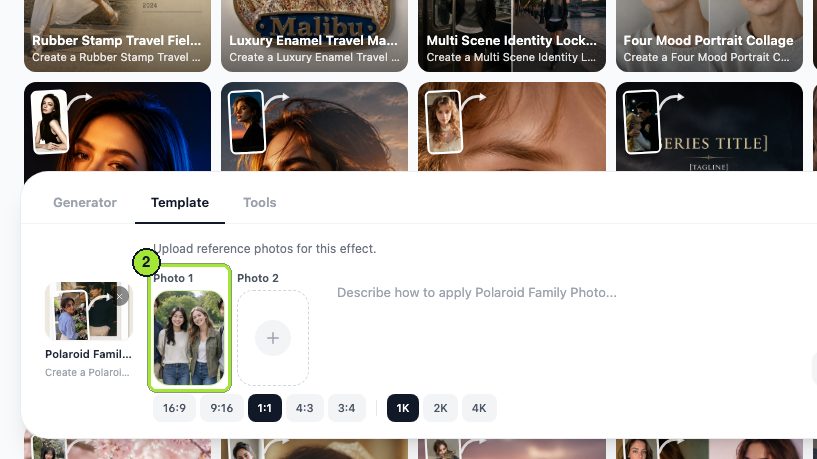

Both people should be lit similarly and shot from a similar height. Two photos with opposite light directions composite into something that reads as a collage even when the edges are clean, and that is a limitation of physics rather than of the tool.
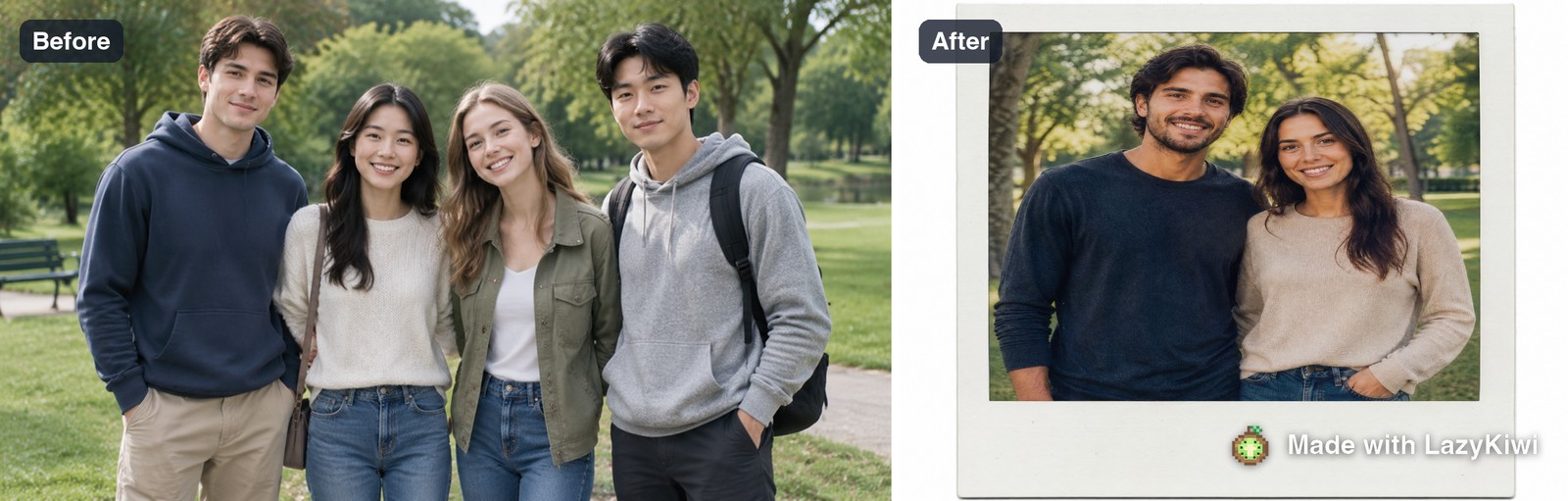
The honest caveat matters more than the technique. A composite is fine as a card, a gift or a phone background. It is not a document, and it should not be presented as a photograph of a moment that happened. Say what it is when you post it.
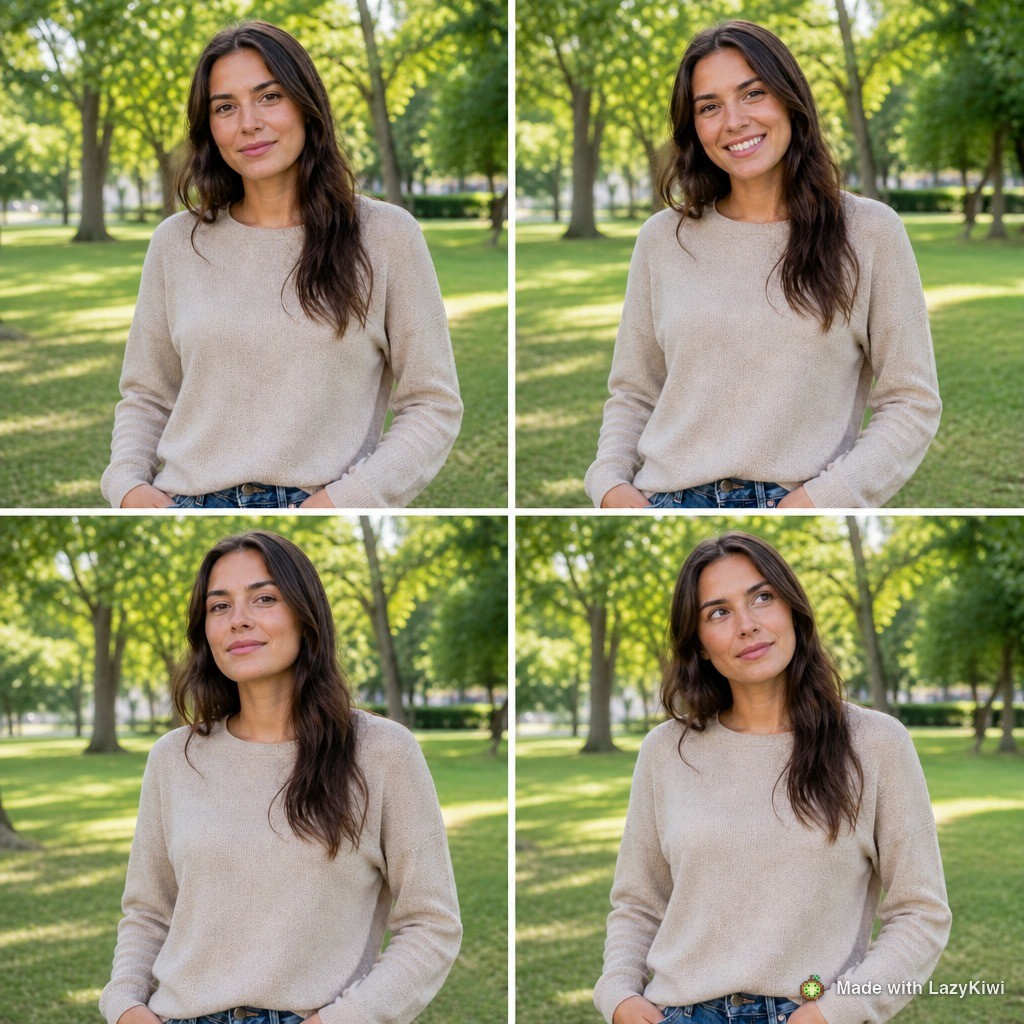
Check the template before you spend on it. Single-portrait templates rebuild one face and discard the second person entirely, as the frame above shows. Templates that ask for two uploads are the ones designed to keep two people. Every run here used GPT Image 2 at 13 credits for a 1K image, and a new account arrives with 40 free credits, so testing which template behaves how costs nothing.
What are the most common couple photo mistakes?
- Matching outfits in a colour that also fills the background. Coordinate, then check both against the wall or the field you are standing in front of.
- Perfect symmetry. Two people at identical angles with identical smiles reads as a passport pair. Offset the heights, the angles and the eye lines.
- Everyone looking at the camera in every single frame. Vary it; the set needs at least a third of its frames looking elsewhere.
- Shooting only at chest height. Drop to waist level for a few frames and shoot a few from slightly above; both change the relationship between the two figures.
- Booking the session for midday because the light is bright. Bright is not the same as good. The hour before sunset does more for a couple photo than any pose on this page.
- Stopping too early. The good frames arrive after people forget they are being photographed, which takes about twenty minutes.
If you are hiring rather than shooting, directories publish what vendors charge in very different ways. WeddingWire lists photo booths and photographers among its categories and says it covers over 157,000 local professionals with reviews and pricing, though most listings still show a request-pricing button rather than a number (checked 2026-09-07). The Knot runs a comparable marketplace. Treat any single figure you see quoted elsewhere as a regional guess unless the vendor publishes it themselves. Photography schools publish free technique libraries too, such as NYIP.
Key takeaways
- Movement, contact points and eye lines decide whether a couple photo reads as warm or as a queue.
- Fix a height gap with the ground, a seat or the camera position before you ask anyone to change posture.
- Work down the contact ladder during a session; people loosen as they go and never the other way round.
- Give tasks, not poses. Walk and talk, whisper, count down and hug on zero.
- For a phone shoot, use interval mode at chest height and frame wider than feels comfortable.
- Compositing two photos works as a card or a gift, not as a record, and only templates with two upload boxes keep two people.
Image & Design Editor
Maya Chen
I spend my days inside image tools, testing prompts and settings on real photos so the steps here match what you actually see on screen.
FAQ
Common questions
What are the best couple photo poses for beginners?
Start with side by side and hands linked, then walking toward the camera while talking. Both need almost no instruction, both produce usable frames in the first minute, and they warm people up for the closer setups that need more trust.
How do you pose a couple with a big height difference?
Change the ground first: a kerb, a step or a slope closes the gap without anyone noticing. If that is not available, seat one and stand the other, or drop the camera to the shorter person's eye level and crop from the waist up.
How do you take couple photos without a photographer?
Put the phone at chest height on a wall or small tripod, use the rear camera in burst or interval mode rather than a single timer, frame wider than you think you need, and give yourselves a task such as walking in and hugging rather than a pose to hold.
Can you make a photo of two people who were never together?
You can composite two separate photos with a template that takes two uploads, and the result is fine as a card or a gift. Match the light direction and camera height in both sources first, and say what it is when you share it. Single-portrait templates keep only one face.
What should couples wear for photos?
Coordinate rather than match, and check both outfits against the background before the day. Two people in the same shade tend to merge into one shape, and a colour that also appears in the wall or the field behind you removes the separation the photo needs.
Build the couple portrait you cannot shoot
Two photos, one frame. The instant couple portrait template composes a pair from separate uploads, and a new account arrives with 40 free credits to test it.
Related reading
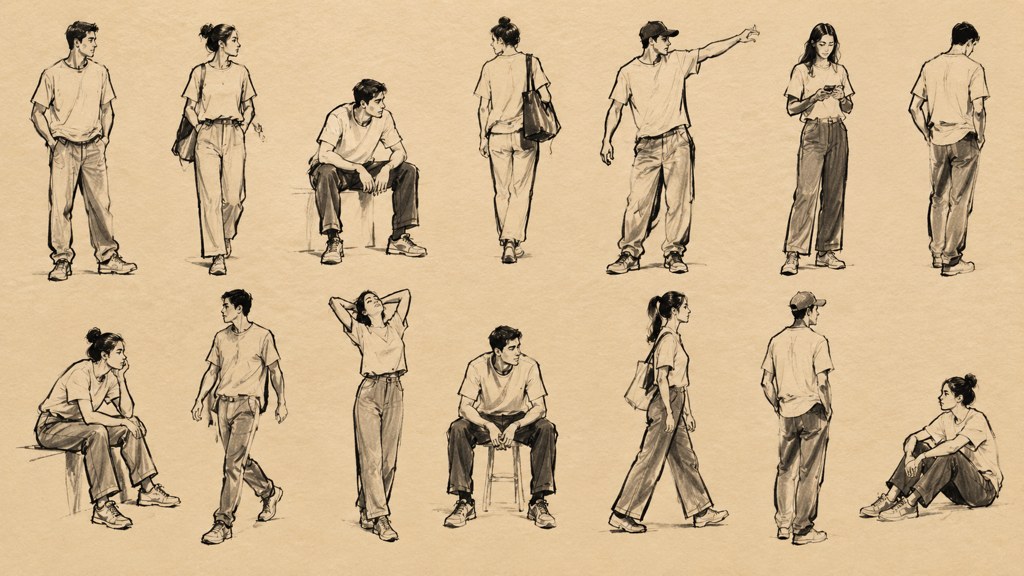
Pose Reference Library: 40 Poses by Use Case
Forty pose references sorted by what you need them for, figure drawing, portrait sessions, product shots, plus how to generate your own on demand.
10 min read
How to Pose for Pictures: 12 Rules That Work
Twelve posing rules that hold for any body and any camera: weight, angles, hands, chin and breath. Plus what to do in the three seconds before the shutter.
10 min read
Family Picture Outfit Ideas: Palettes That Work
Six colour palettes for family photos, how to coordinate without matching, what to avoid on camera, and how to plan the whole set from one anchor outfit.
9 min read
AI Couple Photo Generator: How to Make Natural Couple Photos
Use an AI couple photo generator to merge two selfies into one scene: the image combiner, instant couple and bridal templates, a video route, free credits.
8 min read