
Doodle Ideas: 60 Easy Doodles by Skill Level
Sixty doodle ideas sorted by how long each takes and how much drawing skill it needs, plus the repeatable shapes that fill a whole page fast.
 Maya Chen 9 min read
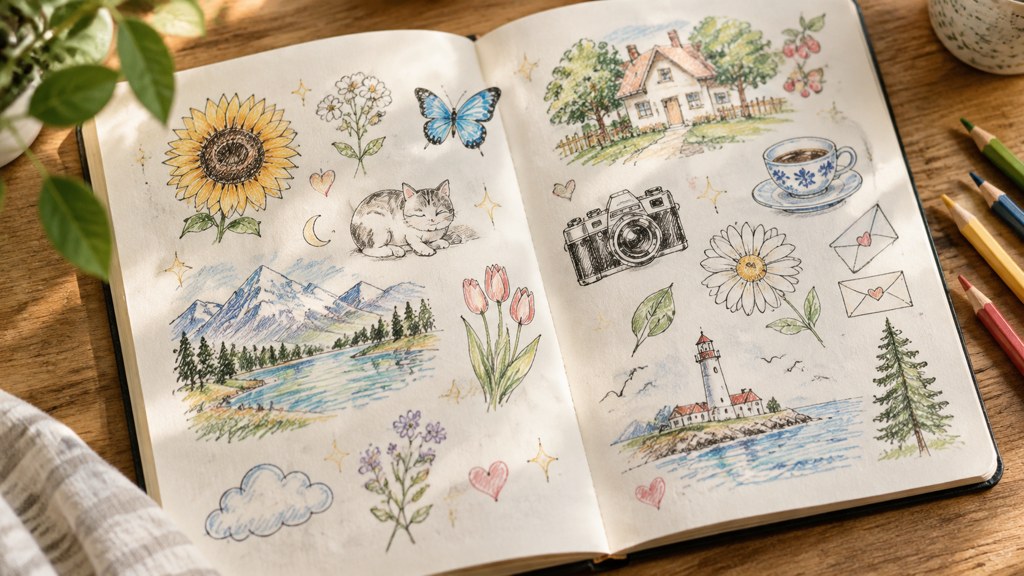
Sixty doodle ideas, grouped by what you need them for: twenty beginner shapes built from circles and straight lines, sixteen repeatable motifs for borders and page fills, sixteen functional icons for journals and planners, and eight generated by five prompt structures for the days when nothing comes. Each one is described by how it is constructed rather than by name, because the construction transfers and the name does not. There is also a section on generating doodle-style sheets in a workbench template, with what that template got right and the subject it refused to draw.
What makes a doodle easy to draw repeatedly?
A doodle you can draw fifty times without getting bored has three properties, and none of them is talent. It closes, so the shape reads even when the line wobbles. It takes three or four strokes, so your hand finishes before your attention wanders. And it has no perspective, so you never have to decide which edge is nearer.
Test any shape against those three properties before you commit it to a page border. A tiny house with a sloping roof passes. A tiny house drawn at three-quarters, with a side wall, fails on the third property, and by the twentieth repetition the wall angles will have drifted.
- Closed: the outline meets itself, so a shaky line still reads as the object.
- Three or four strokes: short enough that muscle memory takes over by the fifth repeat.
- Flat: front-on or top-down, never three-quarter, so nothing has to line up.
- Scalable: it works at five millimetres in a margin and at five centimetres as a header.
| Group | Strokes each | Time for the whole set | Skill needed | Use it for |
|---|---|---|---|---|
| Beginner shapes (20) | 3 to 4 | About 25 minutes | None | Margins, sticky notes, learning the reduction habit |
| Border motifs (16) | 1 unit, repeated | About 20 minutes | Steady spacing | Page edges, dividers, filling dead space |
| Journal icons (16) | 2 to 5 | About 30 minutes | Consistent pen width | Task states, trackers, headers |
| Prompt-built (8) | Varies | Open-ended | Willingness to be wrong | Blank-page days and warm-ups |
Invent your own instead of copying
Take any object, reduce it to its silhouette, then delete every internal line except the one that identifies it. A mug is a rectangle with a handle. A cactus is a rounded column with two stubs. That reduction is the skill; the list below is just practice material.
What are the easiest doodles for absolute beginners?
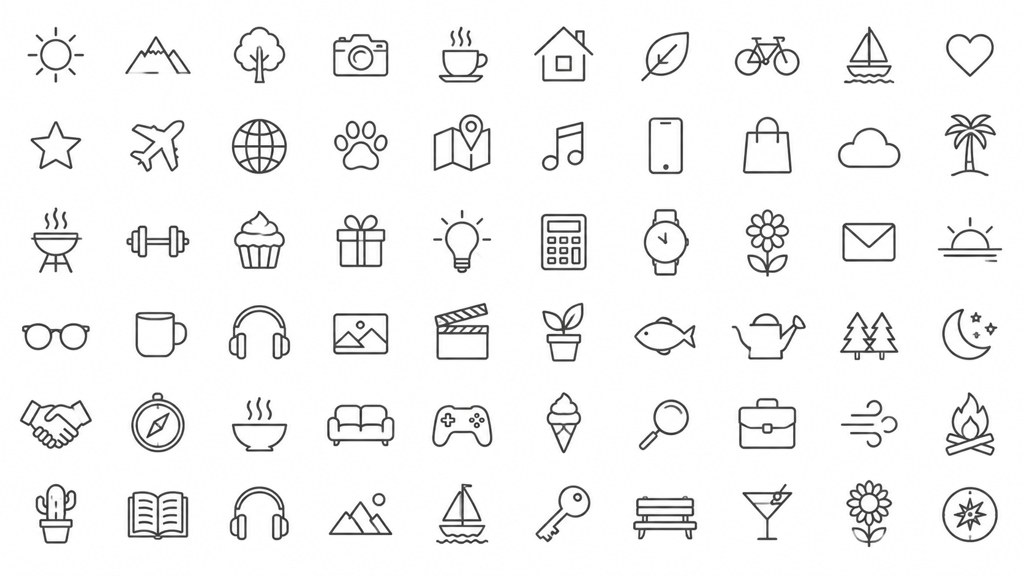
Twenty shapes built from circles, straight lines and one curve. They are described by construction rather than by name, because the construction is the part you can reuse.
- Cloud: three overlapping bumps on a flat base line.
- Star: five strokes, drawn without lifting the pen, corners deliberately uneven.
- Mug: rectangle, softened bottom corners, a hook on the right.
- Leaf: two arcs meeting at both ends, one straight line down the middle.
- Cactus: a tall rounded column, two shorter stubs, four dots for spines.
- Envelope: rectangle with a shallow V from the top corners.
- Sun: circle plus eight short lines that do not touch it.
- Book: two stacked rectangles offset by two millimetres.
- Ghost: a dome with a wavy bottom edge and two dots.
- Balloon: circle, small triangle underneath, one loose S-curve for string.
- Plant pot: a trapezium, a thin band across the top, three arcs above it.
- Camera: rectangle, small circle inside, tiny bump on top.
- Music note: filled oval, one vertical line, one flag.
- Paper plane: three triangles sharing one long edge.
- Lightning: one zigzag, closed at both ends.
- Heart: two bumps and a V, drawn as one continuous stroke.
- Flag: rectangle on a pole with the free edge cut into two points.
- Key: circle, short bar, two teeth.
- Bee: oval, three stripes, two hollow wings.
- Speech bubble: rounded rectangle with a triangle tail off the bottom left.
These are easy doodles in the useful sense: each one survives being drawn badly. If a shape stops being recognisable when the line is uneven, it belongs in a sketchbook, not in a margin.
What doodle ideas fill a page or a border fast?
Sixteen repeatable motifs. A page filler is not a picture; it is a unit you can tile. Draw one, leave a gap the width of the unit, draw the next.
- Wave line, then a second wave line offset by half a wavelength.
- Alternating dots and dashes along a ruled edge.
- A row of triangles pointing up, then a row pointing down beneath it.
- Overlapping circles, each one crossing the last at its midpoint.
- Vertical lines of varying height, like a bar chart with no data.
- Interlocking chain links drawn as flattened ovals.
- A running vine: one long curve with leaves alternating left and right.
- Scallops, each arc starting where the last one ended.
- Squares rotated forty-five degrees and threaded on a line.
- Tiny arrows all pointing the same way, then one pointing back.
- A ribbon: two parallel curves with short diagonals joining them.
- Stacked semicircles, roof-tile fashion.
- Confetti: short strokes at random angles, never touching.
- A stitched border: dashes with a dot centred between each pair.
- Loops, like cursive letter L repeated without lifting the pen.
- Corner spirals in all four corners, each rotated to face the centre.
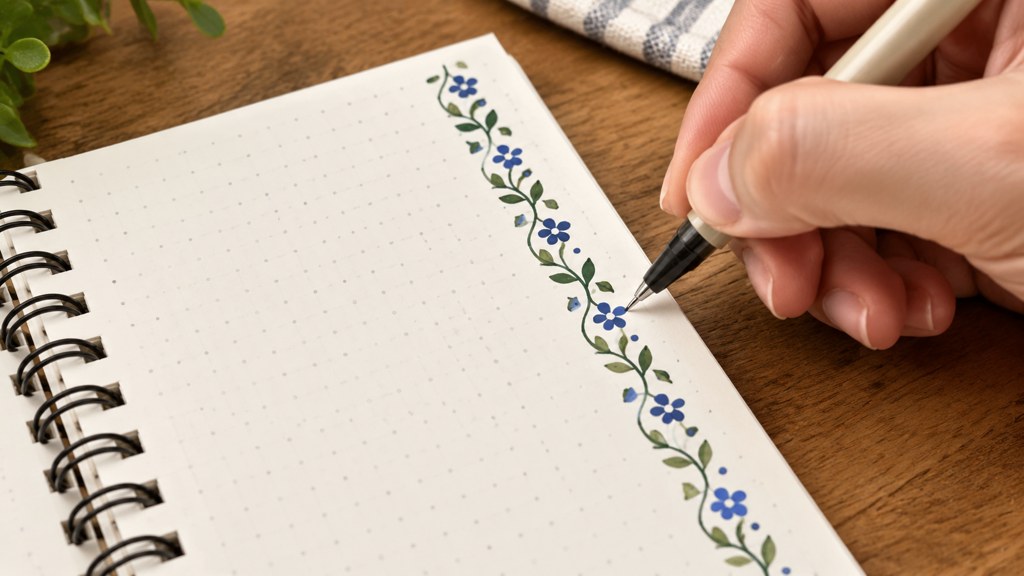
The density rule: keep the total ink under about a third of the area you are filling. Past that, a decorated page reads as a busy page, and the writing it was meant to frame disappears. When in doubt, draw half as many units at twice the spacing.
What doodle art ideas work for journals and planners?
The doodles people actually reuse are functional. They label something, divide something, or mark a state. Sixteen that earn their place:
- Weather set: sun, cloud, cloud with three rain lines, snowflake as a six-spoke asterisk.
- Mood set: five faces that differ only in the mouth line.
- Task states: empty box, box with a tick, box with a diagonal strike, box with an arrow for moved.
- Priority flag: a small triangle on a stick, filled or hollow.
- Divider: a long line with a small diamond at its centre.
- Divider: two parallel lines with a dot between them at the midpoint.
- Header banner: a rectangle with notched ends, wide enough for four words.
- Header ribbon: a rectangle with two folded tails behind it.
- Water tracker: eight small glasses in a row, filled as you go.
- Habit dot grid: a five by seven block of circles.
- Budget icon: a coin as a circle with a smaller circle inside.
- Travel icon: a suitcase as a rectangle with a handle arc.
- Deadline icon: a clock face with only the twelve and the hands.
- Note tag: a rectangle with one corner cut off and a hole punched.
- Bookmark: a rectangle with a V cut into the bottom edge.
- Arrow set: straight, curved, and a looping one for cross-references.
Keep one visual rule across the whole notebook: same pen width for icons, a heavier width for dividers only. Consistency is what makes a hand-drawn system look designed rather than decorated.
What should you doodle when you have no ideas?
Blank-page paralysis is a prompting problem, not a creativity problem. Five structures that always produce something, plus eight shapes they generate to get you started:
- 1
Object plus one changed property
Pick anything on your desk. Change one thing: make it soft, make it enormous, give it legs. A stapler with legs is a doodle; a stapler is a drawing exercise.
- 2
Same object, ten sizes
Draw one shape at ten scales down the page. The small ones force simplification, and the simplification is what you keep.
- 3
One shape, ten costumes
A circle wearing a hat, a scarf, glasses, a crown. The constraint is that the base shape never changes.
- 4
Two objects welded together
Cup plus cactus. Envelope plus bird. The join is the interesting part, and it takes no planning.
- 5
Fill a shape with pattern
Draw an outline of anything, then fill it with one of the border motifs above instead of detail. This works when you cannot face drawing a subject at all.
- A snail whose shell is a spiral of your own handwriting.
- A cloud raining triangles.
- A plant growing out of a coffee cup.
- A moon with a face, drawn with two dots and one curve.
- A stack of three books with one crooked spine.
- A cat drawn as one continuous line.
- A window with four panes and one plant on the sill.
- A pair of headphones drawn as an arc and two rectangles.
Queries like how to doodle ideas and what to doodle ideas are really asking for a generator rather than a list, which is what the five structures above are. Give one of them thirty seconds and you will have something on the page.
What pens and paper actually matter for doodling?
Honest answer: almost none of it matters, and two things do. Ink that does not bleed through, and paper that takes ink without feathering. Everything else is preference dressed up as requirement.
- Bleed-through is a paper problem more than a pen problem. Thin notebook stock will ghost whatever you use.
- Feathering shows up as fuzzy edges on a line that should be crisp. It gets worse as the pen slows down, so it is most visible on dots and short strokes.
- One pen width for a whole page looks more deliberate than three widths used at random.
- Pencil first is a habit worth dropping for doodles. The wobble in an inked line is the character.
Gesture practice helps more than equipment. Timed figure references, such as the free sessions at Line of Action, train the same reduction skill the section above described: look, find the shape, commit, move on. Thirty seconds a pose is enough.
If you want to see how far the reduction can go before a subject stops reading, spend twenty minutes in a modern drawing collection. The MoMA holdings are full of work that is three lines and unmistakable.
How do you turn a doodle into a finished illustration?
Most doodles die at the same step: the scan. A phone photo of a page, at an angle, in yellow light, produces grey mush that no amount of contrast will save. Shoot flat, in daylight, with the page filling the frame, or scan at 600 DPI if you have a scanner.
- 1
Clean
Raise the contrast until the paper goes white and the line goes black, with nothing in between. Grey is the enemy: it prints as mud and it will not colour cleanly.
- 2
Separate
Get the line art onto its own layer with a transparent background so colour can sit underneath it rather than on top.
- 3
Colour
Flat fills first, one colour per shape, no gradients. Doodles read as doodles because the colour is flat.
- 4
Repeat
Tile the finished element into a pattern. This is where a single motif becomes wrapping paper, a phone wallpaper or an endpaper.
The photo to sketch tool does the reverse trip, turning a photograph into line art, which is useful in the other direction: it gives you a clean reference to trace over when you want a doodle version of something real.
How do you generate doodle-style art with AI?
I ran two images through the doodle illustration template in the workbench to see what a generated sheet is actually good for. The composer has four controls that matter: the template chip, the Photo box, the ratio chips and the resolution chips. There is no style picker and no line-weight slider, so anything else you want has to go in the Prompt box.
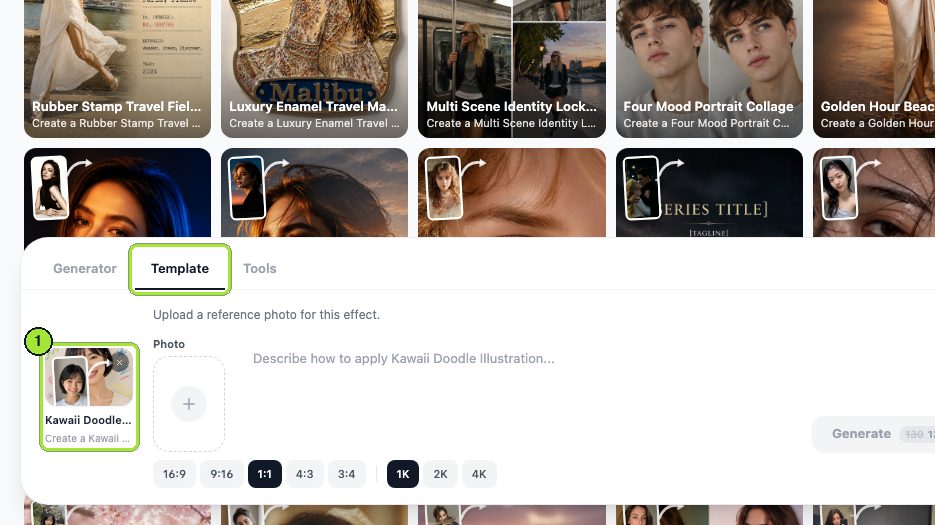
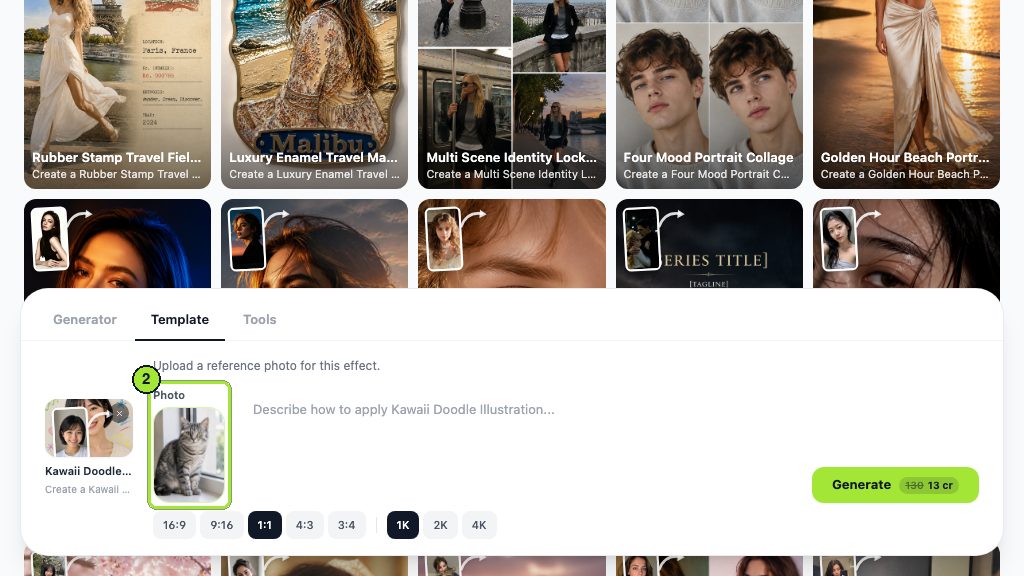
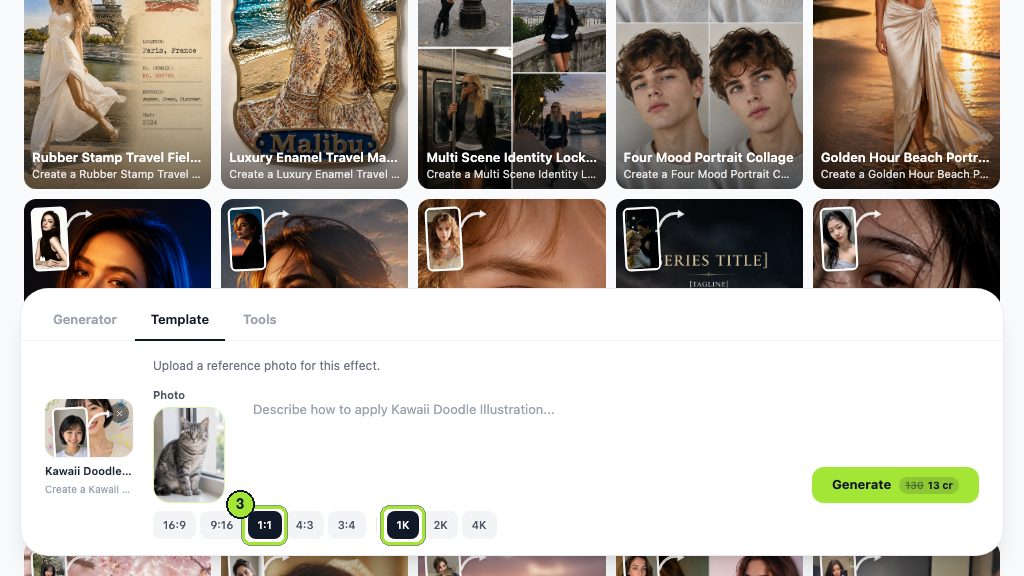
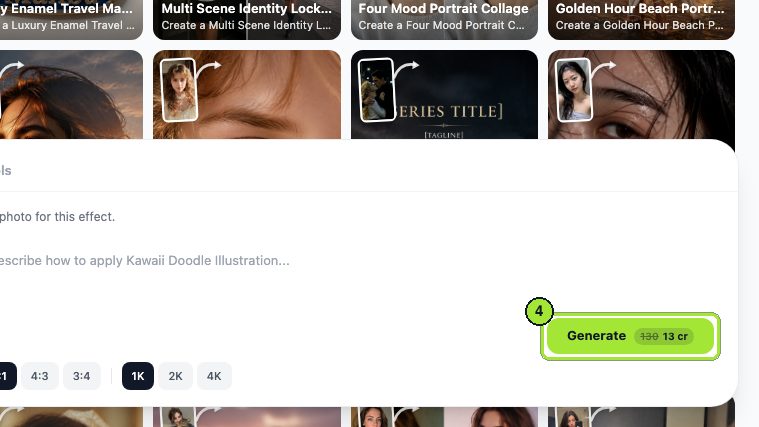
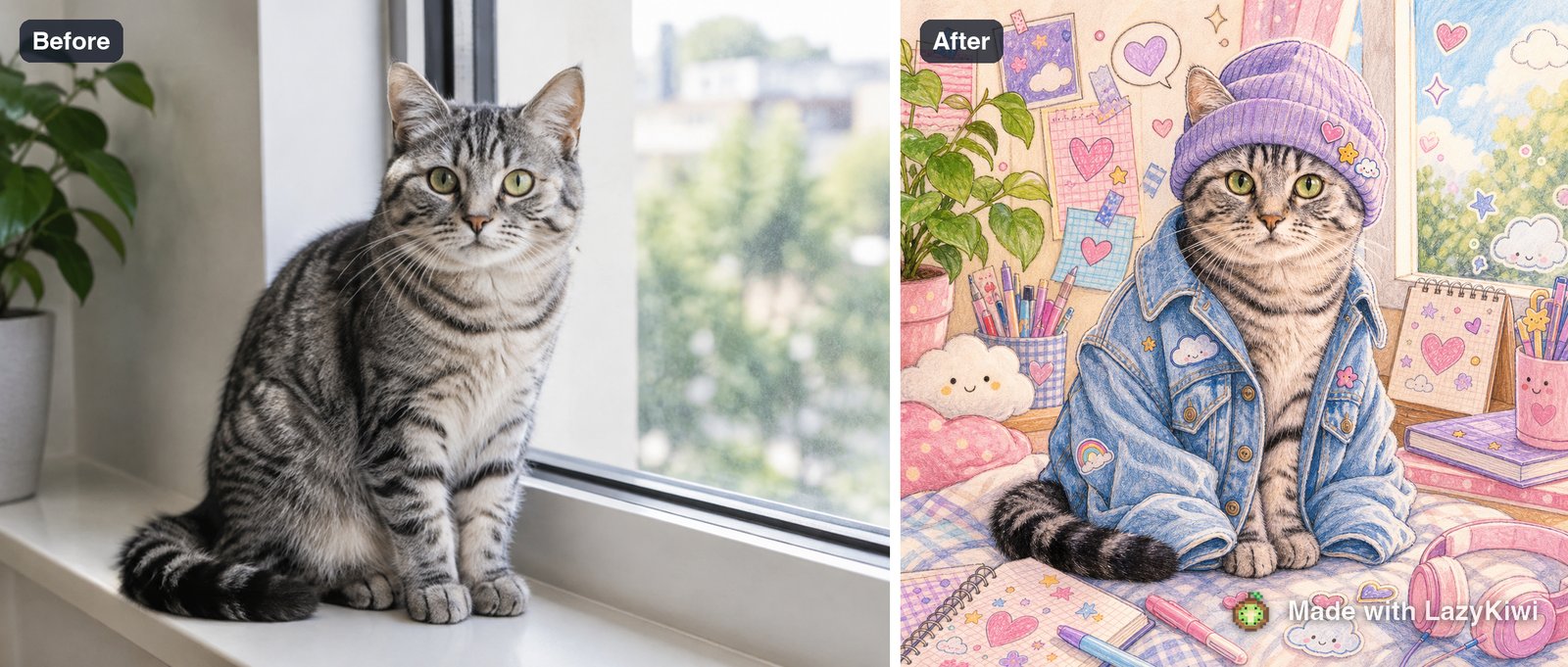
The second run is the honest one. Fed a photograph of a pasta bowl, the same template returned a kawaii character rather than a doodled plate of food. This template rebuilds its subject as a figure, so it is a portrait tool wearing a doodle costume. Useful to know before you plan a set of food icons around it.

single-weight black outline on white, no shading, no gradient, no colour fill, flat sticker style, closed shapes, thick uniform line, generous white space, centred single subject
The words doing the work are single-weight, closed and no shading. Left to itself a model will add soft shadow and a colour wash, which is exactly what stops a generated sheet from being usable as practice reference or as a colouring page. Both runs here went through GPT Image 2, which is the model behind 127 of 181 external generations in LazyKiwi's workbench data (August 2026).
Can you sell doodle art you made with AI?
The legal position is narrower than most listings assume. The US Copyright Office has published its report on copyright and artificial intelligence in parts: Part 1 on digital replicas on 31 July 2024, Part 2 on the copyrightability of generative outputs on 29 January 2025, and a pre-publication Part 3 on training on 9 May 2025. Its earlier registration guidance for works containing AI-generated material appeared at 88 Fed. Reg. 16,190 on 16 March 2023. All of that is on the Office's AI page, read on 7 September 2026.
The practical reading for a doodle sheet: material generated from a prompt alone is not protected by copyright, while your own selection, arrangement and hand-drawn additions can be. A page where you traced, redrew and arranged the motifs yourself is a different artefact from the raw output, and it is the one worth listing.
Before listing anywhere, read that platform's own seller policy on AI-assisted work, because they differ and they change. Portfolio sites are stricter about labelling than marketplaces are: DeviantArt and Behance both expect AI-involved work to be identified as such, and a listing that hides it is the kind that gets pulled. If you want printable pages for children rather than stock art, Crayola publishes free printables, which is a useful reality check on what that market already gives away.
One more reality check before you price anything: search Pinterest for the motif you were planning to sell and count how many free versions come back. The gap you are selling into is not shape production; it is taste, consistency and a set that holds together.
Key takeaways
- A repeatable doodle closes, takes three or four strokes and has no perspective. Test any shape against those three before you tile it.
- Border motifs live or die on spacing: keep ink under about a third of the area you are filling.
- Functional icons for task states, weather and dividers are the ones people actually reuse.
- Five prompt structures beat any list when the page is blank: change one property, ten sizes, ten costumes, weld two objects, fill a shape with pattern.
- Generated sheets are reference material, not the deliverable. The doodle template tested here rebuilds any subject as a character.
- Prompt-only output is not protected by copyright; your selection, arrangement and redrawing are.
Image & Design Editor
Maya Chen
Maya writes about image tools from the desk rather than the demo reel. She tests templates on ordinary photographs, keeps the runs that fail, and reports what the panel actually shows.
FAQ
Common questions
What are some doodle ideas for a bullet journal?
Functional ones: four task-state boxes, a five-face mood set, a weather set of sun, cloud, rain and snowflake, two divider styles and a notched header banner. Those five groups cover almost every page you will lay out, and they stay legible at margin size.
What is doodle art?
Doodle art is drawing made of simple repeatable marks, usually flat, closed and line-based rather than shaded. The defining trait is that it is built from units you can repeat without planning, which is why it fills borders, margins and whole pages so easily.
How do you draw doodle ideas you have only seen once?
Reduce before you draw. Recall the silhouette, decide the one internal line that identifies the object, and ignore everything else. Searches for how to draw doodle ideas mostly return copy-along videos; the reduction habit works on subjects nobody has filmed.
What are the easiest doodles to start with?
Cloud, star, mug, leaf and cactus. Each is three or four strokes, closes on itself and stays recognisable when the line wobbles. Draw each one twenty times before adding a sixth shape, because the repetition is what builds the muscle memory.
Can AI generate usable doodles?
It generates sheets you can trace and study, not finished sets. The template tested here returned a character when fed a photograph of a dish, so plan on human selection and redrawing between the output and anything you publish or sell.
Generate a sheet to draw from
Feed one photo to the doodle template, keep the shapes that read at margin size, and redraw the rest by hand.
Related reading
Paper Animation Tools: Free Options Compared
Tools that turn a photo or idea into a paper-craft animation, compared on style range, render length and what each free tier actually lets you export.
8 min read
Turn Photo Into Cartoon and Keep the Likeness
Cartoon conversion fails when it flattens the face. Which source photos convert well, which styles hold a likeness, and how to fix a result that misses.
8 min read
Turn Photo Into Coloring Page: Line Art Guide
Convert a photo to clean, printable line art: which photos work, the contrast settings that matter, and how to get lines a child can actually colour in.
8 min read
AI Coloring Page Generator: Printable Pages for Kids
Use an AI coloring page generator to make printable line art: prompts by age, photo-to-page conversion, 300 DPI export, free credits and Etsy or TPT rules.
8 min read