
Xianxia AI Filter: Become the Immortal of Your Chinese Zodiac
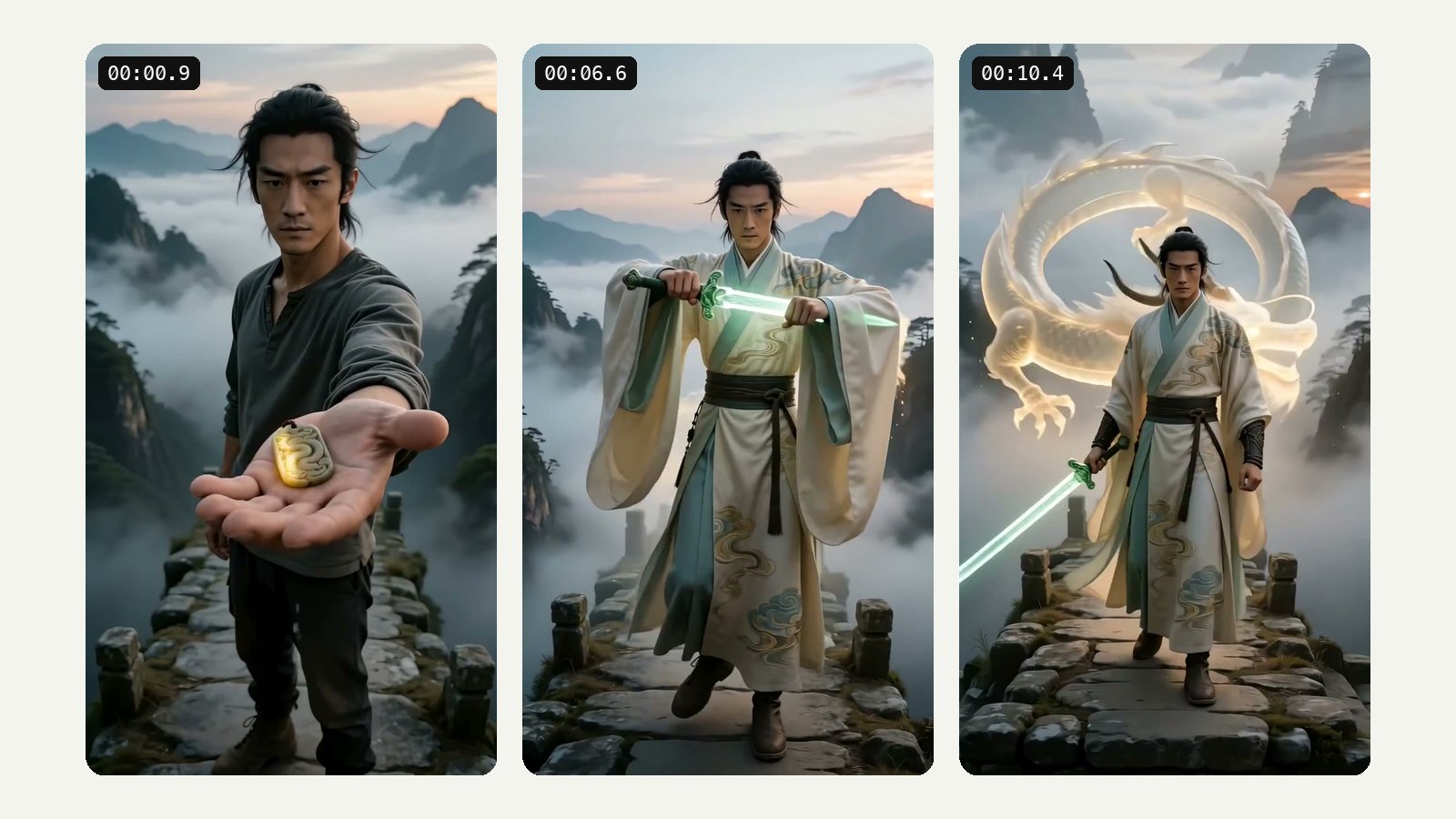
Upload one portrait and type one of the twelve Chinese zodiac animals into the prompt. The AI turns you into a xianxia immortal themed on that animal — flowing robes, drifting mist, a spirit beast at your shoulder — and animates it as a short vertical video. Your face stays the anchor; everything around it becomes cultivation-world fantasy.
What it is
What xianxia is, and what this filter does with it.
Xianxia (仙侠, xiānxiá) is Chinese fantasy about immortals and the people trying to become them. Its heroes are cultivators: they refine their qi, climb through realms of power, fly on swords between mountain sects and, if they survive long enough, ascend. The look is unmistakable — layered silk robes that never quite stop moving, hair pinned with jade, mist around mountain peaks, glowing talismans and spirit beasts. This filter puts you in that world. You upload a portrait, pick your Chinese zodiac animal, and the AI builds an immortal around you with that animal as the theme: a dragon cultivator with scales worked into the embroidery and a dragon coiling through the clouds behind, or a rabbit immortal in moon-white robes. The result is a short video, so the robes, the mist and the spirit beast move. It is a stylised fantasy look, not a historical costume, and the zodiac is a theme, not a fortune.
How it works
Your xianxia video in four steps
Upload a portrait
One person, face towards the camera, in soft even light. A head-and-shoulders selfie works best.
Name your zodiac animal
Type the animal into the prompt box — "Dragon", "Snake", "Tiger" — using the birth-year table below to find yours, or pick whichever animal you like the look of. The animal sets the colours, motifs and spirit beast.
Check the cost
The credit cost is shown before you generate — a 5-second clip currently costs several hundred credits.
Generate and download
Video takes minutes to render. Watch it through, check your face in motion, then download the 9:16 clip.
Xianxia vs wuxia
Two genres that get mixed up
Both are Chinese, both involve robes and swords, and English-speaking fans often use the words interchangeably. They are different. Wuxia (武侠, wǔxiá) is martial-heroes fiction: skilled but mortal fighters, rival schools, loyalty and revenge, set in a recognisably earthly world where the most supernatural thing is a very good lightness skill. Xianxia is the fantasy step beyond that: cultivation, immortality, flying swords, spirit beasts, heavens and demons. The easy rule is that wuxia is grounded and xianxia is ethereal. Visually, wuxia leans on dusty roads, bamboo forests and practical clothing; xianxia leans on floating palaces, glowing qi and robes made of light. This filter is squarely xianxia. A third word you will see is xuanhuan (玄幻, xuánhuàn), a looser fantasy label that mixes Chinese elements with invented worlds and systems; many web novels sit somewhere between xuanhuan and xianxia.
- Wuxia: mortal martial heroes, grounded world
- Xianxia: cultivators and immortals, supernatural world
- This filter: xianxia — mist, qi, spirit beasts, flowing robes
The 12 zodiac immortals
What each animal turns you into
Each of the twelve animals of the Chinese zodiac (生肖, shēngxiào) gives the character a different palette, motif and spirit companion. The list below is the brief the filter works from. Every render is generated fresh, so treat it as the direction the look takes rather than a fixed costume: two Dragon renders will share the scales and the storm clouds, not every fold of the robe.
- Rat — Shǔ (鼠): a quick, shadowy night cultivator in ink-black and silver, with a small spirit rat
- Ox — Niú (牛): a steady earth-realm guardian in bronze and deep brown, horned headpiece, heavy robes
- Tiger — Hǔ (虎): a white-and-gold war immortal with a white tiger spirit at their side
- Rabbit — Tù (兔): a moon-palace immortal in white and pale blue, jade ornaments, silver moonlight
- Dragon — Lóng (龙): a sword immortal in azure and gold, a dragon coiling through storm clouds
- Snake — Shé (蛇): a jade-green serpent cultivator, scaled embroidery, a quiet, dangerous calm
- Horse — Mǎ (马): a wind-riding wanderer in crimson and ochre, a spirit horse of cloud and fire
- Goat — Yáng (羊): a gentle mountain hermit in cream and soft green, curled horn hairpins, mist
- Monkey — Hóu (猴): a mischievous cloud-walking immortal in gold and red, staff in hand
- Rooster — Jī (鸡): a phoenix-bright cultivator in scarlet and gold, feathered sleeves, morning light
- Dog — Gǒu (狗): a loyal sect guardian in earth tones and steel, a spirit hound at their heel
- Pig — Zhū (猪): a serene, prosperous immortal in rose and gold, lotus and peach-blossom motifs
Find your animal
Birth year to Chinese zodiac animal
Your animal comes from your birth year in the lunar calendar, and the animals repeat every twelve years. The one catch is the start of the year: the Chinese zodiac year begins at Lunar New Year, which falls somewhere between late January and mid-February, not on January 1. If you were born in January or early February, check the Lunar New Year date for your birth year — you may belong to the previous year's animal. For example, someone born on 1 February 1996 is a Pig, not a Rat, because Lunar New Year that year fell on 19 February. (Some traditions use the solar term Lìchūn, around 4 February, as the cutoff instead; for this filter, it only matters which look you want.)
- Rat: 1960, 1972, 1984, 1996, 2008, 2020
- Ox: 1961, 1973, 1985, 1997, 2009, 2021
- Tiger: 1962, 1974, 1986, 1998, 2010, 2022
- Rabbit: 1963, 1975, 1987, 1999, 2011, 2023
- Dragon: 1964, 1976, 1988, 2000, 2012, 2024
- Snake: 1965, 1977, 1989, 2001, 2013, 2025
- Horse: 1966, 1978, 1990, 2002, 2014, 2026
- Goat: 1967, 1979, 1991, 2003, 2015, 2027
- Monkey: 1968, 1980, 1992, 2004, 2016, 2028
- Rooster: 1969, 1981, 1993, 2005, 2017, 2029
- Dog: 1970, 1982, 1994, 2006, 2018, 2030
- Pig: 1971, 1983, 1995, 2007, 2019, 2031
Photo tips
Give the filter a clean look at your face
Almost everything in the frame changes — clothes, hair styling, background, light — so your face is what carries the likeness. The best photos are simple: one person, looking roughly at the camera, in soft even light, with the eyes and jawline visible. Heavy beauty filters, sunglasses, a hand in front of the face and strong side shadows all force the model to guess. Group photos are the most common failure, because the model has to choose one face and may blend features from several.
- Do: one person, face forward, soft light
- Do: eyes, brows and jawline clearly visible
- Avoid: sunglasses, masks, heavy beauty filters
- Avoid: group shots — crop to one face first
Ideas
What to make with your immortal self
The simplest use is the one people search for on TikTok: a xianxia filter clip of yourself, posted with a dramatic guzheng track. But the zodiac animal gives you more to work with. Around Lunar New Year, a clip of you as the immortal of the new year's animal makes a better greeting than a stock red-envelope graphic. A family or friend group can each render their own animal and cut the twelve together. And if you write, roleplay or play cultivation games, a moving reference of your own face as a cultivator is useful for a character profile or avatar. Cosplayers can use a render to test a colour scheme and silhouette before sewing anything. And if you are simply curious which animal suits you best, render your own first, then the Dragon and the Tiger — the three side by side usually settle the question.
- A Lunar New Year greeting in the year's animal
- A twelve-animal set with family or friends
- A character reference for writing, roleplay or games
Cost and time
What one clip costs, before you generate
A 5-second clip currently costs several hundred credits, and longer clips cost more; the workbench shows the exact number before you confirm. A small welcome balance will not cover a full clip, so it is worth checking before you plan a family set of twelve. Rendering takes minutes, not seconds. For your own xianxia scene rather than this fixed effect — a sword duel, a realm breakthrough, a flight between sect peaks — use the AI video generator for custom xianxia scenes.
- Several hundred credits for a 5-second clip
- Exact cost shown before generating
- Minutes to render
Why LazyKiwi
Why make it here
A video, not a still
Most xianxia AI art tools stop at an image. Here the robes, mist and spirit beast move.
Your photo, not a prompt
Text-to-video xianxia tools invent a character. This one starts from your face.
Twelve animals, one upload
Change the animal and render again to see yourself across the whole zodiac.
Written with care
Terms are given in English, pinyin and Chinese characters, and wuxia and xianxia are not blurred together.
Vertical by default
9:16 at 720p, ready for TikTok, Reels and Shorts without cropping.
Cost up front
Every clip shows its credit price before it is generated.
FAQ
The xianxia AI filter, answered
What is a xianxia AI filter?+
It is an AI effect that turns a photo of you into a character from xianxia, the Chinese fantasy genre of cultivators and immortals. On this page you also choose one of the twelve Chinese zodiac animals, which themes the character's colours, motifs and spirit beast, and the result is a short vertical video rather than a still.
What does xianxia mean, and how is it different from wuxia?+
Xianxia (仙侠) roughly means "immortal heroes": fantasy about people who cultivate qi to gain supernatural power and, eventually, immortality. Wuxia (武侠) means "martial heroes": stories about highly skilled but mortal fighters in a mostly realistic world. Wuxia is grounded; xianxia is ethereal, with flying swords, spirit beasts and heavenly realms.
Is the result a photo or a video?+
A video: a short 9:16 clip at 720p. Robes, hair, mist and the spirit beast move while your face stays recognisable. You can pause and screenshot a frame if you want a still as well.
How do I find my Chinese zodiac animal?+
Find your birth year in the table on this page. The animals repeat every twelve years in a fixed order: Rat, Ox, Tiger, Rabbit, Dragon, Snake, Horse, Goat, Monkey, Rooster, Dog, Pig. If you were born in January or February, read the next question first.
I was born in January or February — which animal am I?+
It depends on the Lunar New Year date in your birth year. The zodiac year starts at Lunar New Year, which lands between late January and mid-February, so a January or early-February birthday often belongs to the previous year's animal. Look up the Lunar New Year date for your birth year: if you were born before it, use the previous year's animal.
Can I pick a zodiac animal that isn't mine?+
Yes. The animal is a visual theme, so choose whichever you like. Plenty of people pick the Dragon or the Tiger because the look is more dramatic, or try all twelve to see which suits them.
What photo works best?+
One person, facing the camera, in soft even light, with the eyes and jawline visible. A head-and-shoulders selfie near a window is ideal. Avoid sunglasses, heavy beauty filters, strong shadows and group photos.
Will the character still look like me?+
Usually, recognisably. Your face shape and features are kept as the anchor while the costume, hair and scene change completely. It is not a guaranteed match: the character is re-drawn in a stylised fantasy look and in motion, so expect "clearly you as an immortal" rather than an exact copy.
How long is the video and what format is it?+
It is a short vertical clip in 9:16 at 720p. The output settings and the price are shown in the workbench before you generate.
How many credits does one xianxia video cost?+
A 5-second clip currently costs several hundred credits, and longer clips cost more. The exact cost appears in the workbench before you press generate. Video costs far more than an image because every frame is generated.
Use cases
Who uses the xianxia filter
Xianxia and C-drama fans
See yourself in the genre you watch and read, without a costume, a studio or a makeup artist.
Lunar New Year posts
Send family and friends a clip of yourself as the immortal of the year's animal instead of a generic greeting card.
Writers and roleplayers
A moving portrait of your own face as a cultivator makes a good character reference or profile image.
Friend and family sets
Everyone renders their own animal; you cut the twelve together and post the whole zodiac.
Cosplayers
Test a palette, robe silhouette and hair styling on your own face before you commit to fabric, wigs or props.
More answers
More about xianxia and the Chinese zodiac
Is this based on real Chinese astrology?+
No. The zodiac animal is used only as a visual theme. The filter does not read your fortune, compatibility, BaZi or anything else about your life, and which animal you choose changes nothing except how the character looks.
Are the costumes historically accurate?+
No, and they are not meant to be. Xianxia is fantasy, and so is this look: it borrows from hanfu silhouettes, jade ornaments and classical Chinese painting, but it is not tied to any dynasty or real costume history. Think of it as the genre's visual language rather than a museum reference.
Can I use it for a Lunar New Year greeting?+
Yes, it is one of the best uses. Render yourself as the immortal of the new year's animal — 2026 is the Year of the Horse — add a greeting as text in your editor and send it or post it in the days before the holiday. Check the render cost first if you plan to make one for every family member.
Can I post it on TikTok, Reels and Shorts?+
Yes, the 9:16 format fits all three. Add a caption and sound in the app or an editor. Several platforms ask you to label AI-generated content with their built-in label, so check their rules when you post.
Does the video have sound?+
Plan to add your own. Guzheng, dizi or erhu tracks are the classic choice for xianxia clips, and most people add one in their editor or pick a sound when they post.
Can I use someone else's photo?+
Only with their permission. Use your own photo, or photos of friends and family who have agreed. Do not upload strangers, public figures or anyone who has not said yes.
Why did my result look less like me than I hoped?+
Usually the photo. A tilted head, shadows across half the face, glasses or a small face in a wide shot make the model guess. Retake the photo straight on in soft light. Each render is new, so a second try can also come out better on its own; check the cost before re-running.
Is there a softer, less fantasy transformation?+
If you want a lighter, cartoon-style change instead of full xianxia, try the anime AI video transformation. For a fully custom shot from your photo, the Seedance 2 image-to-video model page explains how to prompt one yourself.
Meet the immortal of your zodiac.
Upload one clear portrait, choose your animal and check the cost before you generate. Your short vertical xianxia clip is ready in minutes.
No credit card · Free to try · Results in seconds