
Oval Face Shape: How to Tell and What Suits It
The measurable definition of an oval face shape, how to separate it from round and oblong, and the frames, cuts and camera angles that keep it.
 Maya Chen 9 min read
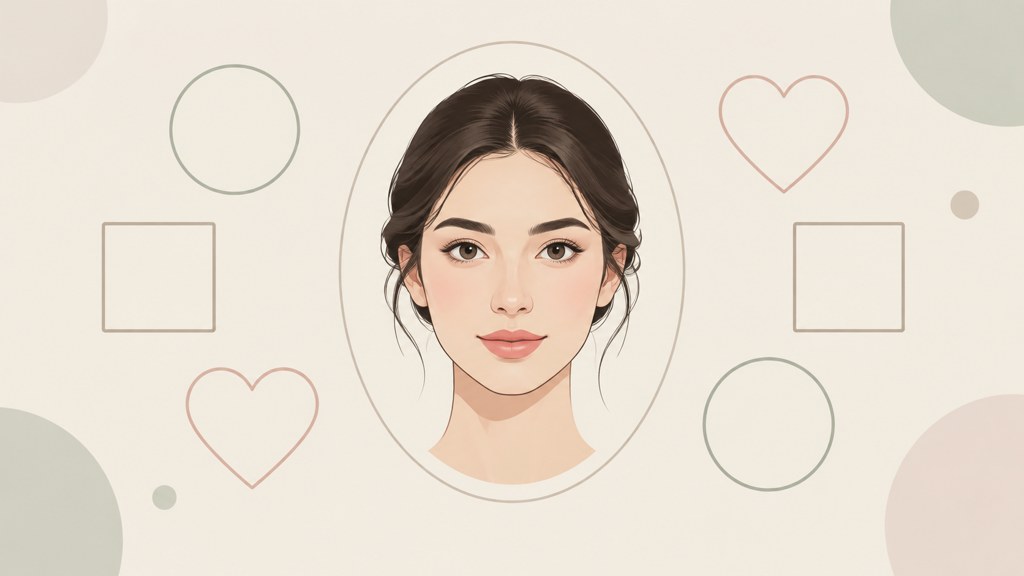
An oval face shape has a definition you can hold a tape against: the face is roughly one and a half times as long as the cheekbones are wide, the forehead is slightly wider than the jaw, and the jawline curves rather than corners. Three measurable statements, no adjectives. Get any one of them wrong and you are looking at a round face or an oblong one, which take opposite advice. This piece gives the numbers, the two shapes it is most often confused with, the frames and cuts that follow from the geometry, and an honest look at why so many tools call almost everyone oval.
What is an oval face shape?
Three conditions have to hold at once. Miss one and the label is wrong, which is why so many people carry an answer that does not fit them.
- 1
Length is about one and a half times cheekbone width
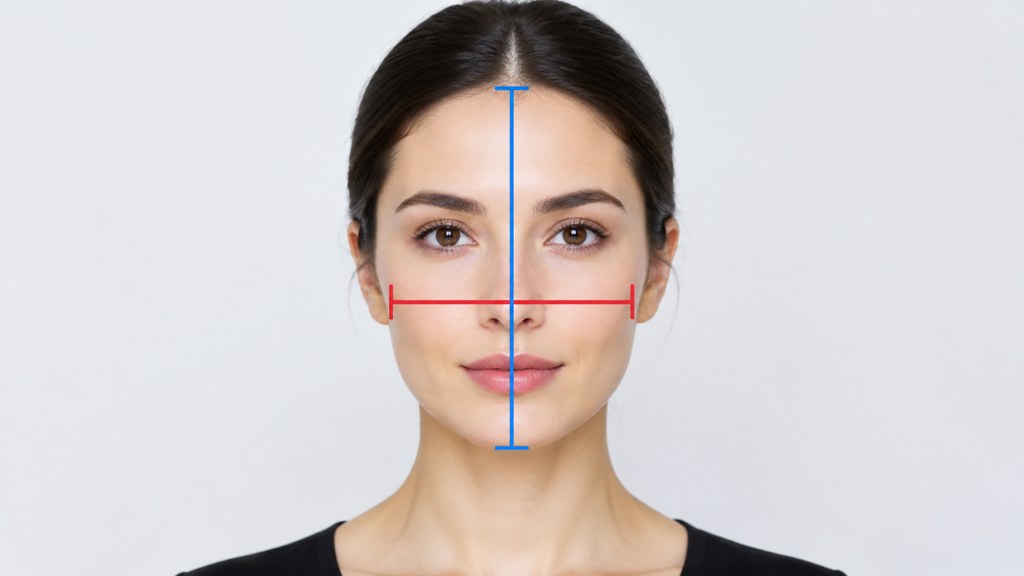
Take a vertical from mid-hairline down to where the chin ends, then a horizontal at cheekbone height, corner of one eye to corner of the other. Vertical divided by horizontal, and anything near 1.5 sits in oval territory.
- 2
The forehead is slightly wider than the jaw
Slightly. A forehead that is obviously the widest point makes it a heart shape; a jaw matching the forehead in width makes it square or oblong.
- 3
The jawline curves
Run a finger from below the ear to the chin. A continuous curve is oval. A point where the direction changes sharply is a corner, and corners mean square.
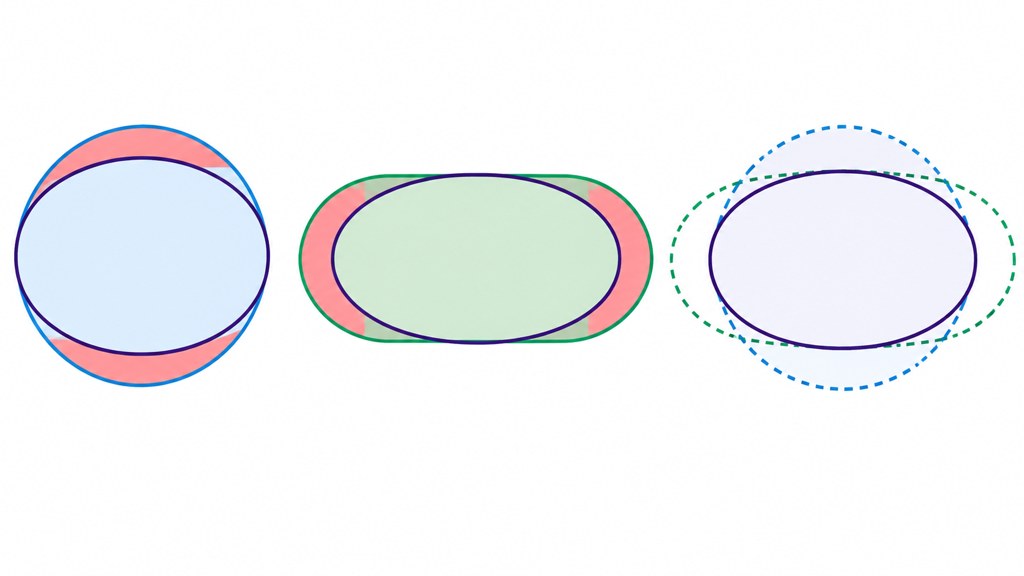
Two extra notes. Oval face shape male and female proportions are measured identically; the difference in how they read comes from brow weight and jaw softness, not from the ratios. A hairline that has moved back also stretches whatever you measure top to bottom, which shunts genuinely oval faces into the oblong column on paper.
How do you know if you have an oval face?
Three checks in about two minutes, done in this order because each one rules out a different neighbour.
- Check the ratio first. Length over cheekbone width close to 1.0 means you are round or square, not oval, and no amount of jaw curve changes that.
- Check the widest point second. Cheekbones should win, narrowly. If the forehead is clearly the widest, look at heart instead.
- Check the jaw corner last. Curve keeps you in oval; a defined corner at the same ratios moves you to a long square, which takes different advice at the perimeter.
The two shapes it gets confused with are round, where the ratio is closer to 1.0, and oblong, where the ratio runs well past 1.5 and the widths stay level all the way down. Borderline readings are normal and useful: if you sit between oval and oblong, take the oblong advice, because the failure mode there is worse.
Measure with the hair off your face
Hair over the temples narrows the apparent cheekbone width and a fringe removes the forehead measurement entirely. Pin everything back before you take a tape or a photograph. This one habit fixes more wrong answers than any tool does.
Oval vs round vs oblong: what is the difference?
Same four measurements, three different readings. Place a borderline face by looking down the columns rather than at the labels.
| Measurement | Oval | Round | Oblong |
|---|---|---|---|
| Length over cheekbone width | About 1.5 | Close to 1.0 | Well above 1.5 |
| Widest point | Cheekbones, narrowly | Cheekbones, clearly | No clear winner, widths stay level |
| Forehead against jaw | Forehead slightly wider | About equal, both soft | About equal, often with a longer chin |
| Jawline | Continuous curve | Soft with no corner | Straight, sometimes with a corner |
| What styling should do | Preserve the proportions | Add height, reduce width | Add width, never height |
The bottom row is the reason this matters. Round and oblong want opposite things, and oval wants neither, so a misidentified oval face ends up being styled against itself. That is the practical cost of getting the label wrong.
What hairstyles suit an oval face shape?
Almost everything, and that answer is less useful than it sounds. What it really means is that the geometric constraint has been removed, so the decision moves entirely to texture, density and upkeep.
- Blunt or layered, short or long, all work at the level of shape. Pick on how your hair behaves when it dries rather than on the outline.
- Middle partings and side partings both sit comfortably, which is not true for round or oblong faces.
- A fringe is optional rather than corrective. On an oval face it is a style decision with an upkeep cost, nothing more.
Two cuts still fight an oval face. Anything that adds significant height on top pushes the ratio past 1.5 and starts reading oblong. And a very long, very flat, centre-parted length drags the same way, especially on a face already at the upper end of the range. If you want to test either before committing, the hairstyle changer renders one cut per prompt at 13 credits.
What glasses shape works for an oval face?
Searches for glasses for oval face, what shape glasses for oval face, what shape glasses for an oval face and what shape of eyeglasses for oval face all want one three-part answer, and only one part of it is about shape.
| Decision | The rule | Why |
|---|---|---|
| Width | Keep the frame inside your cheekbone line | Frames that overshoot the cheekbones square off an oval outline |
| Depth | Moderate lens depth, roughly a third of face length | Very shallow frames cut the face into thirds and lengthen it |
| Bridge | Sitting level with or just below the pupils | A high bridge shortens the visible face and undoes the ratio |
| Geometry | Almost any, from round to rectangular | The proportions are already balanced, so nothing needs correcting |
| What to avoid | Oversized frames that extend past the cheekbone line | This is the one geometry that reliably fights an oval face |
So the honest answer to what glasses shape for oval face is that shape is the least important variable and width is the most. Try the frame you like at two widths before you try two shapes. Seasonal frame coverage from Allure, GQ and Good Housekeeping will tell you what is in the shops; the cheekbone rule tells you which of those will fit.
What beard shape suits an oval face?
The same principle from the other direction. A beard adds apparent length at the chin, so an oval face has less room to spend than a round one does.
- Short and moderate shapes preserve the ratio: stubble, a short boxed beard, a circle beard kept tight.
- Anything that extends below the chin, a ducktail or a long full beard, moves the ratio toward oblong and takes the balance away.
- Width at the cheek is the safer direction if you want a bigger beard, because an oval face has more tolerance for width than for length.
Skin care sits underneath all of it. The American Academy of Dermatology's hair and scalp guidance applies to beard hair too, and consumer health libraries such as Healthline cover the shaving-irritation side that no styling table addresses.
Grooming desks including Esquire and Self publish the seasonal version of these shapes. Our beard styles post has the full pairing table and the four functional groups. The short version for an oval face: keep it short, keep it wide rather than long, and check the result against the same 1.5 ratio you started with.
Is an oval face shape rare?
We could not find a prevalence figure worth quoting. Numbers get quoted around this question with no source attached to any of them, and we decline to add one more. What we can report is first hand and points the other way.
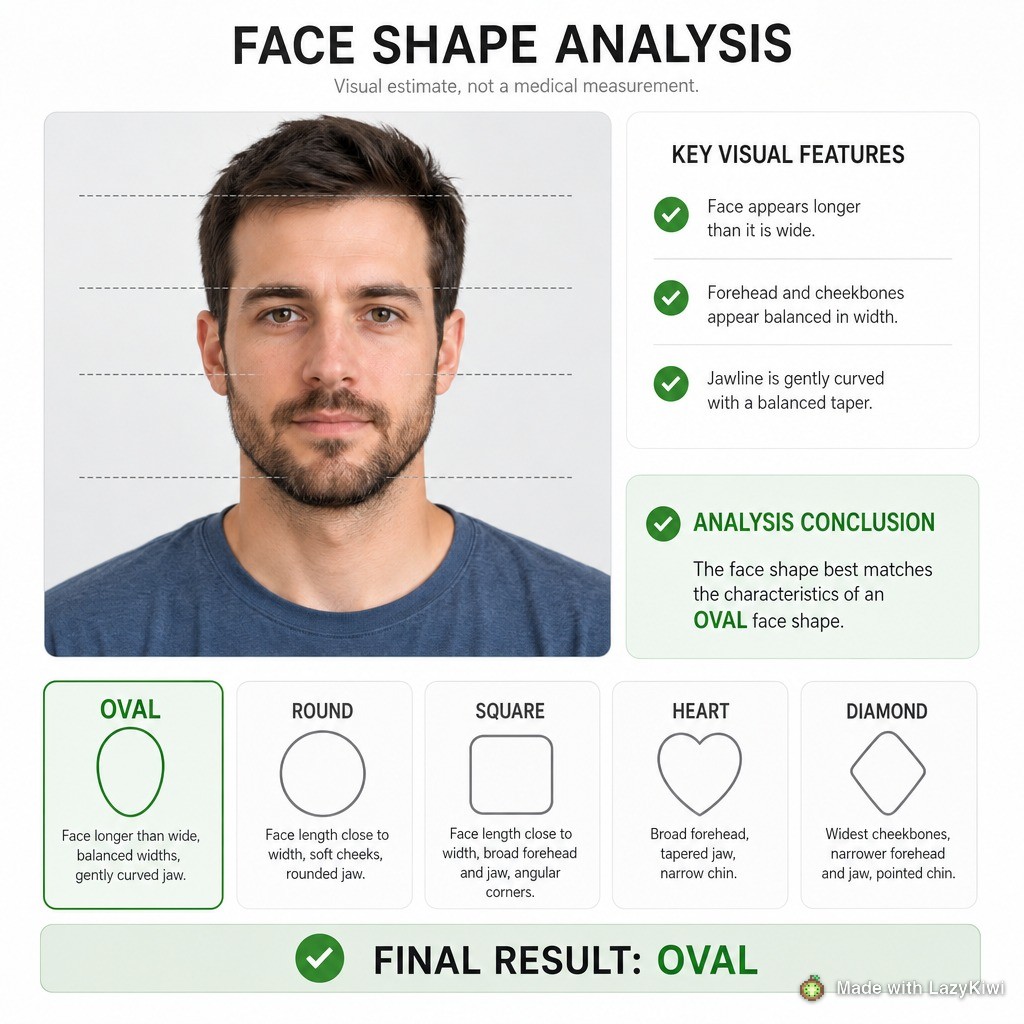
Across two separate demo sessions we ran four different faces through our own face shape detector on 7 September 2026: a man's studio headshot, a woman's studio headshot, a second man's headshot and a casual indoor selfie taken at an angle. All four came back oval.

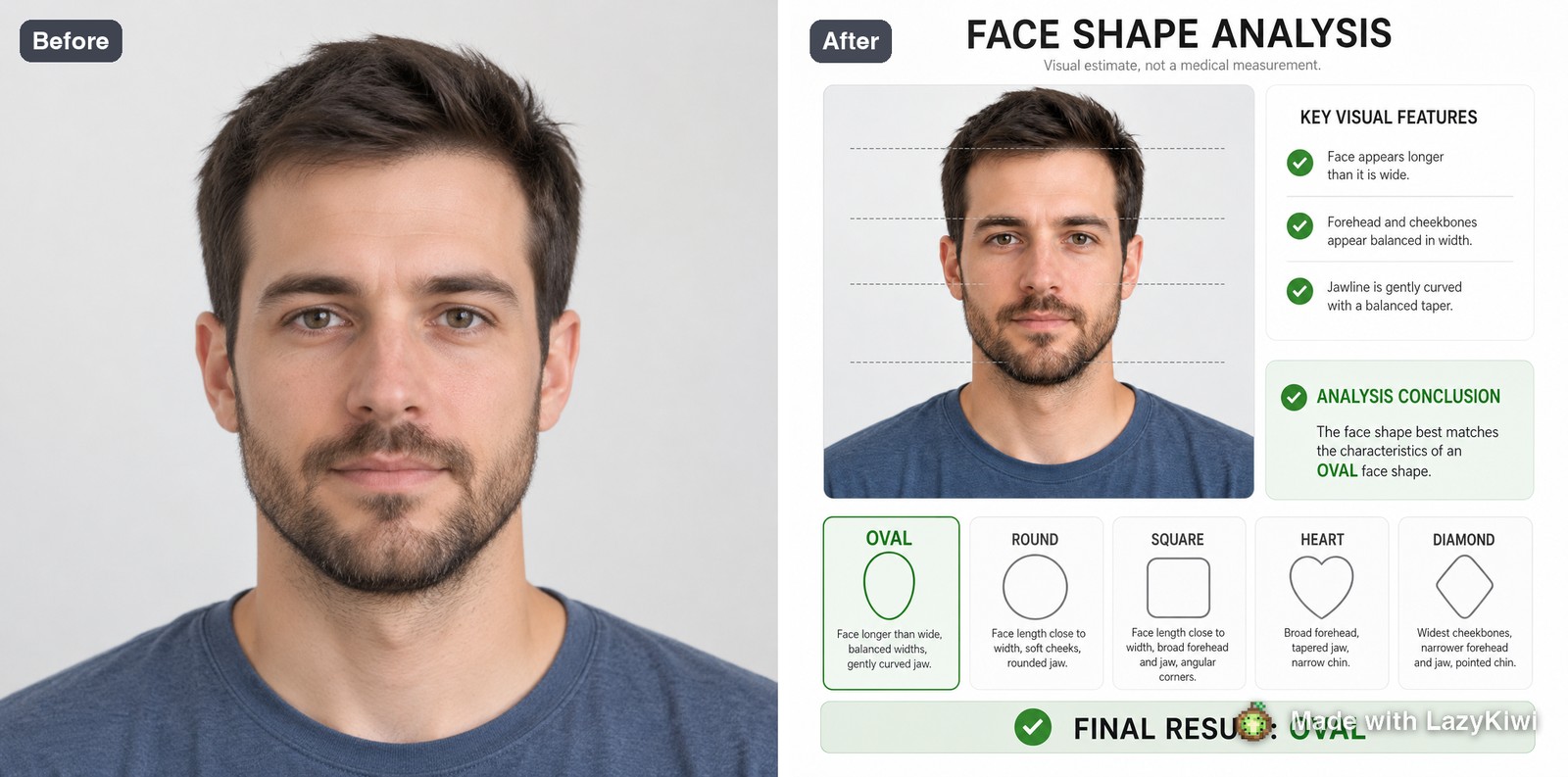
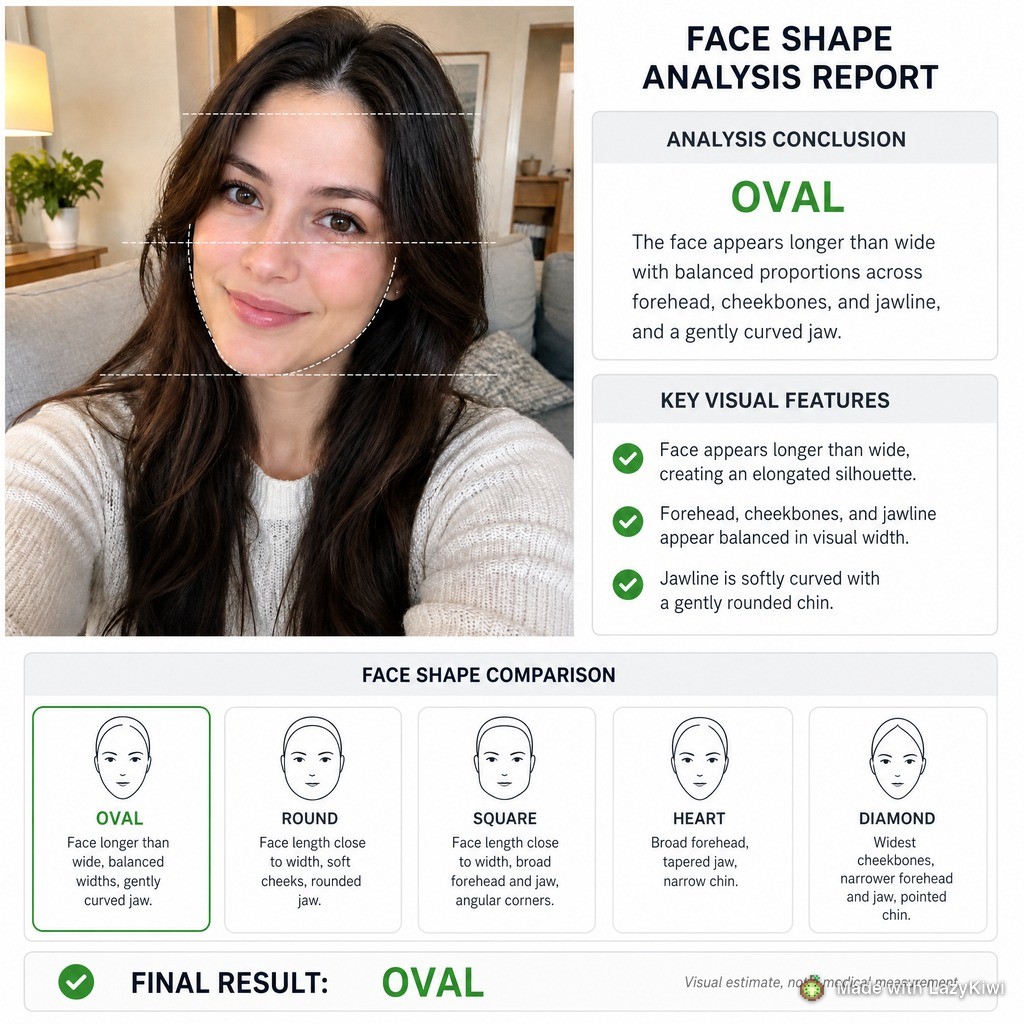
Two things follow. First, a classifier that answers oval for four out of four faces is telling you about its own defaults rather than about the population. Second, count the silhouettes on the card. There are five, and oblong is not among them, which leaves a genuinely long face without a category to be sorted into. Every one of these tools, including ours, runs on GPT Image 2, which draws a report rather than measuring one.
A tool that answers oval four times out of four is describing its own defaults, not your face.
— Maya Chen
So use the card for what it draws well, which is the geometry overlaid on your own photograph, and get the ratio itself off a tape. And whatever the answer, we are not ranking face shapes here. There is no published, attributable basis for doing so, and the geometry is only useful as a styling input.
How do you photograph an oval face well?
Three settings, and the aim is preservation rather than correction. An oval face is already balanced, so the job is to avoid distorting it.
- 1
Camera at eye level or a fraction above
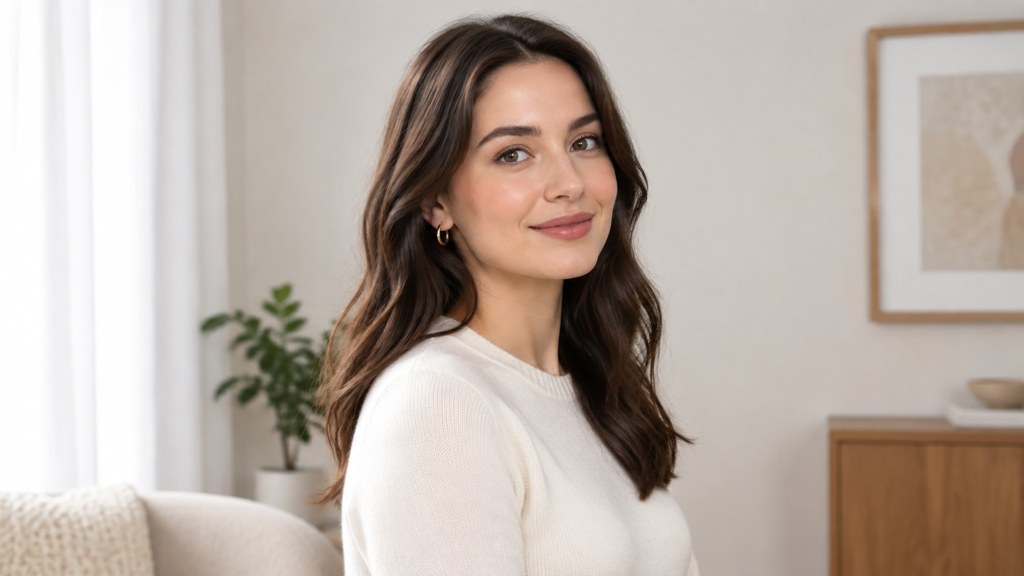
Lower than eye level widens the jaw and shortens the forehead, which turns an oval reading into a square one. Higher than about fifteen degrees does the reverse and stretches it toward oblong.
- 2
A slight three-quarter turn
Around fifteen to thirty degrees off centre keeps the jaw curve visible as a curve. Dead-on flattens it into an outline; a full profile removes it from the frame.
- 3
One soft source at about forty-five degrees
Side light at that angle models the cheekbone without carving a shadow under it. Hard overhead light narrows the jaw and pushes the reading toward heart.
Our photogenic hub covers the rest of the variables in order. If you want to test angles rather than guess at them, take three frames at three lens heights and compare them side by side from the image generator page, where the runs queue together and land in My Image. Our own users overwhelmingly pick square: it took 124 of the 143 external image jobs logged in August 2026 (LazyKiwi workbench data), and it is the right instinct for a head-and-shoulders comparison set.
Key takeaways
- Three conditions define it: length about 1.5 times cheekbone width, forehead slightly wider than jaw, and a curved jawline.
- Round sits near a 1.0 ratio and oblong runs well past 1.5. They take opposite advice, which is why the label matters.
- For glasses, width beats shape. Never wider than your cheekbones is the rule that does the work.
- Keep a beard short and wide rather than long, because length at the chin moves the ratio toward oblong.
- Four faces, four oval verdicts from our own detector, and no oblong option on its reference strip. Use the card as a diagram, not as evidence.
- Photograph at eye level with a slight turn and one soft source at forty-five degrees to preserve the proportions.
Image & Design Editor
Maya Chen
Maya Chen writes the image side of the LazyKiwi blog. She tests every tool in the workbench on real photographs before she describes it, and prefers a measurement to an adjective.
FAQ
Common questions
What is the difference between an oval face and a long face?
The ratio. An oval face measures about one and a half times as long as the cheekbones are wide; an oblong or long face runs well past that, with the forehead, cheek and jaw widths staying level all the way down. Oblong faces should avoid height on top, oval faces need not.
Do oval face shape male and female proportions differ?
The measurements are identical, and so are the three conditions. What differs is how the same ratios read, because brow weight and jaw softness change the impression without changing the numbers. Measure first, then adjust for how strongly your brow and jaw are defined.
What glasses should I avoid with an oval face?
Oversized frames that extend past your cheekbone line, and very shallow frames that cut the face into thirds. Both work against balanced proportions. Frame geometry is largely free, so choose the width first and pick round, square or rectangular afterwards.
Why do face shape tools always say oval?
Partly defaults, partly a missing category. Our own detector returned oval for four different faces in a row, and its reference card carries five silhouettes only. Oblong is absent from that strip, so a long face has nowhere to land and receives the nearest available answer instead.
Is an oval face shape the best one to have?
There is no published, attributable basis for ranking face shapes, and we are not going to invent one. The label reads like a default mainly because so much of the styling canon exists to nudge other proportions in its direction, which says more about the canon than about anyone's face.
Check the ratio against your own photo
Spend 13 credits on a single frontal photo and the detector hands back a card with four reference lines drawn across it, ready to argue with your tape measure.
Related reading
What Is My Face Shape? A Measured Self-Test
Measure four numbers, get one answer. The tape-measure method, the six shapes, and what each one changes about hair, glasses and camera angle.
9 min read
What Hair Color Suits Me? Undertone First
Skin undertone, eye colour and natural depth decide which shades work. Find your undertone in two minutes, then preview the shade on your own photo.
9 min read
Bald Filter: See What You'd Look Like Bald
Where the bald filter lives on each app, which ones produce a believable scalp, and how to read the preview before you take clippers to your head.
9 min read
How to Look Better in Photos: 5 Things That Work
Angle, posture, light, wardrobe and edit — in that order. The five variables that actually change how a photo of you reads, and how to test each one.
9 min read