
How to Determine Your Face Shape: 5 Steps, 7 Shapes
How to determine your face shape: run one photo through a detector or take five tape measurements, then match the numbers to seven shapes, men included.
 Maya Chen 11 min read
Here is how to determine your face shape in the time it takes to find a tape measure: upload one straight-on photo to a face shape detector for a fast first reading, then confirm it with five measurements and two ratios. The photo gives you a picture with reference lines; the tape gives you numbers you can trust next year. This guide covers both, lists all seven shapes with the test that separates each pair, and answers the questions most guides skip: what to do when you sit between two shapes, how the method changes for men with beards or a receding hairline, and whether your face shape can change.
What is the quickest way to find your face shape?
Start with a photo, because it takes a minute and shows you the outline you are about to measure. The photo only works if it is honest: face the camera square on, pull every strand of hair back off the forehead and behind the ears, keep the jaw relaxed, and hold the lens at eye level. A phone held low and close widens the jaw and shortens the forehead, which is the single most common reason people get the wrong answer to what is my face shape.
With that photo, open our face shape detector. It sits under the Tools tab of the image workbench and takes one upload. This is the run we recorded on 7 September 2026; the panel layout may have moved since, so the screenshots are dated.
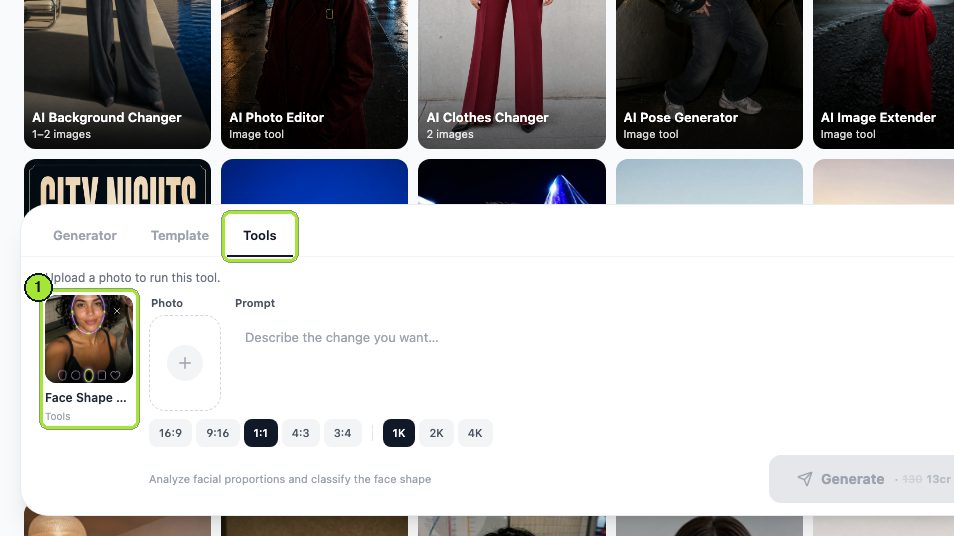
- 1
Open the tool
Use the Detect my face shape button at the end of this page, or choose Face Shape Detector under Tools. The helper line says what it does: analyse facial proportions and classify the face shape.
- 2
Load one photo
Drop the straight-on shot into the Photo box. The Prompt box stays empty for this tool.
- 3
Leave 1:1 and 1K
The result is a report card, so a square canvas at the smallest size is enough.
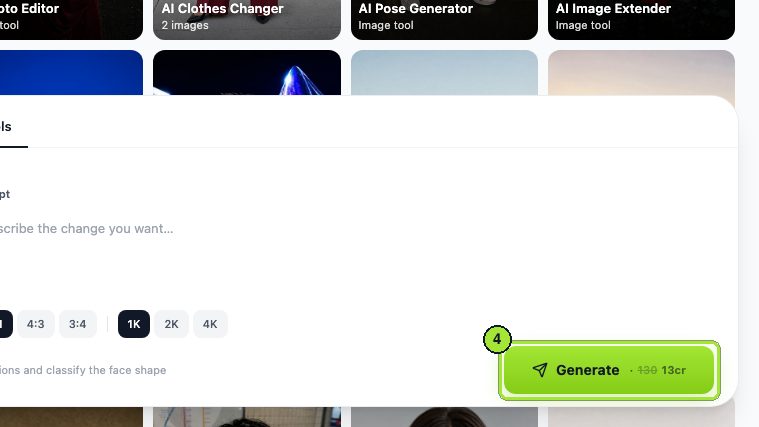
- 4
Read the price, then generate
On our run the button showed 130 credits struck through and 13 credits charged before anything started.
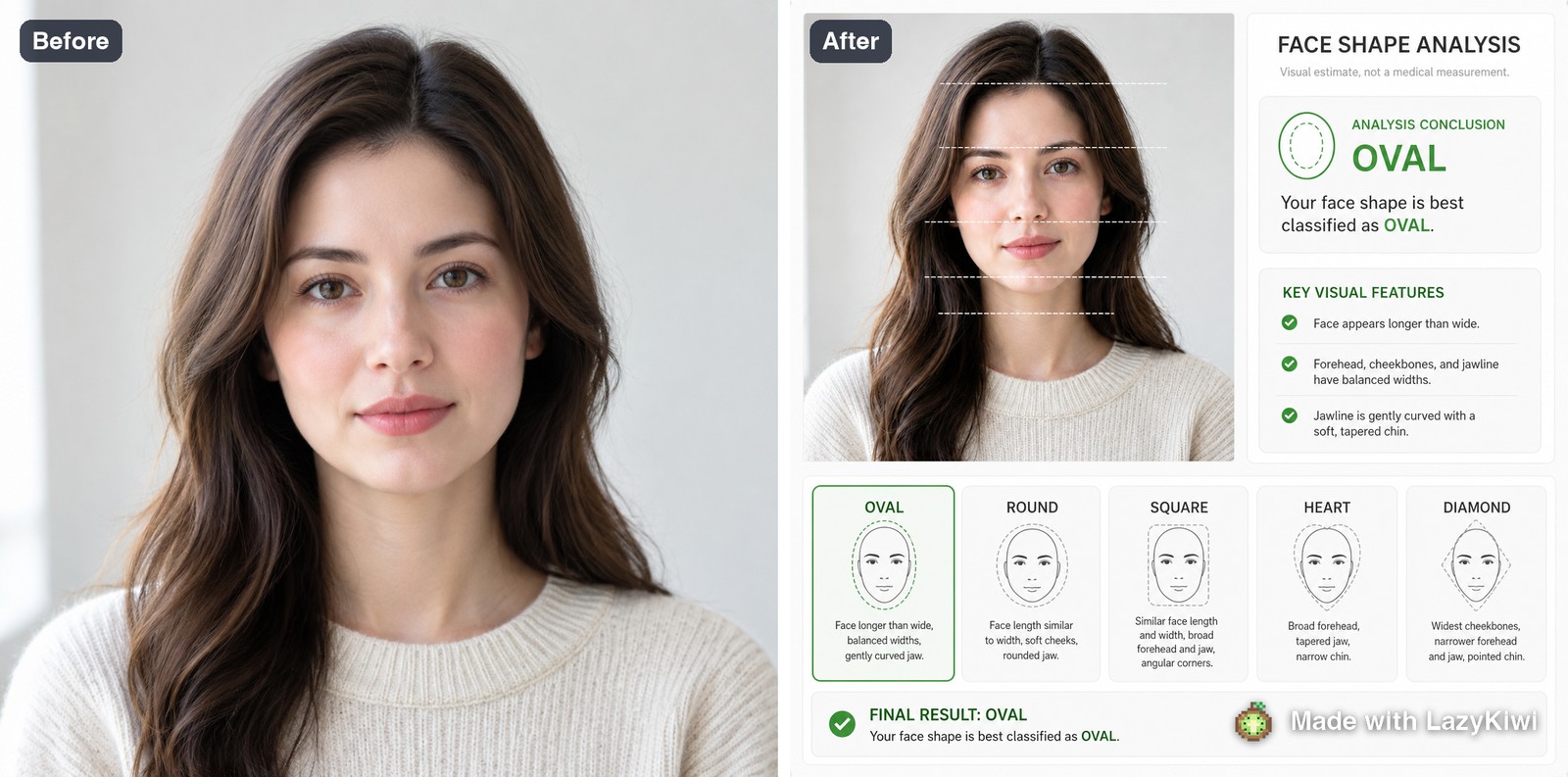
The card draws four horizontal reference lines across the portrait, names a shape, lists the features it used and shows a strip of reference silhouettes, and it labels itself as a visual estimate rather than a medical measurement. Treat it the same way. Both faces we ran in September came back as oval, and that card's reference strip showed five silhouettes with no oblong, so a long face can be handed the nearest shape on offer. That is why the next section exists: the tape is how you check the picture.

How to determine your face shape in 5 steps
This is how to determine your face shape by hand. A soft tailoring tape and a mirror are enough, and the whole set takes about two minutes. What matters is doing it the same way every time, so write each number down as you go.
- 1
Get the right tools
A soft fabric tape, a mirror at eye level, a hair tie or clips, and a notes app. A rigid ruler works for widths if you have no tape, but not for the curved jaw line.
- 2
Measure your forehead
Lay the tape across the widest part of the forehead, roughly halfway between the eyebrows and the hairline. Keep it level and flat; curving it over the brow ridge adds width you do not have.
- 3
Measure your cheekbones
Go from the outer corner of one eye straight across the top of the cheekbones to the outer corner of the other. People tend to take this one too low, which turns a diamond into a square.
- 4
Measure your jawline
Start at the corner of the jaw below the ear, run the tape to the point of the chin, then double the number. Running under the jaw picks up the neck and inflates the reading.
- 5
Measure your face length
Centre of the hairline straight down to the base of the chin. If the hairline has moved back, measure from where it used to sit and note that you did.
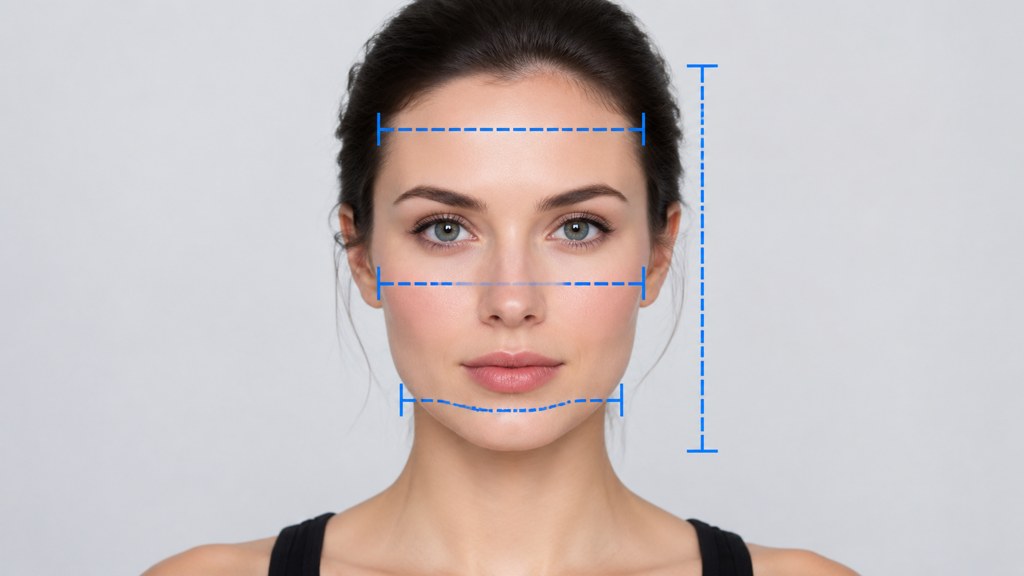
Now turn four numbers into two decisions. First, divide face length by cheekbone width. Close to 1.0 means the face reads as wide as it is long (round or square). Around 1.5 means a balanced length (oval, heart, diamond or triangle). Clearly above that means long (oblong). These thresholds are this guide's working rule of thumb, not a clinical standard, so use them to narrow the field rather than to settle a close call.
Second, find the widest of the three widths. Forehead widest points at heart. Cheekbones clearly widest, with a narrow forehead and jaw, points at diamond. Jaw widest points at triangle. All three within about a centimetre points at square, round or oblong, and the jaw corner decides between them: a corner you can point at is square or oblong, a soft curve is round.
Measure twice on different days and average the numbers. Swelling, a tight ponytail and posture all move the jaw and cheek readings by a few millimetres.
What are the 7 face shapes?
Most charts list six shapes; many add a seventh, triangle (sometimes called pear), for faces whose jaw is the widest line. Use the chart below as a set of tests rather than descriptions, and check your two ratios against each row.
| Face shape | Length against cheekbone width | Widest line | Jaw |
|---|---|---|---|
| Oval | About 1.5 times | Cheekbones, forehead slightly wider than jaw | Curved, tapering to a rounded chin |
| Round | Close to equal | Cheekbones | Soft, no visible corner |
| Square | Close to equal | Forehead, cheeks and jaw nearly level | Straight, with a clear corner |
| Oblong (rectangle) | Well above 1.5 times | Nearly level top to bottom | Straight, often a longer chin |
| Heart | Longer than wide | Forehead | Narrow, tapering to a defined chin |
| Diamond | Longer than wide | Cheekbones, by a clear margin | Narrow, under a narrow forehead |
| Triangle (pear) | Balanced to slightly long | Jaw | Wide and often angular, under a narrower forehead |
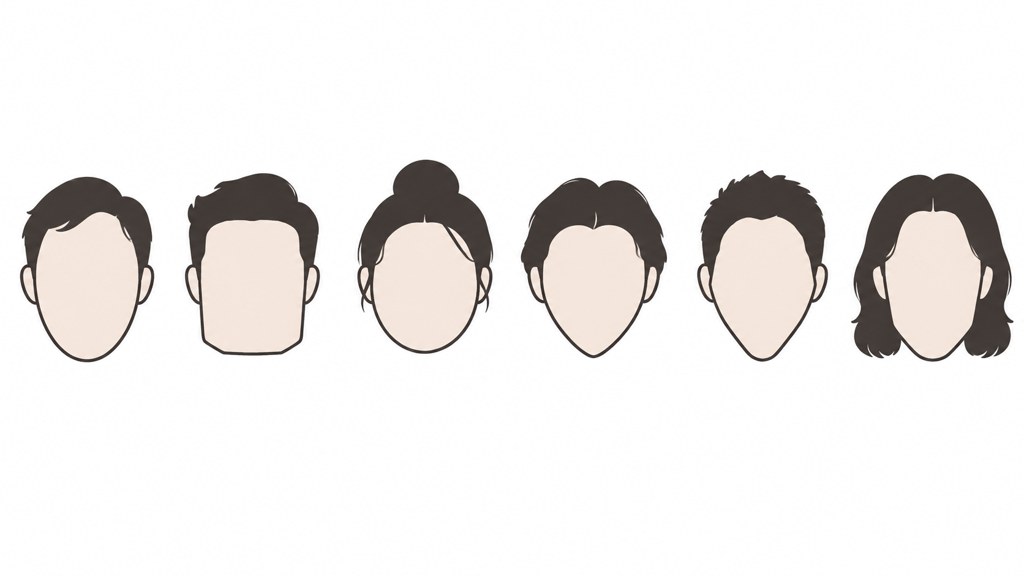
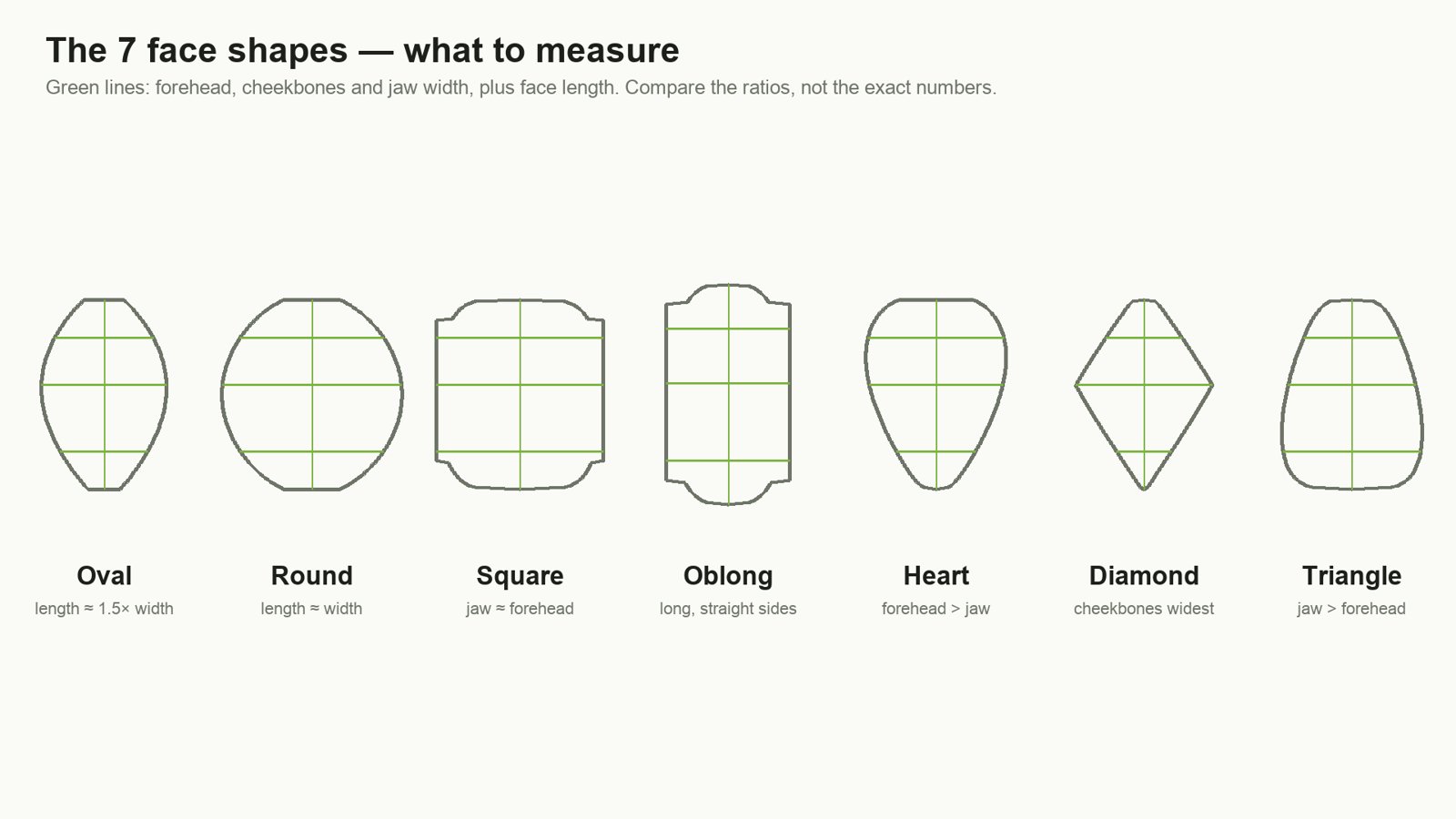
Two pairs cause most confusion. Round and square share the same proportions and differ only at the jaw corner, so look at the corner, not the cheeks. Heart and diamond are both narrow at the chin; the forehead decides it. A forehead as wide as the cheekbones is heart, a forehead noticeably narrower is diamond. Oblong is the shape that charts most often leave out, and it is the one where haircut advice changes most, because adding height to a long face backfires.
What if your face is between two shapes?
Many faces are. If two widths come within a centimetre of each other, or your length ratio sits right on a threshold, you are on a border, and that is a valid result. The common ones are oval and oblong (length ratio near the upper threshold), round and oval (a soft jaw with a slightly long face), and square and oblong (straight jaw, borderline length).
- Re-measure on another day before deciding; small errors at the jaw push borderline faces across the line.
- Take the advice that both shapes agree on. Oval and oblong both suit width at the sides; round and square both suit height on top.
- Where the two shapes disagree, let hair texture and how much time you spend styling break the tie.
- Use a photo with reference lines, from the detector or drawn by hand, to see which border you are closest to.

How do you determine your face shape as a man?
The method is the same; three things get in the way more often. A beard hides the jaw line, a receding hairline lengthens the measured face, and short hair makes the forehead width obvious while long hair hides it. Square and oblong are the shapes men's grooming guides discuss most, but no reliable count of how common each shape is exists, so do not assume yours from the chart.
- Beard: measure the jaw by pressing the tape against the bone, not over the beard. A full beard can add width at the jaw that is not there.
- Receding hairline: measure length from where the hairline used to sit, and note both numbers. The higher number is why many men are told they are oblong.
- Glasses and caps: take them off for the photo; frames sit on the cheekbone line and change the width the detector reads.
- After you know the shape, a beard becomes a tool: length at the chin lengthens a round face, fullness at the sides widens a long one.

If you want to see the effect of a beard or a buzz cut before you commit, our guide to buzz cut lengths explains the guard numbers, and the hairstyle changer previews a cut on your own photo.
Can your face shape change?
Yes, slowly and for known reasons, which is why the old advice to measure once for life is too strong. The facial skeleton keeps remodelling in adulthood: a review of skeletal ageing found that parts of the facial skeleton resorb in a predictable way, notably the midface around the upper jaw, sections of the eye-socket rim and the area of the lower jaw just in front of the jowl, per Mendelson and Wong in Aesthetic Plastic Surgery (2012). Soft tissue changes faster than bone, so weight gain or loss changes the cheek and jaw readings well before age does.
- Weight change: fat in the cheeks and under the jaw moves the width readings and can shift a face between round and oval.
- Hairline: a receding or transplanted hairline changes the measured length even though the bone has not moved.
- Orthodontics and jaw surgery: these change jaw width and chin position directly.
- Swelling: water retention, dental work or a bad night can move the readings for a day or two.
The practical rule: re-measure after a large weight change, after orthodontic work, or every few years, and keep the old numbers so you can see what moved.
What does your face shape decide?
Three practical things, and the reason the measurement is worth two minutes. Haircut volume, because the question is where to add height and where to keep width. Glasses width, because frames read as a horizontal line across the widest third of the face. And camera angle, because turning a few degrees changes apparent jaw width more than any edit.
| Face shape | Frames that work | Hair volume goes |
|---|---|---|
| Oval | Most frames; check width first | Anywhere; choose on texture |
| Round | Rectangular, angular | On top, not at the cheeks |
| Square | Round or oval, soft corners | Off centre, past the jaw corner |
| Oblong | Deep lenses, strong horizontal bar | At the sides, not on top |
| Heart | Bottom-heavy or rimless | At jaw level and below |
| Diamond | Oval or rimless, defined brow | At forehead and jaw |
| Triangle | Strong brow line, wider top | At the crown and temples |

The rule that beats any table is contrast: a soft jaw takes a hard frame and a hard jaw takes a soft one. Heat styling is the cost of most volume-adding cuts, and the American Academy of Dermatology advises readers to limit blow drying and irons and to use low or medium heat with a protectant. For a full walk-through of cuts by shape, read what hairstyle suits me; if you measured as oval, the oval face shape guide goes deeper.
Why do face shape apps disagree?
Run one face through two apps and you can get two answers. Lighting, lens height and a fringe change what any tool sees, and a classifier with fewer outlines than the chart will pick the nearest one it has. General health explainers such as Healthline describe the categories, they do not measure your face, and the medical libraries at Cleveland Clinic treat this as a cosmetic classification rather than a health topic.
- Single overhead light: shadow under the cheekbones narrows the jaw and pushes square toward heart.
- Phone below eye level: shortens the forehead and widens the jaw, pushing oval toward round or square.
- Fringe or hat: hides the top line, so the tool guesses where the forehead ends.
The honest workflow is a hybrid: measure once by hand, keep the numbers, and use the detector when you want the picture and the reference lines to show a stylist. Fashion desks such as Allure, GQ and Self publish seasonal styling advice on top of the same geometry. If you want to try several photos or angles in one sitting, the same tools run from the image workbench, and every tool there runs on GPT Image 2.
Key takeaways
- Fastest route: one straight-on photo in the face shape detector, then confirm with a tape.
- How to determine your face shape by hand: forehead, cheekbones, jaw and length, measured twice, then two ratios.
- Seven shapes: oval, round, square, oblong, heart, diamond and triangle. Round and square differ only at the jaw corner.
- Between two shapes is a valid answer; follow the advice both shapes share and let texture break the tie.
- Face shape can change with weight, hairline, orthodontics and age, so re-measure after big changes.
Image & Design Editor
Maya Chen
Maya Chen writes the image side of the LazyKiwi blog. She tests every tool in the workbench on real photographs before she describes it, and prefers a measurement to an adjective.
FAQ
Common questions
What is my face shape if two measurements are almost equal?
You are on a border between two shapes, which is common. Re-measure on another day, then follow the advice both shapes share, such as width at the sides for oval and oblong. Where they disagree, choose by hair texture and how long you spend styling.
Is a face shape detector more accurate than a tape measure?
Not on its own. A tape reads the same numbers every time, while a detector reads a photograph, and lighting, lens height and a fringe all change what it sees. Use the detector for the picture and reference lines, and keep your tape numbers as the record.
How do I find my face shape without a tape measure?
Take a straight-on photo at eye level with your hair pulled back and use a face shape detector, or trace your outline on a mirror with a dry-erase marker and compare the forehead, cheekbone and jaw widths. Both are faster than a tape but less repeatable.
Can your face shape change with weight loss?
The bone does not change with weight, but the soft tissue over the cheeks and jaw does, so the width readings can move enough to shift a face between round and oval. Re-measure after a large change in weight rather than relying on an old result.
What face shape do most men have?
There is no reliable count of how common each shape is, for men or women, so be wary of charts that claim one. Measure your own face, press the tape against the jaw bone rather than over a beard, and measure length from where your hairline naturally sits.
Check your face shape on your own photo
Upload one straight-on photo with your hair pulled back. The detector draws the reference lines on your face, then confirm the result with the five tape measurements above.
Related reading
Oval Face Shape: How to Tell and What Suits It
The measurable definition of an oval face shape, how to separate it from round and oblong, and the frames, cuts and camera angles that keep it.
8 min read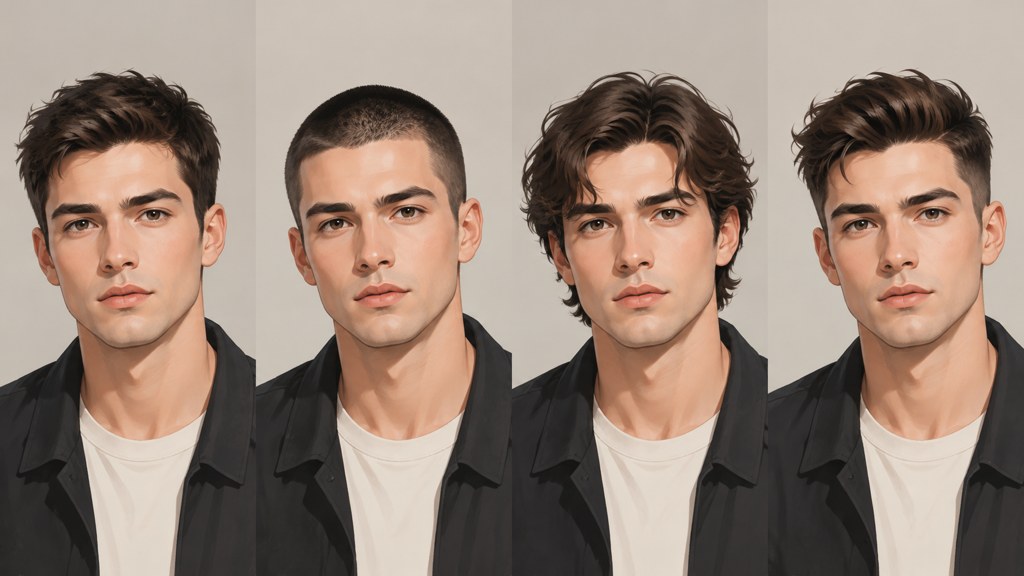
What Hairstyle Suits Me? Try Cuts on Your Photo First
What hairstyle suits me? Preview cuts on your own photo, use the decision table, then pick by face shape, hair texture and men's or women's cuts.
12 min read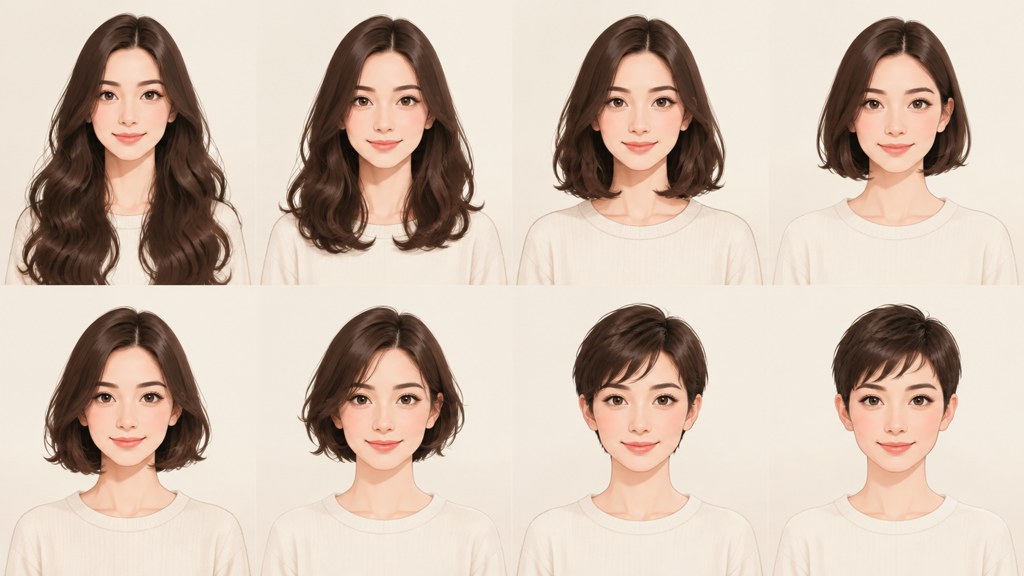
Buzz Cut Lengths: Guard Numbers 1 to 8 Compared
Buzz cut lengths in guard numbers and inches, straight off the manufacturer chart, plus how much scalp shows at each one and which to pick first.
9 min read
How to Look Better in Photos: 5 Things That Work
Angle, posture, light, clothes, edit. Five variables in priority order, what each one is worth, and how to test them one at a time on your own face.
9 min read