
Virtual Try On: What Actually Works in 2026
Virtual try on tools compared on garment types, free tiers and input rules, plus the honest answer on sizing and where the technology still fails.
 Marcus Tan 9 min read
Virtual try on covers two unrelated technologies. Tracked overlays put glasses, jewellery and makeup on a live camera feed, and that job is solved. Generative garment transfer takes a photo of you and a photo of a clothing item and draws a new picture of you wearing it, which is convincing rather than accurate: nothing is measured, so nothing about fit is being answered. Below: which garment categories work and which do not, the tools compared with free tiers read on their own pages today, a two-upload workbench run with the instruction pattern that keeps proportions honest, the consent rules, and the four artefacts that give a generated fitting away.
What is virtual try on and how does it work?
Two completely different technologies share the name, and confusing them is why people arrive with the wrong expectations.
- 1
Augmented-reality overlay
Used for eyewear, jewellery and makeup. The system tracks facial landmarks in a live camera feed and draws a three-dimensional object registered to them. The object's geometry is known in advance, so the hard part is tracking, and tracking is a solved problem.
- 2
Generative garment transfer
Used for clothes. The system takes a photograph of a person and a photograph of a garment and generates a new image of that person wearing it. Nothing is tracked and nothing is measured; the fabric, the drape and the fit are invented to look plausible.
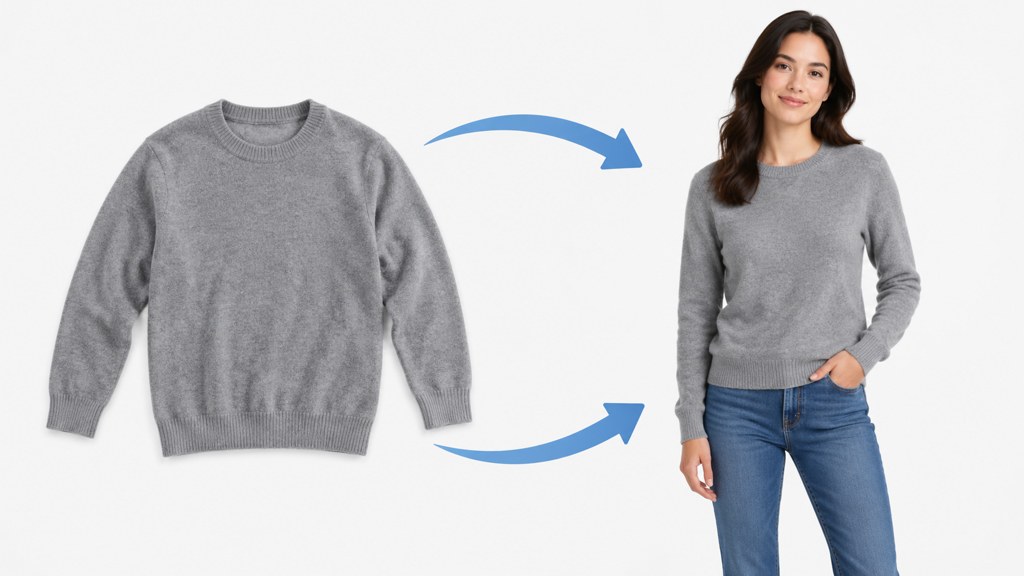
That difference explains everything downstream. The first family is accurate because the object is real and the position is computed. The second is convincing rather than accurate, because the garment on the person never existed. It is a very good drawing, not a measurement.
Which garment types does virtual try on handle well?
Difficulty runs in a predictable order, and knowing where your category sits saves a lot of disappointment.
| Category | Technology | Reliability | Fails when |
|---|---|---|---|
| Eyewear and makeup | Tracked overlay | High | Extreme head angles or heavy occlusion |
| Shoes | Tracked overlay | Good | Feet partly out of frame or crossed |
| Structured tops | Generated | Reasonable | Complex closures, layered collars |
| Draped fabric | Generated | Poor | Anything that hangs, gathers or flows |
| Bold prints | Generated | Poor | Pattern scale needs to change with distance and body curve |
Prints are the most instructive failure. A repeating pattern on a real garment gets smaller as the fabric curves away from the camera and distorts across the body. Generated results tend to paint the pattern at one scale across the whole shape, which is why a striped shirt often looks like a photograph of a striped shirt pasted onto a person.
Draped fabric fails for a related reason: the drape is a function of weight, cut and gravity, and none of those exists in a flat reference photograph. A generated result guesses at a fold pattern that looks like fabric in general rather than like that fabric.
Virtual try on tools compared one by one
Read on each vendor's own page on 7 September 2026. Where a page renders its plan table in the browser and no figure was readable, that is stated rather than filled in.
| Tool | What it covers | Free tier as published today | Aimed at |
|---|---|---|---|
| FitRoom | Clothes on an uploaded model photo | 10 credits a month, FitRoom watermark, standard photo quality | Sellers and individuals |
| Perfect Corp | Clothes, shoes, jewellery, eyewear, makeup, hair | Demo store and contact sales; no public plan table | Brands and retailers |
| Style.me | Retail fitting-room integrations | Site did not load for me today | Retailers |
| PhotoRoom | Garment and product imagery rather than try-on | Published on its own site | Sellers preparing catalogue images |
| LazyKiwi | Clothes on a full-length photo, two uploads | 40 credits on signup, 13 cr per 1K image | Individuals and small sellers |
FitRoom is the closest direct comparison. Its pricing page today gives the free tier 10 credits each month, up to ten wardrobe items and up to ten custom models, with a FitRoom watermark and standard photo quality; the paid tiers remove the watermark and raise quality. The monthly prices themselves render as placeholders on that page, so I am not quoting a figure for them.
Perfect Corp is the enterprise end. Its own page describes try-on across clothes, shoes, jewellery, eyewear, makeup and hair, and for clothes it claims one-click outfit swapping from a 2D photo that adjusts to different body shapes. There is a demo store and a contact-sales route rather than a published price list, which tells you who it is for.
Style.me is a retail integration vendor rather than a consumer tool. Its site did not finish loading for me today, so nothing about its terms is quoted here. PhotoRoom is worth knowing for the adjacent job: getting a clean garment photograph in the first place, which is the input every generated route depends on.
How do you try on clothes with AI from your own photo?
The AI clothes changer takes two photographs, a person and a garment, and puts one on the other. I ran it twice on the same pair to see what changes when only the instruction changes.
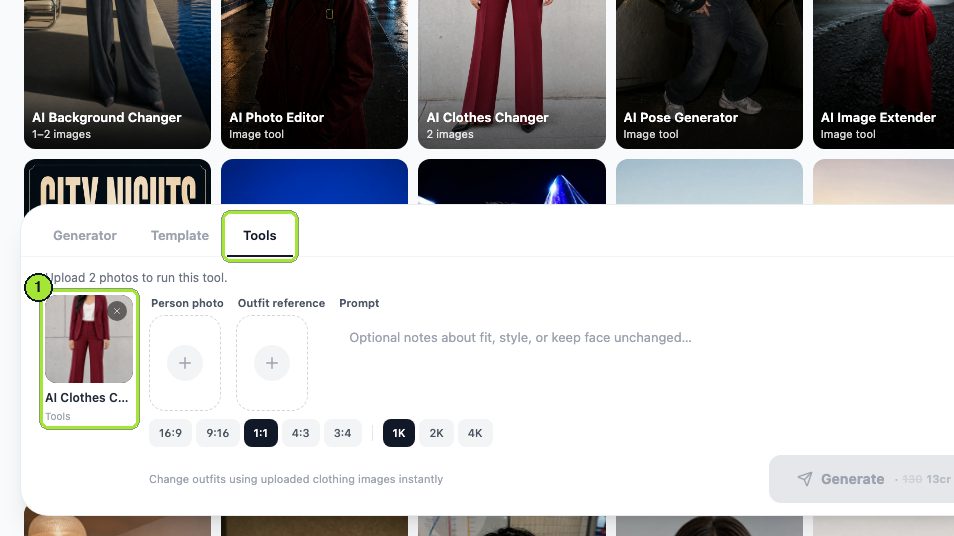
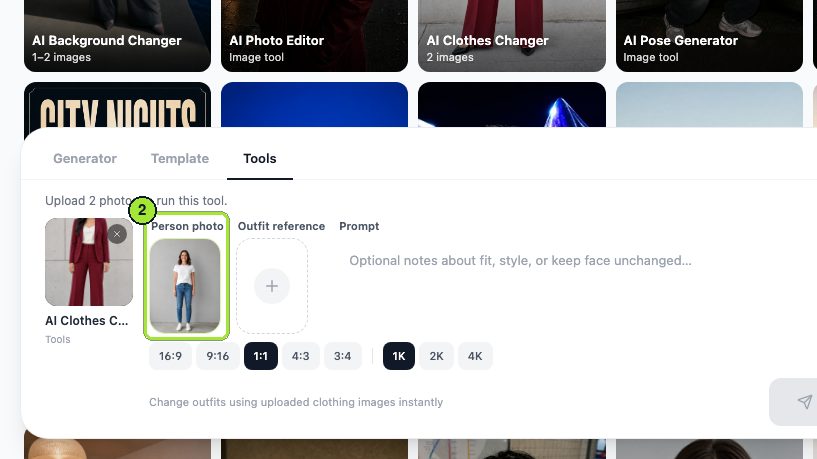
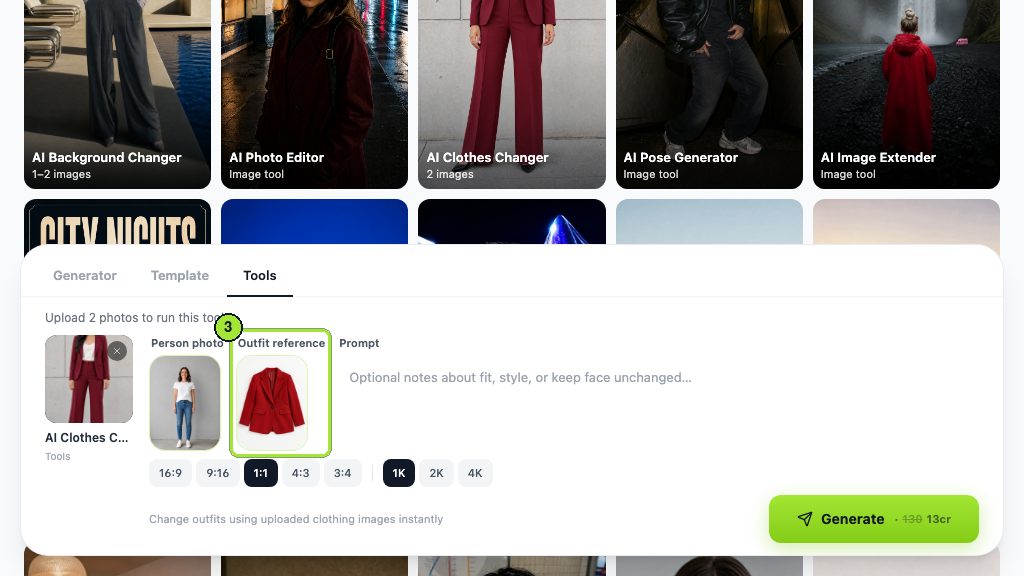
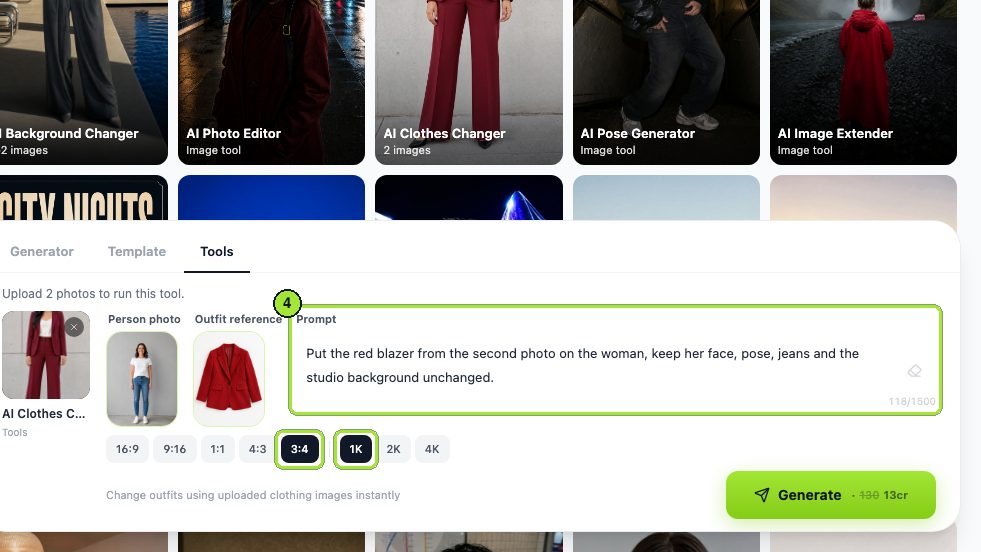
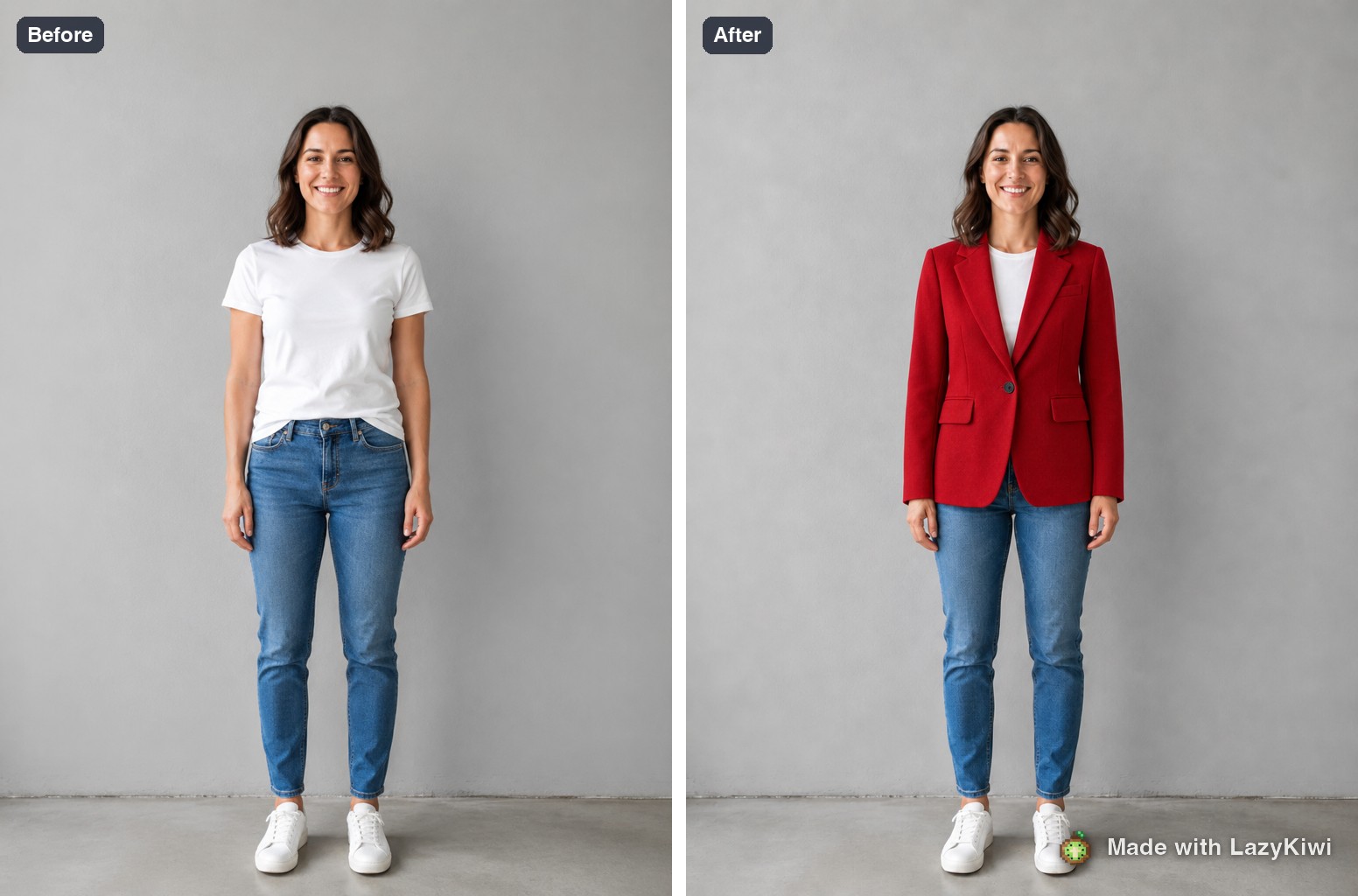
The instruction matters more than any setting, because there are no other settings. Naming what must not change is what keeps the result honest: face, pose, the rest of the outfit and the background. Leave those out and the model will happily rebuild the whole picture around the garment.
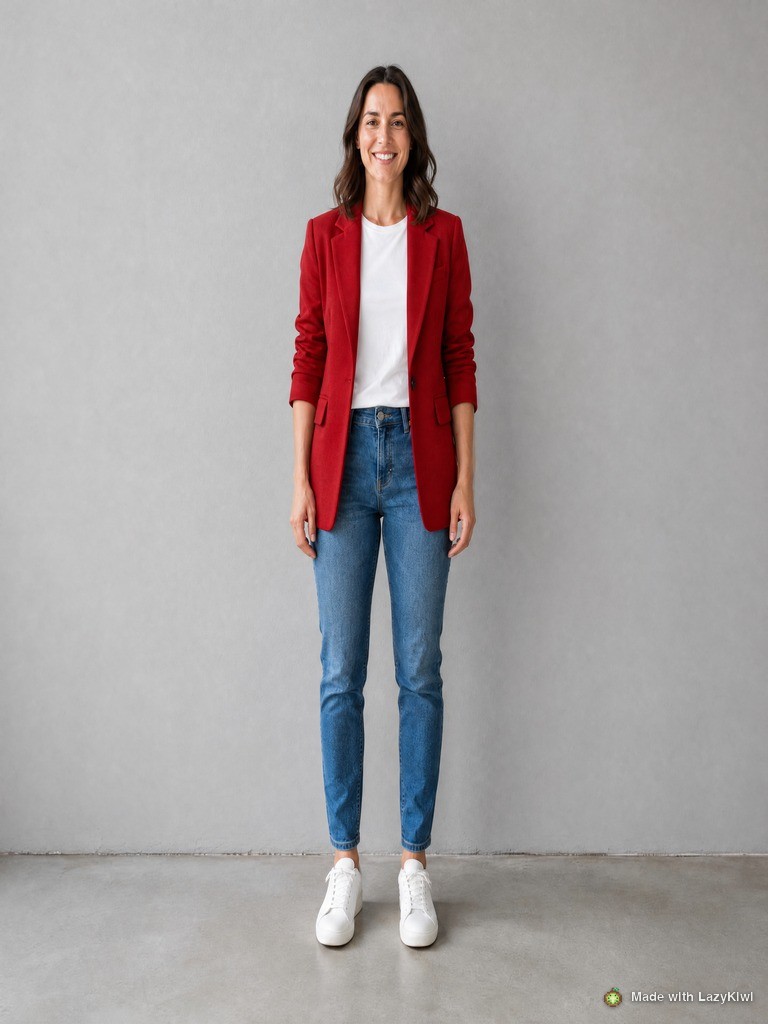
Put the garment from the second photo on the person in the first photo. Keep the face, hair, pose, hands, lower half of the outfit and the background exactly as they are. Match the garment's colour and pattern scale to the reference. Do not change the body shape.
Both runs used the same input pair because the library holds a single garment reference, so run two changes the styling instruction rather than the file. Both were served by GPT Image 2 at 3:4 and 1K. If you want to compose the source photograph itself, the image generator is where the same composer lives with a prompt box instead of a tool chip.
How accurate is a virtual dressing room for sizing?
It is not. This is the single most important thing on the page, and it is worth stating plainly: a generated image tells you nothing about whether a garment will fit.
- Nothing is measured. Neither your body nor the garment is measured, so no comparison between the two is happening.
- The result is generated to look plausible, which means it will usually look like it fits, including when it would not.
- A virtual dressing room built by a retailer on top of real garment measurements is a different product, and even then it is estimating from your stated size rather than from your body.
- Fabric behaviour is invented. Stretch, weight and how a shoulder seam sits are the things that decide fit, and none of them exists in the source images.
Appearance, not fit. A try-on image answers whether you like the look, not whether the button will close.
— Marcus Tan
So use it for the question it can answer. Does this colour work on me, does this silhouette suit my shape, do these two pieces go together. Those are real questions and the technology is genuinely useful for them.
Is there a free AI clothes try on?
Yes, with the usual pattern: free means fewer runs, a watermark, or a lower output quality, and which of those you get is the thing to check.
- FitRoom's free tier: 10 credits monthly, a watermark on the output and standard rather than best photo quality, as published on its pricing page today.
- Perfect Corp: no public free plan. There is a demo store to try the technology, and a sales conversation after that.
- LazyKiwi: 40 credits on a new account against 13 cr per 1K image, so three runs before any decision, with no watermark.
- Retailer implementations: free wherever a shop has built one, and limited to that shop's own catalogue, which is the trade.
If the question is what to wear rather than how a specific item looks, that is a different tool: an outfit generator builds a look rather than transferring one garment. The practical advice for a free budget: fix the garment photograph before you spend a credit. A flat, evenly lit, background-free reference produces a usable result far more often than a second run with a better prompt does, and preparing that image costs nothing.
How are retailers using it in 2026?
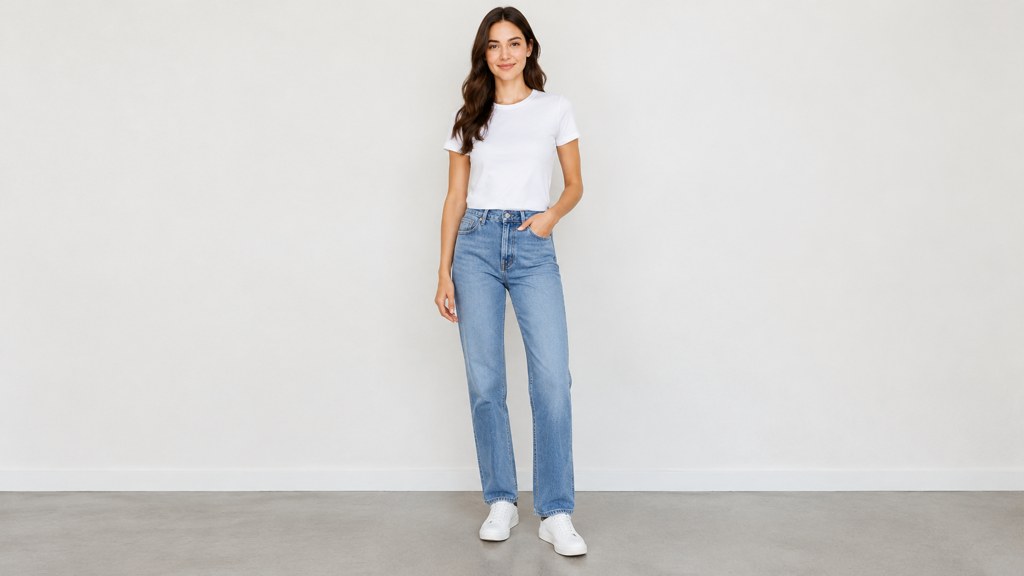
Two patterns dominate, and they have different economics.
- Platform-level try-on, built by a search or marketplace platform across many merchants' catalogues. Google publishes its shopping product announcements on its own blog, and the current Shopping section carries a back-to-school piece illustrated with a try-on showing a shirt on an avatar.
- Retailer-level try-on, built into one shop's own product pages, usually on a fixed catalogue with controlled garment photography. Large retailers announce these through their own newsrooms, which is where any adoption claim should be read, Amazon's being the obvious example.
I am not going to repeat any of the return-rate or conversion figures that circulate about this, because I could not open a first-party page carrying one today. Treat every such number you see as needing a link to the retailer's own announcement before you plan around it.
What the retail versions have that a general tool does not is control of the inputs. One catalogue, one photography standard, one set of poses. That is why a retailer's try-on of its own coat looks better than the same coat run through a general tool from a photograph scraped off the product page.
What are the safety and consent rules for try-on images?
Short and non-negotiable, because this is a category where the rules matter more than the features.
- 1
Only your own photo, or one you have permission to use
Uploading a photograph of another person to put clothes on them requires their agreement. That includes friends, colleagues and anyone whose picture you found online.
- 2
Never images of minors
No try-on use on photographs of children, in any tool, for any reason.
- 3
Garment removal is out of scope
This post covers putting clothing on a photograph. Tools and techniques aimed at the reverse are not covered here, not compared here, and not something we build for.
- 4
Disclose it in commercial use
A generated image of a product on a person, used in advertising, is a marketing claim about that product. The FTC's endorsement guidance is the reference point for what has to be clear to a reader in the United States.
On the disclosure question generally, stock libraries have converged on the same position: Getty Images treats identification of synthetic content as a condition of licensing rather than a courtesy. If a professional library needs to know, so does a shopper looking at a product photograph. Assistants tend to decline edits that put clothes on a photograph of a real person, which is exactly why the consent question is worth answering here rather than assuming it is handled somewhere else.
What makes a virtual try on result look wrong?
Four tells, and each one points at a different missing piece of physics.
- Fabric that ignores the body. Cloth that does not compress where an arm crosses the torso, or fold where the waist bends, was drawn onto the shape rather than fitted to it.
- A floating collar. Collars and necklines sit against the neck and cast a small shadow there. A collar with a clean gap behind it is the most common single artefact.
- Pattern at one scale. Stripes and prints should shrink towards the edges of the body and distort over curves. Uniform scale across a torso is a giveaway.
- Vanished hands. Hands overlapping the garment are hard, so they often come back missing, merged or with the wrong number of fingers. Check them first.
The fastest quality check is to look only at the boundary between garment and person: the shoulder seam, the neckline, the cuff and the hem. Everything a generated fitting gets wrong lives on that boundary, and everything it gets right is in the middle of the garment where there was nothing difficult to solve.
Key takeaways
- Two technologies, one name: tracked overlays for eyewear and makeup, generated transfer for clothes.
- Difficulty order: eyewear and makeup, then shoes, then structured tops, then draped fabric and bold prints last.
- It answers appearance, never fit. Nothing is measured on either the body or the garment.
- The instruction does the work: name what must not change, starting with face, pose, hands and background.
- Fix the garment photograph before spending credits; a clean flat reference beats a better prompt.
- Only your own photo or one you have permission to use, never a photo of a minor.
Tools & Reviews Editor
Marcus Tan
Marcus tests creative software against the same brief until something breaks, then writes down where. He covers tool comparisons, free tiers and the gap between a feature list and a finished file.
FAQ
Common questions
What is virtual try on technology, exactly?
Two things. Tracked augmented reality registers a known three-dimensional object to facial or body landmarks in a camera feed, used for eyewear and makeup. Generative transfer produces a new image of a person wearing a garment from two photographs, used for clothes.
Can virtual try on clothes tell me my size?
No. No measurement of your body or of the garment takes place, so nothing is being compared. A result that looks like it fits will look that way whether or not the real garment would close, which is why it answers style questions rather than sizing ones.
Is there an ai clothes try on free option worth using?
FitRoom's free tier gives 10 credits a month with a watermark and standard photo quality, as published today. LazyKiwi gives new accounts 40 credits against 13 cr per 1K image, so three runs without a watermark. Both are enough to judge whether the category helps you.
Why do prints and stripes look wrong on ai try on clothes results?
Pattern scale should shrink as fabric curves away from the camera and distort across the body. Generated results usually paint the pattern at one scale over the whole garment shape, so a striped shirt reads as a picture of stripes laid on top of a person.
Whose photo am I allowed to use?
Your own, or someone else's with their agreement. Never a photograph of a child. In commercial use, a generated image of a product on a person is a claim about that product, so it needs to be clear to the reader that the image was generated.
Put a garment on your own photo
Two uploads, one instruction, and the price on the Generate button. Name what must not change and the result stays honest.
Related reading
AI Stylist Apps: Which Ones Actually Help
AI stylist and personal styling apps tested on three real briefs — interview, date, travel week — with what each gets right and what it never sees.
8 min read
How to Look Better in Photos: 5 Things That Work
Angle, posture, light, wardrobe and edit — in that order. The five variables that actually change how a photo of you reads, and how to test each one.
8 min read
AI Product Photography: White Background to Branded Scene
AI product photography in practice: shoot on a phone, get a white-background image, swap in a branded scene, upscale, and export to Amazon and Google rules.
8 min read