
Celebrity Look Alike: How the Matching Works
How face matching actually works, why two tools disagree about the same photo, what our own run really returns, and the privacy questions to ask.
 Maya Chen 9 min read
A face-matching tool does not recognise anyone. It converts your photograph into a list of numbers, then finds the closest entry in whatever reference set it was built with. That reference set decides the answer far more than your face does, which is why the same photo can produce two different verdicts in two apps and why a result is entertainment rather than a statement about you. Below: how the embedding step works in plain language, how to shoot an input that gives it a fair chance, what our own tool actually returns, which turned out not to be what we expected, and the privacy and posting rules worth knowing first.
How does a celebrity look alike tool decide who you resemble?
Three steps, and only the first is about your face.
- 1
Detect and normalise
The tool finds the face, rotates it upright, crops it to a standard box and evens out the exposure. Anything it cannot normalise, such as a heavy angle, is carried into the next step as noise.
- 2
Embed
The normalised crop becomes a vector, a fixed list of numbers describing relationships between landmarks rather than the pixels themselves. Two photographs of the same person should land close together in that space.
- 3
Search a reference set
The vector is compared against a stored set and the nearest entries come back. This is the step people misunderstand. The tool is not searching all famous faces; it is searching the ones it holds.

So the honest framing of who is my celebrity look alike is: which entry in this particular reference set sits nearest to my vector today. Change the set and you change the answer without touching the photograph.
Why do two look alike finders give different results?
Four reasons, in order of how much difference they make.
| Cause | What it changes | How much it matters |
|---|---|---|
| Reference set | Which faces are available to match at all | Most of the difference between tools |
| Crop | How much forehead, hair and neck the vector describes | Large; a tight crop and a loose crop are almost different photographs |
| Lighting normalisation | Whether shadow reads as bone structure | Large on side-lit inputs, small on flat ones |
| Nearest-neighbour threshold | How confidently it will name anything at all | Decides whether you get a strong claim or a hedge |
You can watch this happen with one tool and two photographs of one person, which is exactly what we did below. It is also why running the same picture through two apps and treating the agreement as confirmation is a mistake: two tools sharing a reference set will agree for reasons that have nothing to do with your face.
How do you get a fair celebrity look alike match?
Everything that helps is about the input photograph. Four faults account for most bad results.
- Angle. Anything past about fifteen degrees off centre forces the tool to infer the far side of the face, and inference is where identity leaks away.
- Hard light. A single strong side source paints a shadow that reads as a cheekbone, changing the vector without changing your bones.
- Occlusion. Sunglasses, a fringe over the brow, a hand near the jaw. Each one removes landmarks the embedding depends on.
- Expression. A wide smile moves the cheeks, the eye corners and the mouth all at once, which is three landmark groups displaced simultaneously.

Front on, neutral, even light, hair off the face. If your proportions are the thing you actually want measured, our face shape detector reads geometry from the same kind of frame and gives you a ratio rather than a name.
How do you find your celebrity look alike from a photo?
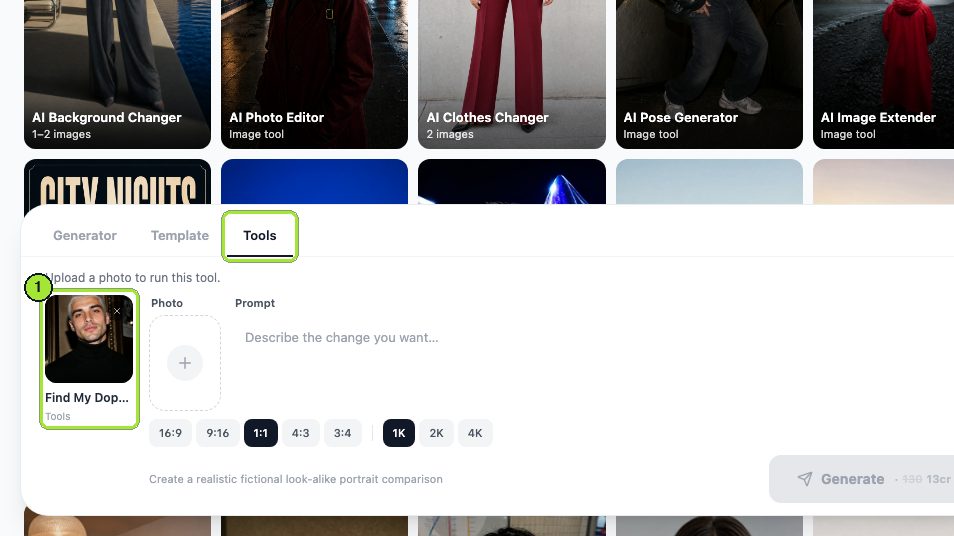
Here is our run on 7 September 2026, and a correction we owe readers up front: our tool does not name a celebrity and it does not print a similarity score. Understanding what it does return is more useful than the thing you expected.
- 1
One photo into the Photo box
A single upload is the whole input. Nothing needs typing in the Prompt box for this tool.
- 2
Square at 1K
Two chips, square shape and smallest size. A two-panel output reads better in a square frame than in a wide one.
- 3
Spend 13 credits
That cost is printed on the button ahead of the click, and the job appears in My Image while it renders.
- 4
Run a second, different photo of the same person
Our second input was a casual indoor selfie rather than a studio headshot. Same person, different conditions, another 13 credits, 26 in total.

What comes back is a two-panel image: your face on the left and a generated near-twin on the right. Nobody is named, no percentage is shown, and the face on the right is synthesised rather than retrieved from a database of real people. That is a meaningfully different product from a matcher, and it is worth saying plainly rather than implying a score exists.

The two runs are the demonstration. Same person, two photographs, and the near-twin on the right differs noticeably between them in skin tone, hair weight and jaw softness. The engine underneath is GPT Image 2. It composes rather than looks up, which puts even more weight on your input photograph than a retrieval system would.
Read the output as a family resemblance, not a verdict
A generated near-twin tells you which of your features the model considers most defining, because those are the ones it keeps. That is genuinely interesting. It is not a claim that you resemble any particular person.
Is a celebrity resemblance actually meaningful?
No, and the reasons are structural rather than a knock on any tool.
- A nearest neighbour is always found. Distance to that neighbour can be enormous and you still get a result, because something has to be nearest.
- Reference sets are small relative to the number of human faces, and they are skewed toward whoever was well photographed and widely licensed.
- Embeddings encode what the training data taught them to weight, which is not the same as what people notice about each other.
- In a generative tool like ours, the near-twin never existed at all, so the question of resemblance to a real person does not arise.
Keep it as entertainment and it is a good time. Treat it as evidence and you are over-reading a distance calculation. For what it is worth, curiosity searches like this bring real traffic: ChatGPT referrals are now the second-largest source of visits to lazykiwi.ai after direct, at 300 sessions from 279 users over 90 days (GA4 and Search Console data to 4 September 2026), mostly landing on image tool pages.
What happens to your photo when you use a look alike finder?
Face data has its own rules in several jurisdictions, and the better policies name it explicitly. We read three on 7 September 2026.
| Service | What its own policy or page says today | Account needed before a result? |
|---|---|---|
| Picsart | Says a face scan of your uploaded image happens whenever an effect is applied to a face, names the output biometric data, and gives a three-year post-closure window for some retained information | Plan grid begins at a paid Pro tier |
| Fotor | Its FAQ promises free editing with no image cap and watermark-free export; the obvious privacy-policy path returned an error when we checked | Account suggested for cross-device use |
| Perfect Corp | A business platform offering a free web demo, with no consumer terms or price published | Reached through a brand's own site |
| LazyKiwi | 13 credits per 1K render, price shown on Generate; new accounts start with 40 credits | Yes, and the free grant covers three runs |
Of the three, Picsart writes the most explicit face-data clause, and it is worth reading even if you never use the product, because it models what such a clause should contain. Fotor and Perfect Corp publish their commercial terms more readily than their retention terms.
One habit beats reading any of them. Pick an image that is already on your public profile: the internet has it, so handing it to a tool costs you almost nothing extra in exposure.
Can you post a celebrity look alike result?
Your own generated result, yes, with two conditions. Somebody else's photograph, no, without their agreement.
- Keep real celebrity photographs out of your post entirely, cover image and side-by-side alike. Pictures of public figures are licensed material, and Getty Images publishes its licence information and editorial policy on its own site, which is where that question gets answered.
- Keep it clear of anything that reads as a product recommendation. FTC guidance for endorsers turns on whether the person recommending something actually holds that view and actually used the thing, and a face nobody has met can do neither.
- Say that it is generated. Meta applies its own label once it spots the usual technical markers or once a poster ticks the box, while YouTube puts the duty on the creator for realistic material showing a real person doing something they never did.
- Provenance can also ride inside the file. Content Credentials is a specification hosted by the Coalition for Content Provenance and Authenticity, and it records how a picture was made and what was done to it afterwards.
None of that is onerous for a picture of yourself. All of it matters the moment another person's face enters the frame.
What are the best free celebrity look alike tools?
Judge them on what they ask for rather than on the headline word free. Three things are worth checking before you upload: whether a result appears without an account, whether the download carries a watermark, and whether the policy names face data.
- Searches for how to find your celebrity look alike and how to find out your celebrity look alike mostly surface apps that require an install and an account before showing anything.
- A watermark-free download is the exception rather than the rule on genuinely free tiers, and it is the thing most people actually want.
- A named face-data clause is rarer still. Its absence is not proof of anything, but its presence tells you the company has thought about the question.

For our own numbers: a run costs 13 credits at 1K, the figure appears on the Generate button, and a new account starts with 40 credits, which covers three runs. Several inputs can be queued in one sitting from the image generator page, and the finished cards stack together for comparison.
The reference set decides your answer more than your face does. Change the set, keep the photo, get a different celebrity.
— Maya Chen
Key takeaways
- Matching is three steps: normalise the face, turn it into a vector, then find the nearest entry in a stored set.
- The reference set explains most of the disagreement between two tools, not your photograph.
- Our own tool generates a near-twin rather than naming a celebrity, and prints no similarity score.
- Two photographs of the same person produced visibly different near-twins, at 13 credits each.
- Front on, neutral expression, even light, nothing covering the brow or jaw. Input quality decides result quality.
- Never publish a real celebrity photograph beside your result, and label anything generated.
Image & Design Editor
Maya Chen
Maya Chen writes the image side of the LazyKiwi blog. She tests every tool in the workbench on real photographs before she describes it, and prefers a measurement to an adjective.
FAQ
Common questions
Who's my look alike celebrity, and can a photo actually tell me?
A tool can tell you which entry in its own reference set sits nearest to your face vector, which is not the same question. Change the set and the answer changes without your photograph changing at all. Treat any name it returns as a distance calculation, not a description of you.
Who's your celebrity look alike if you only upload one selfie?
Different reference sets first, then different crops and different lighting normalisation. A tight crop and a loose crop describe almost different photographs, and a side-lit input can have shadow read as bone structure. Agreement between two apps often just means a shared reference set.
Does the LazyKiwi tool name a celebrity?
No. Our doppelganger tool returns a two-panel image with your face beside a generated near-twin, and it prints no name and no similarity percentage. The face on the right is invented rather than fetched, which makes this a resemblance sketch and not a database query.
Is it safe to upload my photo to a look alike finder?
Start with the retention clause, and choose an image you have already put on a public profile. Picsart's policy is the clearest example we found: it states that applying effects to a face means scanning your face geometry, which it names as biometric data.
Can I post the result on social media?
Your own generated image, yes, labelled as generated. Do not attach a real celebrity's photograph to it, since those are licensed material, and keep it clear of anything that reads as a product recommendation. YouTube and Meta both publish disclosure rules for realistic synthetic content.
Run your own photo and see what comes back
Thirteen credits, one square render, and a two-panel result showing which of your features the model treats as the ones that define your face.
Related reading

What Will My Baby Look Like? Genetics vs AI
What genetics can and cannot predict about a baby's face, why every prediction tool is entertainment, and how the AI versions actually build the image.
9 min read
How to Look Better in Photos: 5 Things That Work
Angle, posture, light, wardrobe and edit — in that order. The five variables that actually change how a photo of you reads, and how to test each one.
9 min read
The Rarest Eye Color, and How to Preview Any Shade
Which eye colours are genuinely uncommon, what decides yours, and how to try a different shade on your own photo without touching your eyes.
9 min read
Best AI Profile Picture Generator in 2026: 7 Tools Compared
Seven AI profile picture generator options compared on prices checked today, likeness, style range and photo retention, plus LinkedIn and Instagram sizes.
8 min read