
Attractiveness Test: 478 Landmarks, 10 Measurements, One Honest Card
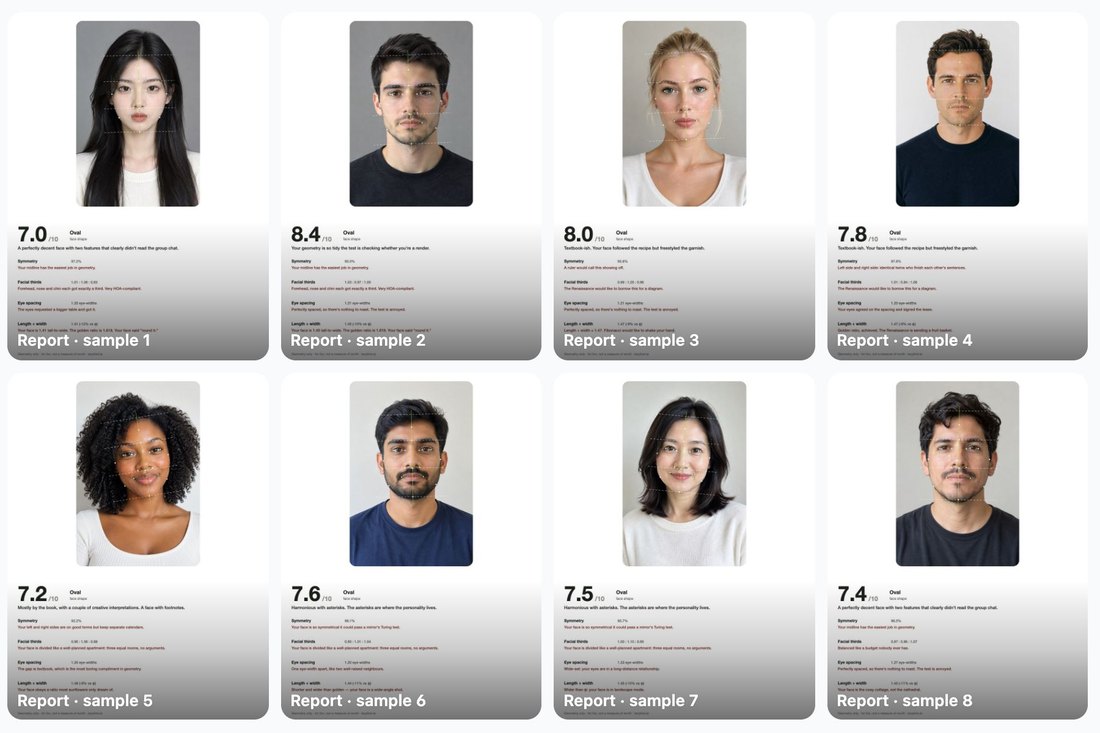
Upload one front-facing photo. The test finds 478 points on your face right in your browser, draws the symmetry line, the facial thirds and the five-eyes grid on your picture, and measures ten things: symmetry, thirds, eye spacing, face width in eyes, canthal tilt, nose-to-mouth width, jaw-to-cheekbone width, golden ratio, lip proportion and face shape. Each comes with the number, the reference range and one line that tells it like it is — a joke about the geometry, never about you — plus a score out of 10 computed from the readings. Free, no sign-up, and the photo never leaves your device.
What it is
Real measurements, honest ranges, one line each.
Most online attractiveness tests show you a number and ask you to trust it. This one shows its work. A face-landmark model (MediaPipe Face Landmarker, 478 points) runs in your browser and the test measures the geometry people have argued about for centuries: how closely the two halves mirror each other, whether the forehead, mid-face and lower face split evenly (the facial thirds), whether the gap between your eyes is one eye wide (the rule of five), how your eye corners tilt, how your nose width compares to your mouth, how your jaw compares to your cheekbones, how your face length compares to its width against the golden ratio 1.618, how your upper and lower lips balance, and which of six face shapes the widths point to. Every reading is printed with its reference range and drawn on your own photo, and the score out of 10 is computed from those readings with a formula written on the card — nothing learned from other people's faces. Then comes the fun part: each reading gets one line, in the voice of a friend who owns a ruler. The lines joke about lines, ratios and angles on the photo; they never touch weight, ethnicity, gender, age, skin or anything about you as a person. What it is not: a measurement of you. It is a measurement of one photo, and camera distance, head tilt, expression and light all move the numbers — turn your head and the score drops, and if the geometry gets truly absurd, so does the score.
How it works
How to take the attractiveness test
Open the tool and upload a photo
Attractiveness Test sits in the Image Generator's Tools, next to Face Shape Detector. Upload a front-facing photo with the whole face visible, or tap one of the sample photos. The face model loads once (about 10 MB) and then everything runs in your browser.
Press Analyze
It is free — the button says so. The photo is measured on your device; nothing is sent anywhere.
Read the card, download it
Your report card appears with the other results: your photo with the lines, ten readings with ranges, a face shape, a score out of 10 and a verdict. Open it and download the PNG.
Ten readings, each with a range and a line of its own
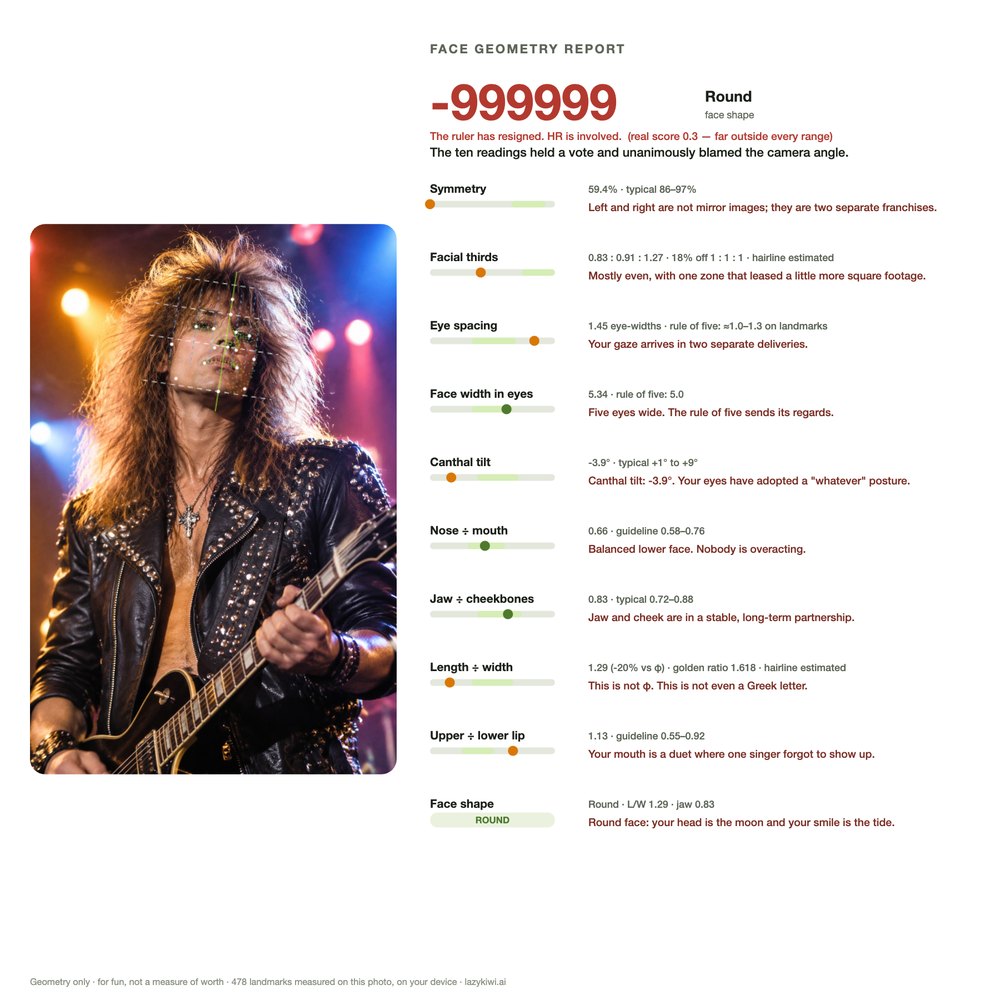
Symmetry (how closely twelve mirror pairs of points — eye corners, brows, nostrils, mouth corners, cheekbones, jaw — match across the midline), facial thirds (forehead → brows → nose base → chin against 1 : 1 : 1), eye spacing in eye-widths (the rule of five says 1.0), face width in eye-widths (the rule says 5), canthal tilt in degrees, nose width as a share of mouth width (guideline about two thirds), jaw width as a share of cheekbone width, length-to-width against the golden ratio, upper-to-lower lip height, and face shape (oval, round, square, heart, diamond or oblong) from the same widths. The head is levelled first so a small tilt does not read as asymmetry, and the card warns you when the face looks turned.
- Symmetry from 12 mirror pairs
- Thirds, rule of five, canthal tilt, golden ratio
- Face shape from measured widths
Jokes about geometry, not about people
Every line on the card is about a line or a ratio on the photo — eyes keeping "one eye-width of personal space", a jaw that "could level a bookshelf", a face that "hit the golden ratio, which is the geometry equivalent of a hole-in-one". When a reading is far outside its range the line gets sharper, and when the whole photo is far out — a turned head, a mid-laugh, a lens pressed to the nose — the score slot gives up and prints things like −999999 or 404 with the real number underneath. None of it touches weight, ethnicity, gender, age, skin or disability, and none of it calls a person anything; the copy is screened against a banned-word list. Every card says in the corner that it is geometry only, for fun, and not a measure of worth.
A real 0–10 you can trace back
Each reading is turned into a deviation — how many tolerances it sits from its textbook value — and the score is 10 × (1 − weighted mean deviation ÷ 1.25), with symmetry and the golden ratio weighing most and lips least. A face inside every typical band lands around 7–8.5; a straight-on, level, relaxed photo of the same face scores higher than a tilted, grinning one, which is the point: use it to pick the angle and the light that read best, not to grade yourself. Attractiveness is also personal and cultural in ways no symmetry line captures. Glasses, hair over the forehead and a big smile all shift the readings too — take them off, tie it back, relax, and the same face scores differently.
Why LazyKiwi
Why this attractiveness test
Measured, not guessed
478 landmarks and ten explicit readings with reference ranges.
Nothing uploaded
The model runs in your browser; the photo stays on your device.
Free, no sign-up
No credits, no account, no watermark on the card.
One honest line per reading
A joke about the geometry — never about weight, ethnicity, gender, age or skin.
A score you can trace
The formula is printed on the card and uses only the ten readings.
Part of the image tools
Sits next to Face Shape Detector and the hairstyle tools, so the next step is one click away.
FAQ
Attractiveness test questions
How does the attractiveness test work?+
Open Image Generator → Tools → Attractiveness Test in the LazyKiwi workbench, upload a photo and press Analyze. A face-landmark model finds 478 points in your browser; the test levels the head, measures symmetry, facial thirds, eye spacing, face width in eyes, canthal tilt, nose-to-mouth width, jaw-to-cheekbone width, golden ratio, lip proportion and face shape, prints each with its range and one line, and computes a score out of 10.
Is it accurate?+
The landmarks are consistent, so the readings are repeatable on the same photo. But a photo is not a measurement of a face: camera distance widens or narrows features, a tilt breaks symmetry, a smile changes the thirds. Treat the numbers as a read of this picture.
What does the score mean?+
A real 0–10: each reading becomes a deviation from its textbook value, and the score is 10 × (1 − weighted mean deviation ÷ 1.25). Faces inside the typical bands land around 7–8.5. It is not a rating of your worth or of how attractive anyone finds you — turn your head and the same face scores lower.
Why is my score −999999?+
When the geometry on a photo is far outside every range — usually a turned or tilted head or a big expression — the score slot prints something absurd (−999999, 404, undefined, √−1) with the real number underneath. Take a straight-on, relaxed photo and it comes back to a normal number.
Is my photo uploaded?+
No. The model and the measurements run in your browser. Nothing is sent to our servers; the report card is drawn and downloaded on your device.
Which photo gives the best reading?+
Front-facing at eye level, from at least arm's length, whole face visible, eyes open, relaxed expression, no sunglasses, soft light from the front. The card warns you when the head looks turned.
Does it use the golden ratio?+
As one of ten readings: face length divided by face width, reported as the percentage away from 1.618. It is not the whole score.
Can I test someone else's photo?+
Only with their permission. Rating people from photos without their agreement is unkind, and the jokes are meant for you to laugh at your own geometry.
Is it free?+
Yes — no credits, no account. The Analyze button says Free because it is.
Does it work for every face?+
It needs one clearly visible face looking roughly at the camera. Heavy occlusion, strong profiles or very small faces are rejected rather than measured badly.
Do glasses, hair or a smile change the result?+
Yes. Glasses frames make the measured eye width smaller, so eye spacing and face-width-in-eyes read higher than they are; hair over the forehead moves the estimated hairline; a wide smile stretches the mouth and lips. For the fairest numbers use a straight-on, relaxed photo with the forehead visible and no glasses.
Use cases
Why people take it
Picking a profile picture
Run three photos and keep the angle and light that read best for dating apps, LinkedIn or socials.
Roasting yourself in the group chat
Run it, download, send. Only run photos of people who agreed.
Checking the TikTok face-rating trend
See what canthal tilt and facial thirds actually measure, with the lines drawn on your own photo.
Before a haircut or new glasses
Face shape and thirds tell you where volume or a fringe would rebalance things.
Testing camera distance and tilt
Watch symmetry and eye spacing change between a selfie at arm's length and a photo from across the room.
Learning face proportions
The five-eyes grid and the thirds lines make the classic rules concrete.
Measure the photo, keep the face
478 landmarks, ten honest readings and one joke each — free, in your browser.
No credit card · Free to try · Results in seconds