
What Will My Baby Look Like? Genetics vs AI
Nobody can predict it, and here is precisely why: how inheritance actually works, what the AI tools are really doing, and how to read a result.
 Maya Chen 10 min read

The honest answer to what will my baby look like is that nobody knows, including every app that says it does. Appearance is polygenic: most visible traits come from many genes acting together, and even eye colour, the textbook example of simple inheritance, turned out not to work that way. What the picture-making tools do is different and worth understanding on its own terms. They blend or regenerate faces toward infant proportions, which is an illustration rather than a prediction. This piece separates the genetics from the graphics, then shows what our own template actually produced, which was not a baby.
Can anyone predict what a baby will look like?
No, and the clearest evidence is the trait people assume is easiest. MedlinePlus, the National Library of Medicine's consumer genetics resource, states that researchers used to think eye colour came from a single gene with brown dominant over blue, and that later studies showed the model was too simplistic. It also notes that although uncommon, parents with blue eyes can have children with brown eyes.

If the simplest visible trait needs several genes acting together, a whole face, which is bone geometry plus soft tissue plus pigment plus growth timing, is not going to resolve into a grid you can fill in. That is the entire scientific content of this question.
The American Academy of Pediatrics, which describes itself as 67,000 paediatricians and publishes parent guidance through its own consumer site, is a better first stop than any calculator for what actually matters about a newborn.
Which traits are actually inherited in a predictable way?
A short list behaves close to the textbook, and a much longer one does not. Keep every claim attributable and the split looks like this.
| Trait | How predictable | What the sources say |
|---|---|---|
| Blood type | Fairly predictable | Well-characterised inheritance with a small number of alleles |
| Eye colour | Not simple | MedlinePlus: multiple genes involved, and blue-eyed parents can have brown-eyed children |
| Hair colour | Not simple | Multiple contributing genes, and shade often changes through childhood |
| Height | Strongly heritable, weakly predictable | Many contributing variants plus nutrition and health during growth |
| Face shape | Heritable, not calculable | Bone geometry, soft tissue and growth timing all contribute separately |
| Dimples, hairline shape, earlobes | Popularly treated as simple | Frequently taught as single-gene traits, and frequently more complicated in practice |
Notice what the right-hand column does not contain: percentages. Anywhere you see a tool quoting a precise chance of a trait, ask which gene set it used, and then notice that it will not tell you.
Newborn appearance is a moving target anyway
Infant eye colour and hair colour commonly change during the first year, so even a perfect prediction of a newborn would be a prediction with a short shelf life. Any question about a specific child belongs with a paediatrician rather than with a generator.
General health libraries carry the same message in plainer language. Cleveland Clinic and the NHS both publish parent-facing material on newborn development, and neither of them offers an appearance calculator, which is itself informative.
How do baby prediction tools actually make the picture?
Three families of product hide behind the same promise, and none of them consults a genome.
- 1
Morphers
Two faces are aligned on their landmarks and averaged, then the average is pushed toward infant proportions: bigger eyes relative to the face, smaller nose and jaw, higher forehead. It is a weighted blend, not a simulation.
- 2
Generators
A model is given one or two reference faces and asked to draw a child in the same visual family. Nothing is averaged; a new image is composed from scratch each time, which is why running it twice gives two different children.
- 3
Quizzes
Multiple-choice inputs feed a lookup table. Searches for what will my baby look like quiz and what will my baby look like genetics calculator mostly land here, and the output is a stock illustration selected by your answers.
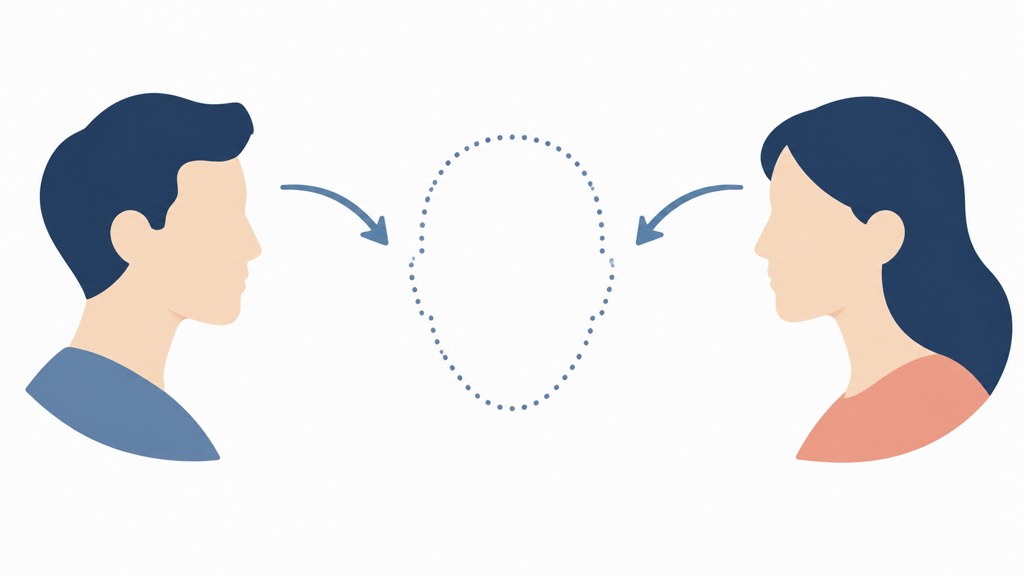
Understanding which of the three you are using tells you exactly how much to read into a result. A morph shows you an average of two faces. A generator shows you one sample from a very wide distribution. A quiz shows you a picture chosen from a shelf.
How do you make a baby-face image from your own photos?
We ran the baby filter template on 7 September 2026, and the result needs a correction before the walkthrough: this template takes a single photo, not two, and what it returns is a child of roughly primary-school age rather than an infant. It is a younger-you tool, and it cannot blend two parents at all.

- 1
Load the Photo box once
There is one slot and no second one for a partner. Nothing needs typing into the Prompt box either.
- 2
Square at 1K
We used the 1:1 and 1K chips, which frame a head and shoulders without waste.
- 3
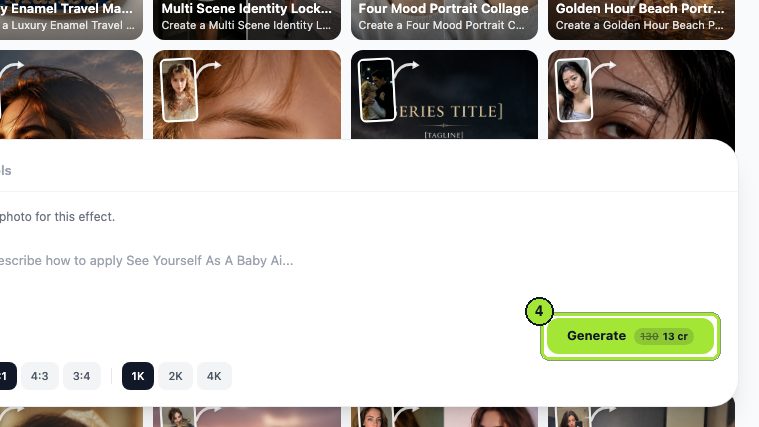
Generate for 13 credits
The figure is shown on the button before the click, and the card renders into My Image.
- 4
Repeat with a second person if you want a pair
We ran a man's headshot as a second job for another 13 credits. That gives you two separate younger portraits side by side, which is genuinely not the same thing as a blended child.
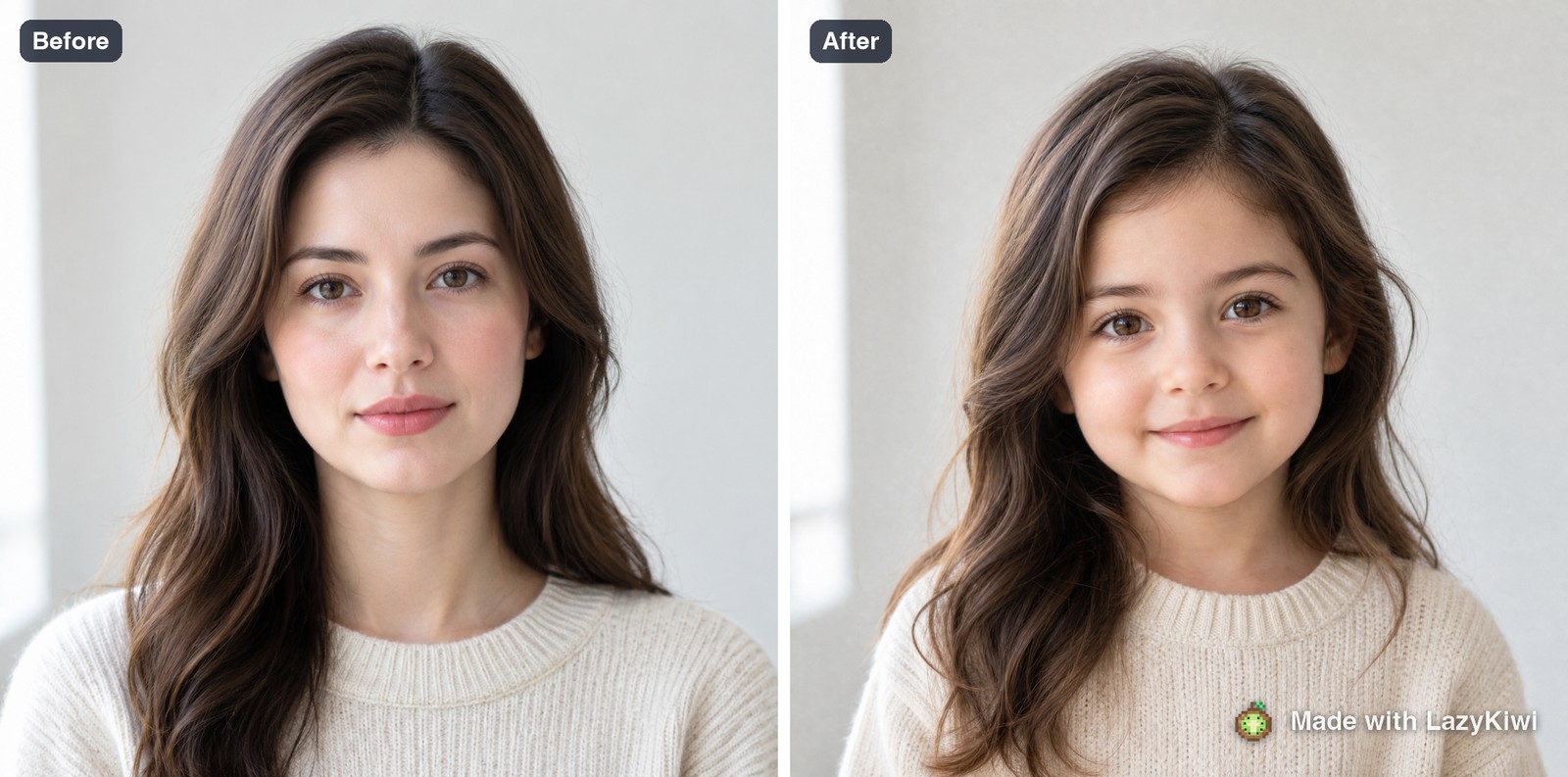
The output kept the hair colour, the eye colour, the knitwear and the background, and shrank the facial proportions convincingly. What it did not do is anything genetic. Everything in the workbench renders through GPT Image 2, which composes a new picture each time, so a second run on the same photo would return a different child.
For pregnancy portraits rather than child portraits, the pregnancy portrait template is the separate tool, and it has the same honesty requirement: it produces a photograph-styled image, not a scan.
Why do baby prediction results always look conventionally cute?
Because of what the models were shown. Photographs of infants and children that exist in quantity online are overwhelmingly smiling, well lit, symmetric and professionally or at least carefully taken. Nobody uploads the blurry unhappy ones.
- Expression: the training distribution is heavily skewed toward smiling, so the output smiles even when the input does not.
- Symmetry: generated faces are more symmetrical than real ones, which reads as attractive and as slightly unreal at the same time.
- Lighting: soft, even, frontal light dominates the reference images, so the result arrives lit that way regardless of your input.
- Age: the visual centre of gravity for child photography sits at a few years old, which is part of why our own run returned a young child rather than a newborn.
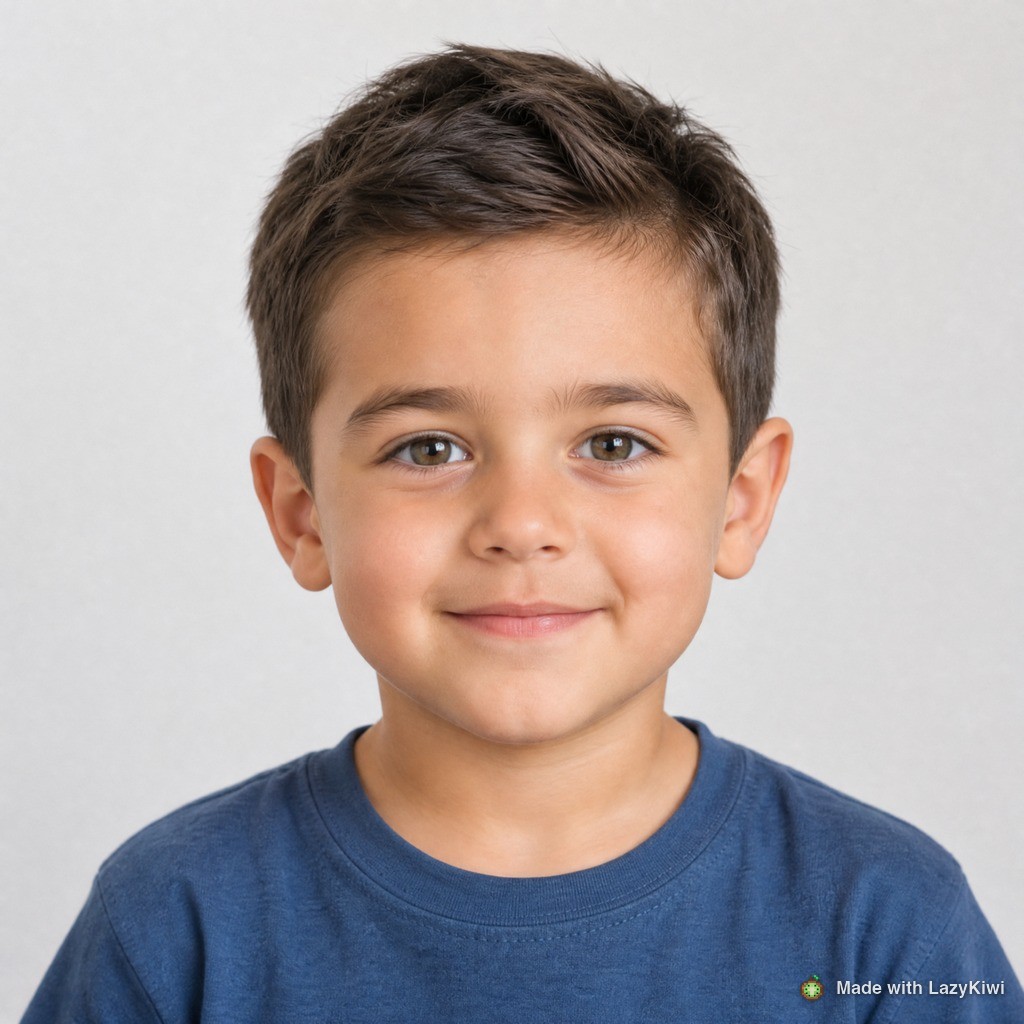
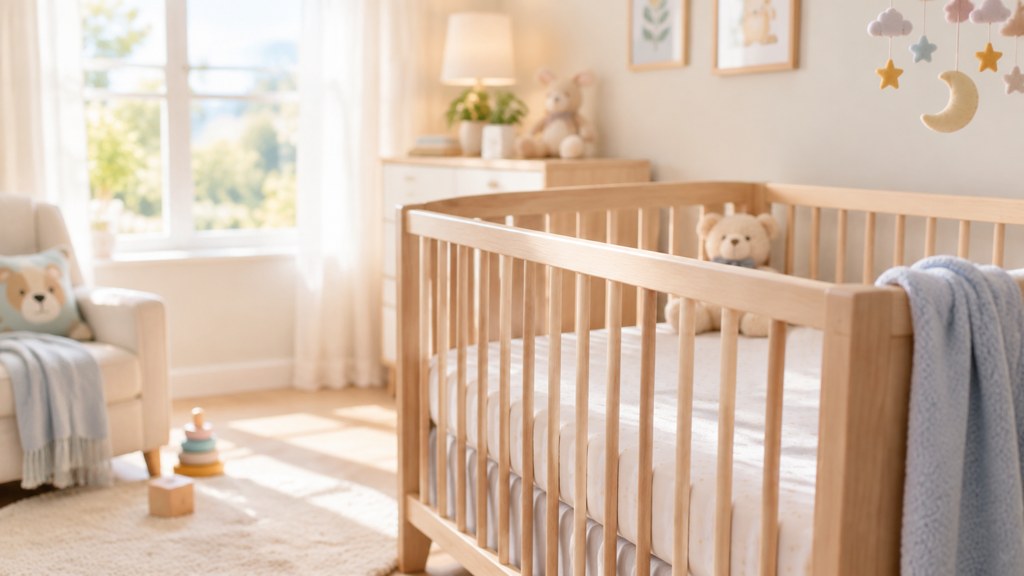
So a result that looks charming is telling you about the training data. It is not a forecast, and it is certainly not a compliment about your genes.
Is it safe to upload family photos to a baby generator?
Three rules, and the first is not negotiable.
- Never upload a photograph of somebody else's child. Not a niece, not a friend's baby, not a class photo. There is no version of this that is acceptable.
- Read the retention clause for your own face too. Picsart's privacy policy is the most explicit we found: it states that applying an effect to a face means the service scans your face geometry, which it calls biometric data, and that some collected information may be kept for up to three years after account closure.
- Reach for something you have already made public. A picture that is already on your own profile is the one upload that barely changes your exposure at all, whatever the terms happen to say.
The Fotor home page carries a plain answer on cost, and an AI baby generator sits in its tool list, but the obvious path to its privacy policy returned an error when we looked on 7 September 2026. Absence of a published clause is not the same as absence of a practice, which is exactly why the third rule above is the practical one.
A note from our own side. Safety checks run before a picture is made rather than after it, and they are the largest single cause of jobs that never complete: 49 blocked attempts across thirty days (LazyKiwi workbench data, August 2026).
How should you talk about a baby prediction image online?
Label it, and never let it stand in for a medical image. Two specific things go wrong.
- Presenting a generated image as a scan. A rendered face beside a pregnancy announcement invites exactly that reading, so say what it is in the caption rather than in a reply.
- Presenting it as a real child. An image of a supposed child that nobody can verify is a category people share quickly and question slowly.
Platforms have their own rules. Meta labels AI-generated images when it detects standard indicators or when a poster discloses, and to attach the disclosure to the file rather than to the caption, use Content Credentials, whose pin exposes how an image was made along with a record of its editing history.
Say what it is in the caption, not in a reply. A generated child gets shared long before anyone reads the thread.
— Maya Chen
What free baby generators exist and what do they cost you?
The word free usually means one of three things: a watermarked download, an account and an email, or an app install with a subscription behind the result. Here is what each of these said on its own page on 7 September 2026.
| Route | Its own page, today | What it actually asks of you |
|---|---|---|
| LazyKiwi baby template | 13 credits per 1K render, printed on the Generate button; a new account holds 40 credits | An account, and a correct expectation: one photo in, one child out, no blending |
| Fotor | Lists an AI baby generator among its tools, and answers the cost question in its FAQ with a free plan, no limit on images edited and downloads free of watermarks | That answer covers the editor; AI features are metered separately |
| Picsart | Plan grid opens at a discounted annual Pro tier with no free row shown | Payment, plus an explicit biometric clause in the policy |
| Quiz sites | Typically no published terms at all | Your answers, an email, and a stock illustration |
Anyone searching what would our baby look like is usually two people at a laptop wanting a laugh, and that is a perfectly good reason to run one. The searches phrased as what will my baby look like based on genetics are asking a different question, and the answer to that one is upstream: read MedlinePlus on how eye colour is actually inherited and the appeal of the calculator fades.
If you want to compare several inputs in one sitting, the templates all queue from the image generator page and land together in My Image. And if what you actually want is a resemblance exercise between two adult faces, our doppelganger tool does that job openly, without implying anything about a child.
Key takeaways
- Appearance is polygenic. MedlinePlus is explicit that even eye colour is not the single-gene trait it was once taught as.
- Blue-eyed parents can have a brown-eyed child, which is the shortest possible refutation of any prediction grid.
- The tools morph, generate or look up. None of them consults a genome, and all three are illustration.
- Our own baby template takes one photo, not two, and returns a young child rather than an infant. It cannot blend parents.
- Results look uniformly cute because the training photographs of children are uniformly smiling, symmetric and well lit.
- Never upload a photograph of someone else's child, and label anything generated before you post it.
Image & Design Editor
Maya Chen
Maya Chen writes the image side of the LazyKiwi blog. She tests every tool in the workbench on real photographs before she describes it, and prefers a measurement to an adjective.
FAQ
Common questions
What will my baby look like based on genetics, honestly?
Unknowable from the parents' faces. Most visible traits involve many genes at once, and MedlinePlus states that even eye colour, long taught as a simple dominant trait, needed a more complicated model once researchers looked properly. No calculator has access to anything better.
Can two blue-eyed parents have a brown-eyed child?
Yes. MedlinePlus states that although it is uncommon, parents with blue eyes can have children with brown eyes, precisely because multiple genes are involved. That single fact is enough to retire the square-grid model that most prediction quizzes are built on.
Does the LazyKiwi baby template blend two parents?
No. It takes one photograph and returns one younger version of that person, at roughly primary-school age rather than infancy. Running two people gives you two separate portraits side by side, which is a different thing from a blended child and the article says so.
Why does every result look like a smiling, symmetrical child?
Training data. The child photographs that exist online in quantity are overwhelmingly smiling, symmetrical and softly lit, so generated results inherit all three. A charming result tells you about the reference images rather than about any prospective child.
Is it safe to upload photos to a baby generator?
Use your own face, ideally a picture you have already published, and never a photograph of someone else's child. Read the retention clause first; Picsart's policy is the clearest example, naming a face-geometry scan as biometric data with a three-year post-closure window.
See the younger version of your own face
One photo, 13 credits, and a portrait that is honest about what it is: an illustration made from your features, not a prediction about a child.
Related reading

Celebrity Look Alike: How the Matching Works
What a celebrity look-alike tool measures, why two tools give you different answers, how to get a fair match, and the privacy questions worth asking first.
9 min read
How to Look Better in Photos: 5 Things That Work
Angle, posture, light, wardrobe and edit — in that order. The five variables that actually change how a photo of you reads, and how to test each one.
9 min read
How to Make an AI Baby Meme (Video and GIF) in 2026
Where the AI baby meme came from, how to make the image, video and GIF versions from one photo, caption formats that land, and the label rules per platform.
9 min read