
What Is the Rarest Eye Color? Ranked by Data
The rarest eye color, ranked with every figure attributed: green, grey, amber and true violet, why melanin decides it, and how to identify your own.
 Maya Chen 9 min read

Green is the rarest eye color in the general population: about 2 percent of people worldwide have it, with grey next at around 3 percent, according to Wikipedia's eye color article read on 7 September 2026. Violet and red are rarer still, but they are not really colours in the same sense, since both come from albinism rather than from pigment. Below is the ranking with each figure attributed, why the distribution is so lopsided, how to work out your own colour in the right light, and how to preview a different one in a photo.
What is the rarest eye color in the world?
Ranked by prevalence, the rarest eye color is green, then grey, then the categories nobody counts consistently: amber and hazel, followed by blue and brown. Every figure below comes from Wikipedia's eye color article as it stood on 7 September 2026, and each is worth treating as an estimate rather than a census, because classification itself is inconsistent.
| Colour | Share of people | Source note |
|---|---|---|
| Green | About 2 percent worldwide | Described there as the rarest human eye colour |
| Grey | About 3 percent | Called the second-rarest natural colour after green |
| Amber and hazel | No global figure given | Both often folded into brown or green in surveys |
| Blue | No single global figure | Concentrated in northern Europe rather than evenly spread |
| Brown | About 79 percent | By far the most common, and near-universal in some regions |
| Violet or red | Under 1 percent | Occurs through albinism, not through pigment |
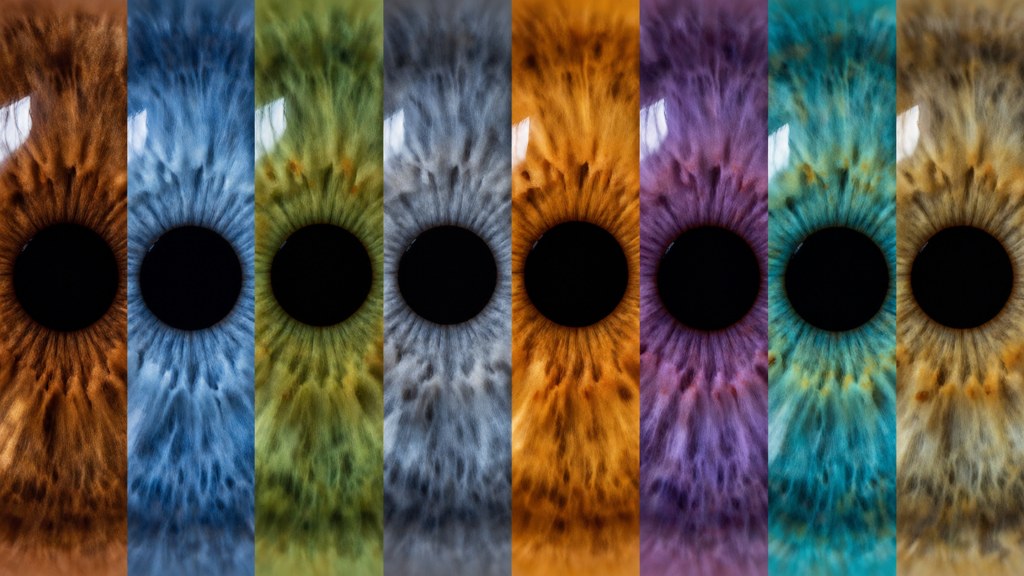
Two cautions before anyone quotes a number from an eye color chart. Regional figures move enormously: the same article records around 8 to 10 percent of men and 18 to 21 percent of women in Iceland having green eyes, and 6 percent of men against 17 percent of women in the Netherlands. And plenty of people sit between categories, which is why survey totals rarely agree.
Why is eye color so uneven across the world?
Because one pigment does most of the work, and the genes that regulate it vary by population. MedlinePlus, the US National Library of Medicine's genetics resource, explains that colour comes from pigmentation of the iris, ranges on a continuum from very light blue to dark brown, and is directly related to how much melanin sits in the front layers of the iris. It also states plainly that brown is the most frequent eye colour worldwide.
- A region of chromosome 15 carries OCA2 and HERC2, two genes sitting very close together, and that pair does most of the heavy lifting.
- OCA2 produces the P protein, which governs how much melanin ends up in the iris; common variants reduce it, which is what produces blue rather than brown.
- A stretch of HERC2 known as intron 86 switches OCA2 expression up or down.
- Several other genes contribute smaller effects, among them ASIP, IRF4, SLC24A4, SLC24A5, SLC45A2, TPCN2, TYR and TYRP1.
- The old one-gene model, where two blue-eyed parents could not have a brown-eyed child, is described there as too simplistic; it happens, though it is uncommon.
That is why answers to what is my eye color can be genuinely ambiguous. The output is a continuum produced by many small genetic contributions, and we then force it into five or six named buckets.
How rare is green, amber, grey or hazel?
Green and grey have published estimates. Amber and hazel mostly do not, and the reason is definitional rather than scientific.
- Green sits at roughly 2 percent globally, and the colour comes from a yellowish pigment called lipochrome combined with the blue produced by light scattering in the iris.
- Grey is put at about 3 percent, and grey irises contain small amounts of yellow and brown.
- Amber carries the same lipochrome, showing as a golden or coppery tint that is most obvious in sunlight.
- Hazel is the awkward one: in looser modern usage it means a brown and green mix, which anthropology historically classed simply as a mixed colour.
- Because amber and hazel get absorbed into brown or green in most surveys, any percentage you see for them is someone's rounding rather than a measurement.
share of people with green eyes worldwide, per Wikipedia's eye color article, read 7 September 2026
So the honest ranking of the rarest eye color depends on where you draw the category lines, which is the single most useful thing to know before arguing about it.
What color are my eyes if they look different in different light?
They are one colour. What changes is the light hitting them, and irises with less melanin change appearance the most, because more of what you see is scattered light rather than pigment.
- 1
Go to a window in daylight
Indirect daylight, not direct sun, and not within a metre of a coloured wall.
- 2
Face the light, do not look into it
Turn towards the window so the iris is lit evenly and the pupil is a normal size.
- 3
Take off any make-up around the eye
Strong liner and shadow shift the perceived hue more than most people expect.
- 4
Look at the outer ring and the inner ring separately
Many irises are two-toned, with a darker limbal ring outside and a warmer centre.
- 5
Photograph it, then check indoors
Compare the same eye under a warm bulb. The difference you see is the light, not the eye.
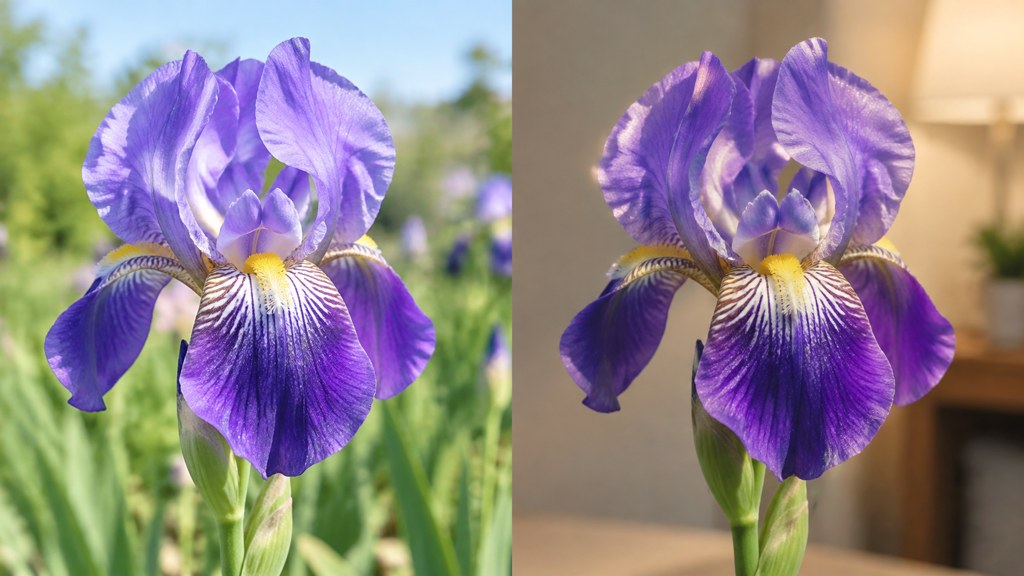
The clothing effect is real
A green top makes hazel eyes read green, and a blue scarf pushes grey towards blue. If you are trying to settle what color are my eyes once and for all, wear something neutral while you look.
Are violet, red or black eyes real?
Partly, and not in the way the internet suggests. The Wikipedia article is specific on this: eyes may appear red under some lighting in severe forms of albinism, because there is so little melanin that blood vessels show through, and truly violet eyes occur only through albinism. Deep blue eyes can look purple in certain conditions without being violet.
- Red or violet appearance from albinism affects under 1 percent of the world's population.
- The red-eye effect in flash photography is a different thing entirely: bright light bouncing off the retina.
- Black eyes are very dark brown. Photographed in low light, a dark iris and a wide pupil merge into one shape.
- Any colour that appears in one photo and never in daylight is a lighting artefact rather than a discovery.
Albinism is a medical condition rather than an aesthetic category, and Mayo Clinic's page on albinism is the place to read about it properly rather than a listicle about rare eyes.
What is heterochromia and how common is it?
Heterochromia iridum is having two differently coloured eyes, and the same article puts it at under 1 percent of the world's population, in humans and in some breeds of domesticated animals.
- Complete heterochromia: the two irises are different colours.
- Sectoral heterochromia: one wedge of a single iris differs from the rest.
- Central heterochromia: an inner ring of a different colour, which is extremely common and often mistaken for the sectoral kind.
- Some cases are present from birth; others follow injury, inflammation or a medical condition.
That last point is the one that matters. A colour difference you have always had is a trait. A colour change that appears later, or arrives with pain, redness or a change in vision, is a reason to see an eye doctor rather than to post a photo. The American Optometric Association leads its eye-care guidance with comprehensive exams by a doctor of optometry, and that is the correct next step here.
Can you change your eye color safely?
Nothing you do at home changes the pigment in your iris. What people actually mean is one of three things, and they carry very different levels of risk.
- Coloured contact lenses: medical devices, whether or not they correct vision. They need a proper fit and a prescription from an eye-care professional, and lenses bought as a costume accessory are the ones that cause problems.
- Surgical iris implants and laser depigmentation: marketed cosmetically, and treated with considerable caution by eye-care bodies. This is a conversation for an ophthalmologist, not for a search result.
- Photo editing: changes the picture, not the eye, which is the only fully risk-free option in this list.
- Anything that promises a permanent change through drops or exercises: not something to spend money on.
For the clinical side of any of this, go to the source rather than to a summary. The American Academy of Ophthalmology publishes patient guidance on what determines eye colour, and Cleveland Clinic's health library covers the conditions that can alter it. Nothing in this article is medical advice.
How do you change eye color in a photo?
This is the safe version, and it is a good way to preview a lens colour before buying anything. Here is a real run in the LazyKiwi workbench, done with the eye color changer on 7 September 2026. One thing to know before you start: there is no colour picker in the composer. Each shade is a separate instruction typed into the Prompt box, followed by its own Generate.
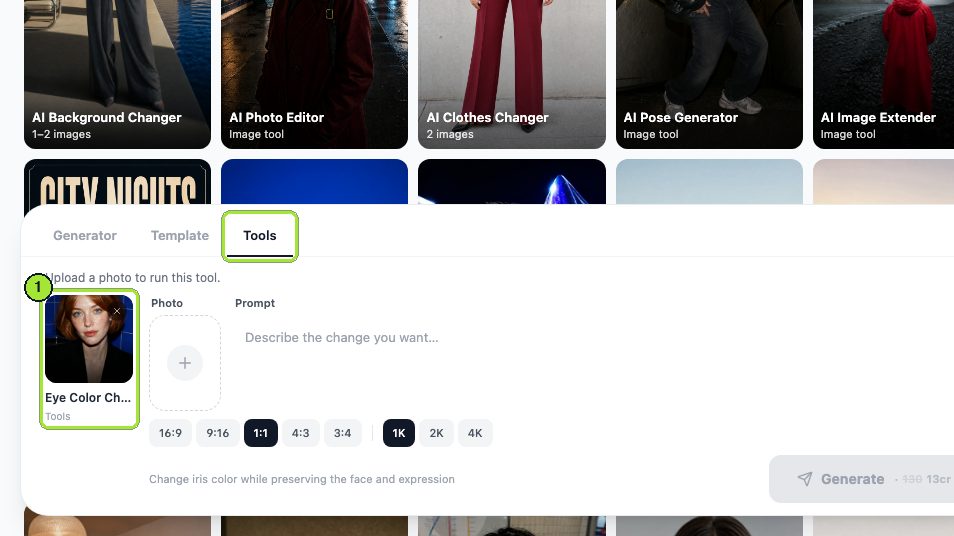
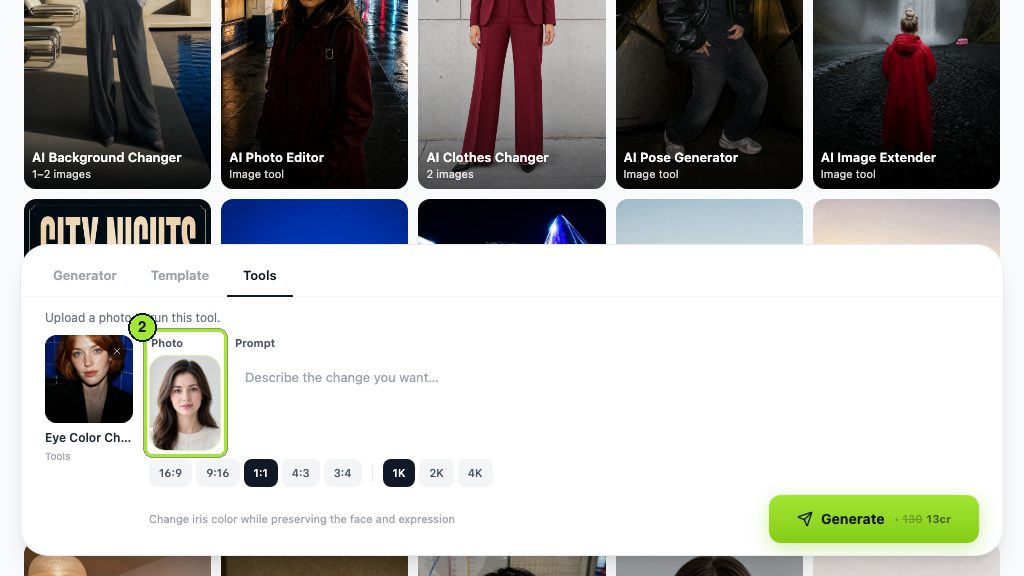
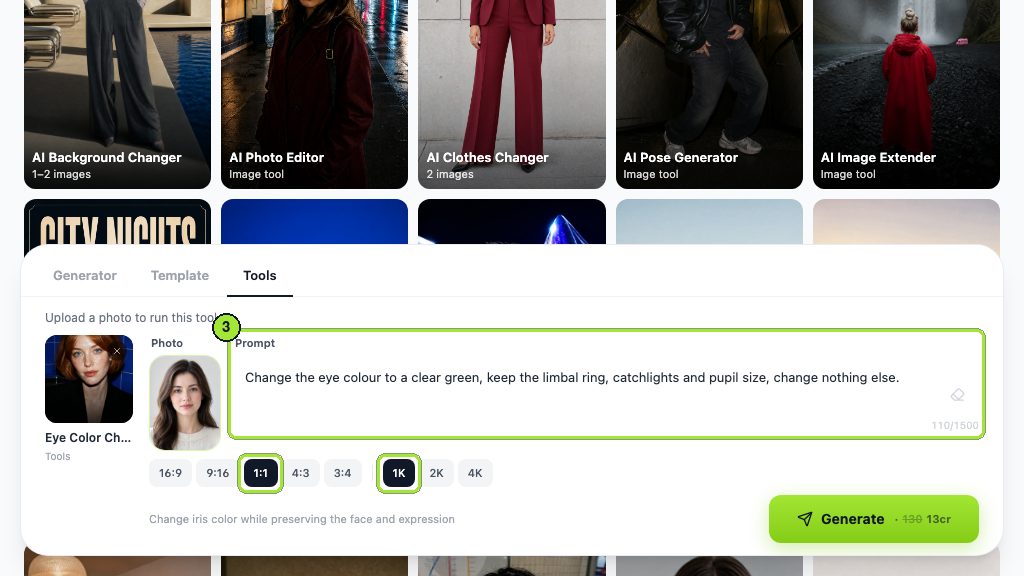
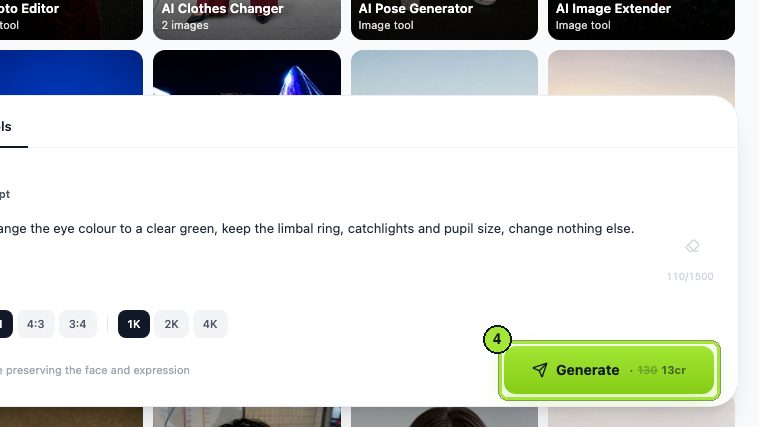
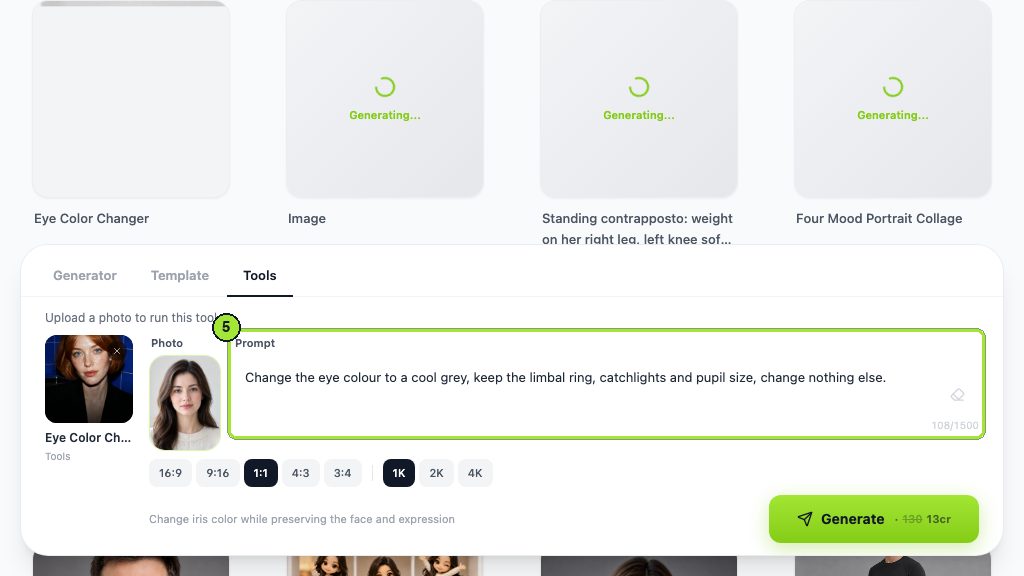
- 1
Name the shade precisely
A clear green, a cool grey, amber. Vague colour words produce a flat contact-lens look.
- 2
Protect the eye anatomy in the same sentence
Ask for the limbal ring, the catchlights and the pupil size to be kept. This is the difference between a believable iris and a painted one.
- 3
Say what must not change
Adding 'change nothing else' keeps skin, hair and lighting out of the edit.
- 4
Run each shade separately
Three colours means three prompts and three renders; there is no swatch row to click.
- 5
Judge it at full size
Open the result rather than the thumbnail, and look at the pupil edge first.
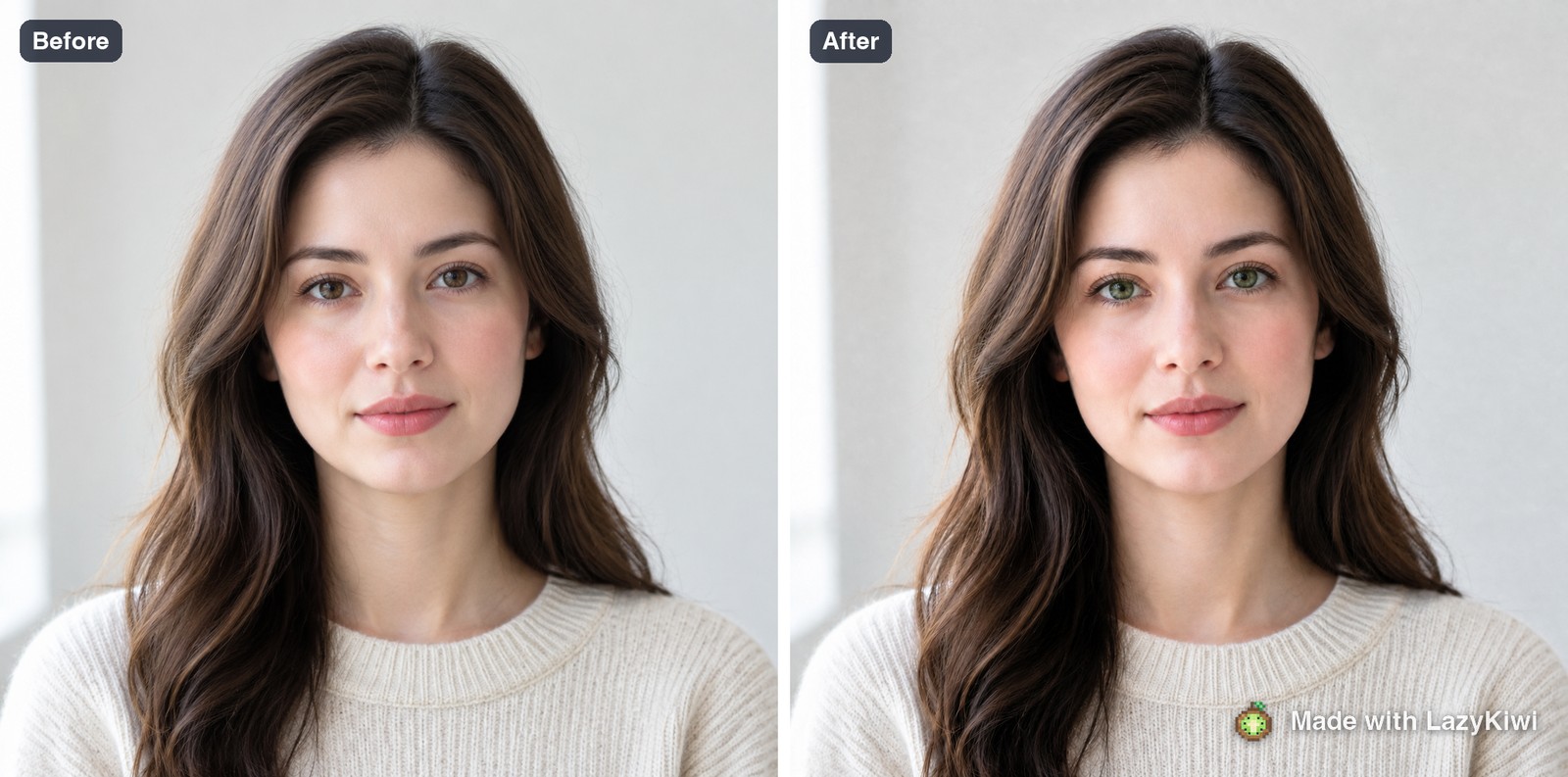

Three shades cost 39 credits in total on that session, all on GPT Image 2 at 1K. If a portrait needs other work first, such as exposure or skin texture, do it in the AI photo editor from the Tools tab of the image workbench before recolouring, since a corrected photo gives the recolour a cleaner iris to work from. Square framing suits this job, and in LazyKiwi's workbench data (August 2026) 1:1 accounted for 124 of 143 external image jobs, which matches where these end up.

Two closing rules. Label an edited portrait as edited when it might be taken for a real photo of a real person, and never use a recolour to imply a medical result. If you came here from an eye color quiz, treat that as entertainment: the categories it sorts you into are the same loose buckets the surveys argue about.
Key takeaways
- Green is the rarest eye color among the ordinary categories, at about 2 percent worldwide, with grey next at about 3 percent.
- Brown covers roughly 79 percent of people, so the question is really about the thin end of a very lopsided distribution.
- Colour comes from melanin in the iris, governed mainly by OCA2 and HERC2 with several smaller genes contributing.
- True violet and red appearances come from albinism, not pigment, and affect under 1 percent of people.
- A colour change that appears later in life belongs with an eye doctor, not in a photo caption.
Image & Design Editor
Maya Chen
I spend my days inside image tools, testing prompts and settings on real photos so the steps here match what you actually see on screen.
FAQ
Common questions
Which is the rarest eye color, green or grey?
Green, on the figures published in Wikipedia's eye color article: about 2 percent of people worldwide against roughly 3 percent for grey, which the same page calls the second-rarest natural colour. Both estimates depend on where the boundary between categories is drawn.
Are violet eyes real?
Only through albinism. Deep blue eyes can look purple under some lighting without being violet, and eyes that appear red or violet because of albinism occur in under 1 percent of the world's population. Photographs that show violet in one shot and blue in the next are showing you the lighting.
Why do my eyes look green some days and grey on others?
Because lighter irises show more scattered light and less pigment, so surroundings change how they read. Clothing colour, make-up and whether you are in daylight or under a warm bulb all shift the apparent hue. Check in indirect daylight wearing something neutral.
Can two blue-eyed parents have a brown-eyed child?
Yes, though it is uncommon. MedlinePlus describes the old single-gene model, in which that was thought impossible, as too simplistic, because many genes contribute. Predictions from family eye colours are usually right and sometimes produce unexpected results.
Is changing eye colour in a photo the same as a filter?
Close, but the useful version keeps the anatomy. Ask the tool to preserve the limbal ring, the catchlights and the pupil size while it recolours the iris. Without that instruction you get a flat coloured disc that reads as a cheap contact lens rather than an eye.
Preview a shade before you buy lenses
Upload one clear headshot, describe the colour you want, and keep the catchlights and iris texture intact.
Related reading
How to Look Better in Photos: 5 Things That Work
Angle, posture, light, wardrobe and edit, in that order. The five variables that actually change how a photo of you reads.
8 min read
What Is My Face Shape? A Measured Self-Test
Measure four numbers, get one answer. The tape-measure method, the six shapes, and what each one changes about hair and glasses.
8 min read
Celebrity Look Alike: How the Matching Works
What a look-alike tool measures, why two tools give different answers, how to get a fair match, and the privacy questions worth asking.
8 min read
What Will My Baby Look Like? Genetics vs AI
What genetics can and cannot predict about a baby's face, why every prediction tool is entertainment, and how the AI versions build the image.
8 min read