
Beard Styles by Face Shape: A Practical List
Fourteen beard shapes sorted by what they do to a jawline, matched to face geometry, and a real preview of the shave direction before you commit.
 Maya Chen 9 min read
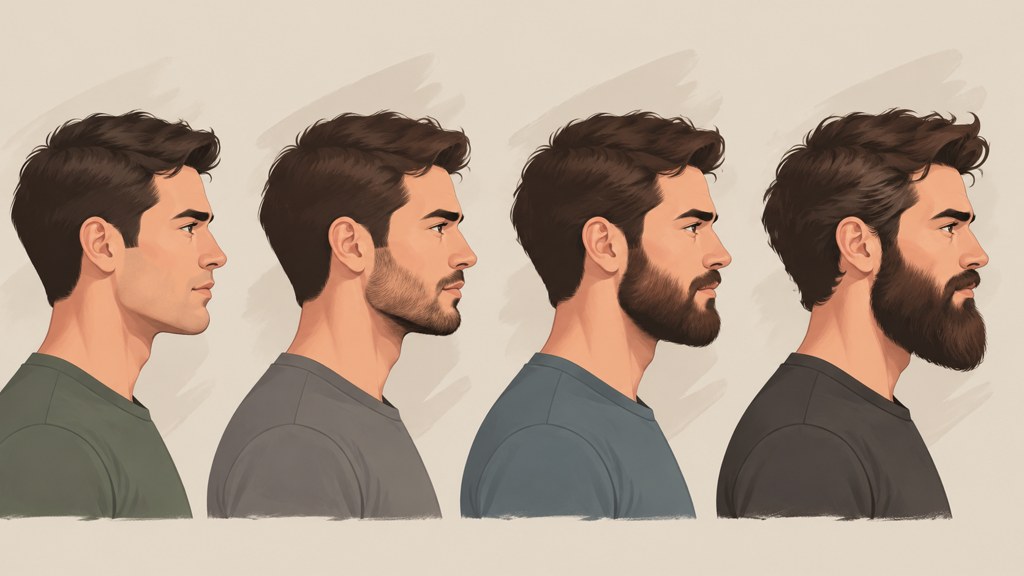
Every beard does one of four jobs: it lengthens the face, widens the jaw, sharpens the jaw, or hides it. Sort the shapes by that and choosing one stops being a taste question. Pick the axis you want to move, pick a shape from that group, then check it against the length of your face rather than against a photograph of somebody else. Below are fourteen shapes in four functional groups, the pairing table, the four-week reality of growing one, a preview of the clean-shaven direction we actually ran, and the home-trimming rules that prevent the two mistakes everybody makes.
What are the main beard styles and what do they change?
Names date. Function does not. These fourteen cover almost everything a barber will offer, grouped by the thing they change rather than by the decade they came from.
| Job it does | Shapes in this group | Who it helps |
|---|---|---|
| Lengthen the face | Goatee, Van Dyke, anchor, extended goatee | Round and square faces that want a vertical line |
| Widen the jaw | Full beard, garibaldi, mutton chops, friendly mutton chops | Narrow, heart and diamond faces that want width low down |
| Sharpen the jaw | Boxed beard, corporate beard, ducktail, short boxed | Softer jaws that want a defined edge drawn in |
| Add texture without shape | Stubble, heavy stubble, chinstrap, circle beard | Anyone testing the idea before committing four weeks |

Two of those groups are opposites, which is why so much advice contradicts itself. A goatee and a full beard are not two flavours of the same thing; one adds length at the chin and the other adds width at the cheek. Deciding which direction you want first removes about ten of the fourteen options immediately.
Which beard style suits your face shape?
One rule beats the table below, so learn it first: a beard adds apparent length at the chin and apparent width at the cheek. Choose the axis you want to change and everything else follows.
| Face shape | What it needs | Shapes that deliver it | Shape to skip |
|---|---|---|---|
| Oval | Nothing in particular | Most shapes at a moderate length | Anything very long, which turns oval into oblong |
| Round | Vertical line, narrow at the sides | Goatee, Van Dyke, short boxed with tight cheeks | Full round beard, mutton chops |
| Square | Softened corners, some length | Circle beard, ducktail, rounded short boxed | Chinstrap, which traces the corner you are trying to soften |
| Heart | Weight at the jaw | Full beard kept wide and short, garibaldi | Narrow goatee, which sharpens an already pointed chin |
| Diamond | Width at chin and forehead, not cheek | Boxed beard, full beard trimmed flat at the cheek | Anything that peaks at the cheekbone |
| Oblong | Width, never length | Mutton chops, wide short beard, heavy stubble | Goatee, ducktail, anything that extends below the chin |
If you do not know your proportions, four tape measurements settle it, and our face shape post covers the method. The pairing above assumes an accurate answer, because the difference between an oval and an oblong is exactly the difference between a ducktail working and a ducktail dragging your face down.
How do you know if a beard will suit you before growing it?
Four weeks. That is the honest entry price for judging a full beard, and most people abandon it in week two, when the growth is uneven and itchy and looks like neither a beard nor a shave.
- 1
Weeks one and two: do nothing
Do not trim, do not shape, do not fix a patch. Growth rates differ across the face and the gaps you see now are mostly a matter of timing rather than density.
- 2
Week three: the patch test
Now look at where growth is genuinely thin. Cheeks and the corners of the mouth are the usual answers, and they decide whether a full beard or a chin-led shape is realistic for you.
- 3
Week four: first shape-up
Set the neckline and the cheek line for the first time, and only then judge the beard. Anything you judge before this is unshaped growth, not a style.
- 4
Any time: preview the endpoint
This is the step that makes the four weeks survivable, and it is also the step that tells you not to bother if the answer is obviously wrong.
Searches like how beard styles work, how to trim beard styles and how to fade beard styles all resolve to those same four stages plus two lines on your face. And the answer to how many beard styles are there is that the count is arbitrary; the four functional groups above are the part that matters.
How do you preview a beard or a clean shave on a photo?
Both directions are possible and they are not equally reliable. Removing a beard is the easier problem: the model has the jaw outline, the skin tone and the shadow to work from. Adding one means inventing density, direction and a growth pattern it cannot see. So the shave preview is the one to trust.
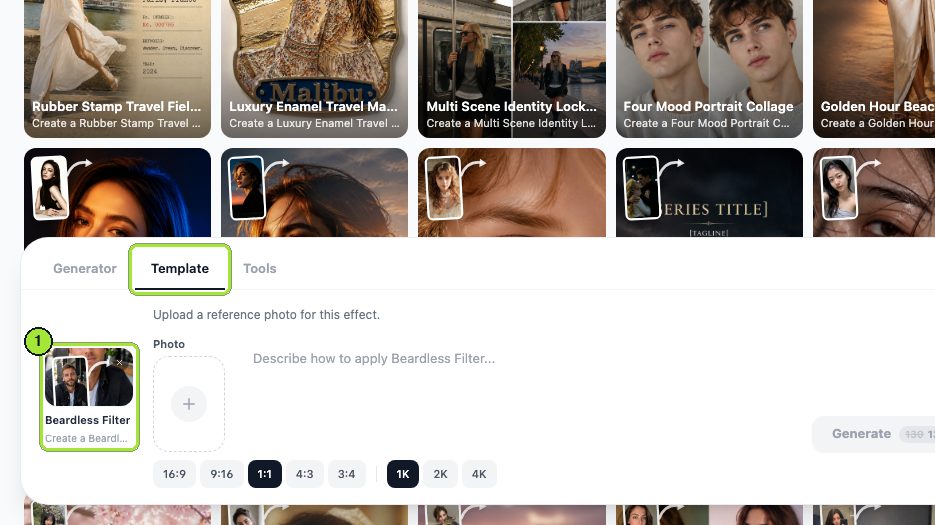
We ran the shave direction through the beardless filter template on 7 September 2026.
- 1
One photo, template selected
Templates sit on their own tab beside Generator and Tools. This one takes a single upload and needs nothing typed.
- 2
1:1 and 1K
Square framing keeps the crop on the jaw, which is the only area you are assessing.
- 3
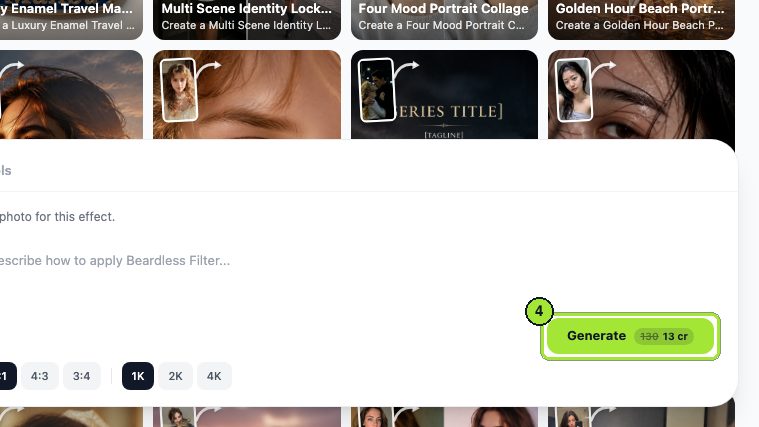
Generate for 13 credits
The figure is printed on the button. One render, one card in My Image, and the whole run cost 13 credits.

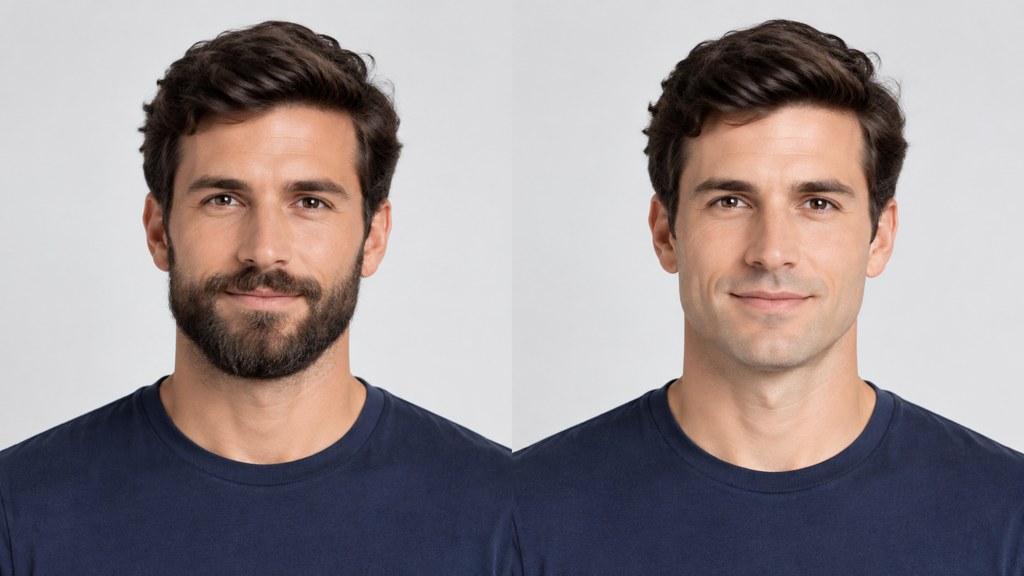
That result is more informative than it first looks. Without the beard the jaw reads narrower and the face reads longer, which is a direct measurement of what the beard was contributing: width low down and a shortening of the visible face. If you like the longer, narrower reading, you want a chin-led shape or nothing. If you miss the width, you want a full shape kept wide and short.
For the other direction, adding length rather than removing it, the hairstyle changer accepts a prompt describing facial hair alongside the cut. Treat it as a mood board rather than a forecast: it renders even, idealised growth, and your actual pattern is the thing it cannot know. Everything here runs through GPT Image 2.
How do you trim and shape a beard at home?
Two lines do ninety per cent of the work, and both are drawn in the wrong place by most people.
- The neckline sits about two finger widths above the Adam's apple, curving up to behind each ear. Set it at the jaw and you lose the jaw entirely, which is the most common self-inflicted error in this whole article.
- The cheek line follows your natural growth edge, softened rather than drawn. A hard straight line high on the cheek reads as a mistake from three metres away.
- Work in guard numbers by zone: longest at the chin, one number shorter at the jaw, another shorter at the temple. That is a fade, and it is the only way a short beard reads as a shape rather than as stubble.
- Trim dry, never wet. Wet hair sits longer than it dries, so a wet trim is always shorter than you intended.
- The two jobs to leave alone: a genuine fade into the hairline, and any corrective work on an uneven neckline you have already cut too high.
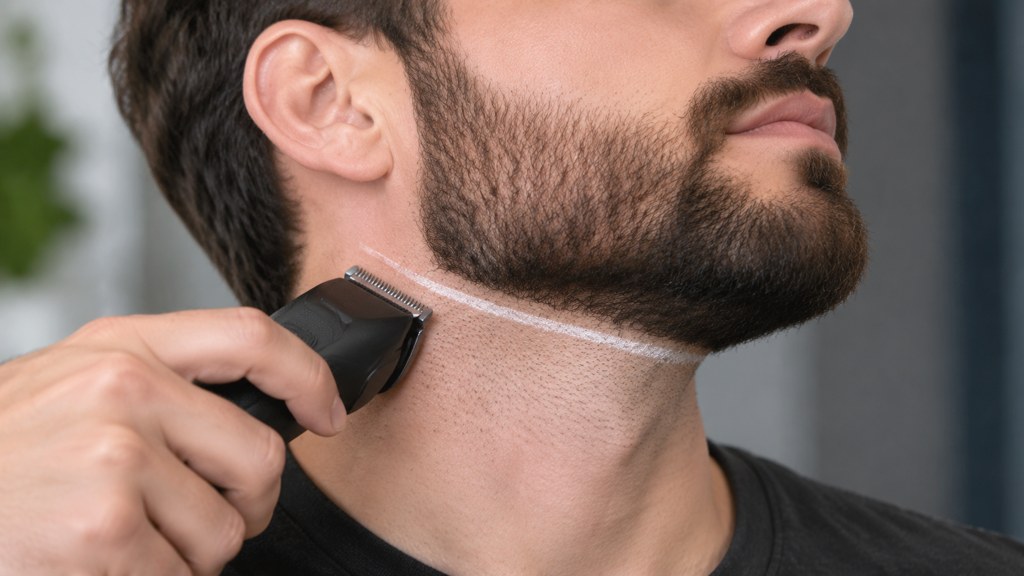
On guard numbers: clipper attachments step up in eighths of an inch, and Wahl's own guide comb chart lists a #1 at an eighth and a #4 at half an inch. Beard trimmer guards do not always follow that scale, so read the chart that shipped with your own trimmer rather than assuming. Blades are a separate purchase, because no trimmer sets a clean neckline on its own. On 7 September 2026 the Dollar Shave Club catalogue priced its twin blade at 6 US dollars and its six-blade handle at 10, with free shipping above 18.
Wash it like hair, because it is hair
The American Academy of Dermatology's guidance to limit heat and to match washing frequency to hair type applies below the jaw as well as above it. Beard hair is coarser and drier than scalp hair, so it takes conditioner better than it takes daily detergent.
How do you remove a beard from a photo?
This comes up for a practical reason: you need a clean-shaven headshot for a role or a document and you have a beard today. The technical answer is the run above. The honest answer has a limit attached.
- For a mood board, a mock-up or your own decision-making, remove beard from photo freely. Nobody is misled.
- For a professional profile, the edited version should still be a photograph of how you look when you turn up. A beard is a reversible fact about your face, so the picture will be true again the day you shave.
- For an identity document, do not do it at all. Those have their own rules and an edited photograph fails them.
- For anyone else's face, get their agreement first. That is the same rule that applies to every face tool on this site.
A beard filter is a low-stakes version of the same operation, and treating it as a decision aid rather than as a photograph you publish is the difference between the two. General health explainers such as Healthline and the grooming service pieces at Reader's Digest cover the skin side of shaving, which is the part a preview cannot show you at all.
Which beard styles are actually current right now?
We are deliberately not naming this season's shape. Anything printed here in September 2026 would be stale by the time most readers act on it, and a trend claim without a dated source is worse than no claim at all.
Check it yourself on the day. The grooming desks at GQ, Esquire and Men's Health all run dated coverage, and a dated headline is the only kind worth acting on. Then read what they describe through the four groups above, because a named trend is nearly always one of those four jobs with a new label on it.
A named trend is almost always one of four jobs wearing a new label. Learn the jobs and the labels stop mattering.
— Maya Chen
The one structural change worth noting is durable rather than seasonal: video calls and phone cameras both flatten the face, which quietly favours shapes with a defined edge over shapes that fade into the neck. That has been true since the cameras became the main way people see each other and it will not reverse next season.
What are the most common beard mistakes?
Four, in order of how often we see them and how long they take to fix.
- 1
Neckline too high
Cutting along the jaw rather than above the Adam's apple. It removes the jaw definition the beard was supposed to provide, and takes two to three weeks to grow back.
- 2
Cheek line too low
Shaving down onto the cheek to tidy stray hairs narrows the beard and undoes any width you wanted. Same recovery time, less obvious to the person who did it.
- 3
Uneven fade between zones
Jumping two guard numbers between the chin and the temple leaves a visible step. Move one number at a time and blend the boundary.
- 4
Trimming wet
Everything sits longer wet than dry. Every wet trim is shorter than intended, and the correction is another wet trim, which is shorter again.
The preview run above prevents none of these, and that is worth saying plainly. It answers the shape question, not the execution question. What it does prevent is the larger mistake of spending four weeks growing something that was never going to suit the length of your face. If you are weighing this against going shorter everywhere, our buzz cut filter covers the head half of the same decision.
Key takeaways
- Every beard does one of four jobs: lengthen the face, widen the jaw, sharpen the jaw, or hide it. Choose the job first.
- A beard adds apparent length at the chin and apparent width at the cheek. That single rule outranks any pairing table.
- Judging a full beard honestly takes four weeks, with no trimming at all in the first two.
- The shave preview is the reliable direction: removing a beard uses information in the photo, adding one invents it.
- Our beardless run cost 13 credits at 1:1 and 1K, and showed the jaw narrowing and the face lengthening without it.
- Neckline two finger widths above the Adam's apple, cheek line on your natural edge, and never trim wet.
Image & Design Editor
Maya Chen
Maya Chen writes the image side of the LazyKiwi blog. She tests every tool in the workbench on real photographs before she describes it, and prefers a measurement to an adjective.
FAQ
Common questions
Which beard style suits a round face?
Something that adds a vertical line and keeps the sides narrow: a goatee, a Van Dyke or a short boxed beard with the cheeks kept tight. Avoid a full round beard or mutton chops, which add width exactly where a round face already has it.
How long does it take to know if a beard suits me?
Four weeks, with no trimming in the first two. Growth rates differ across the face, so the gaps visible in week two are usually timing rather than density. Set the neckline and cheek line at week four, and judge the beard only after that first shape-up.
Can a beard filter show what I would look like with a full beard?
It shows a shape, not your growth pattern. Rendered facial hair is even and idealised, while real growth is patchy in specific places that no tool can see from a clean-shaven photo. Use it for direction, then rely on the four-week test for density.
Is it acceptable to remove a beard from a photo for work?
For your own planning, yes. For a professional profile, the edited picture should still match how you turn up, and a beard is reversible so it will be true again once you shave. For any identity document, do not edit at all, since those have their own rules.
Where should the neckline of a beard sit?
About two finger widths above the Adam's apple, curving upward to behind each ear. Setting it along the jaw is the most common self-inflicted mistake in beard trimming, because it removes the jaw definition the beard was meant to create, and it takes weeks to grow back.
See the shave before you decide to keep it
One photo through the beardless template for 13 credits shows exactly what your beard is adding to the jaw, which is the number the mirror never gives you.
Related reading
What Is My Face Shape? A Measured Self-Test
Measure four numbers, get one answer. The tape-measure method, the six shapes, and what each one changes about hair, glasses and camera angle.
9 min read
Buzz Cut Lengths: Guard Numbers 1 to 8 Compared
What each clipper guard actually leaves in millimetres, how much scalp shows at each number, and how to pick a length you will not regret in week two.
9 min read
Gender Swap Filter: How to Use It Safely
Where the gender swap filter lives on each platform, how to get a result that still looks like you, and what happens to the photo you upload.
9 min read
How to Look Better in Photos: 5 Things That Work
Angle, posture, light, wardrobe and edit — in that order. The five variables that actually change how a photo of you reads, and how to test each one.
9 min read