
AI Stylist Apps: Which Ones Actually Help
AI stylist apps judged against three briefs: interview, dinner and a week of travel. What the category answers well, and what none of it can see.
 Marcus Tan 9 min read
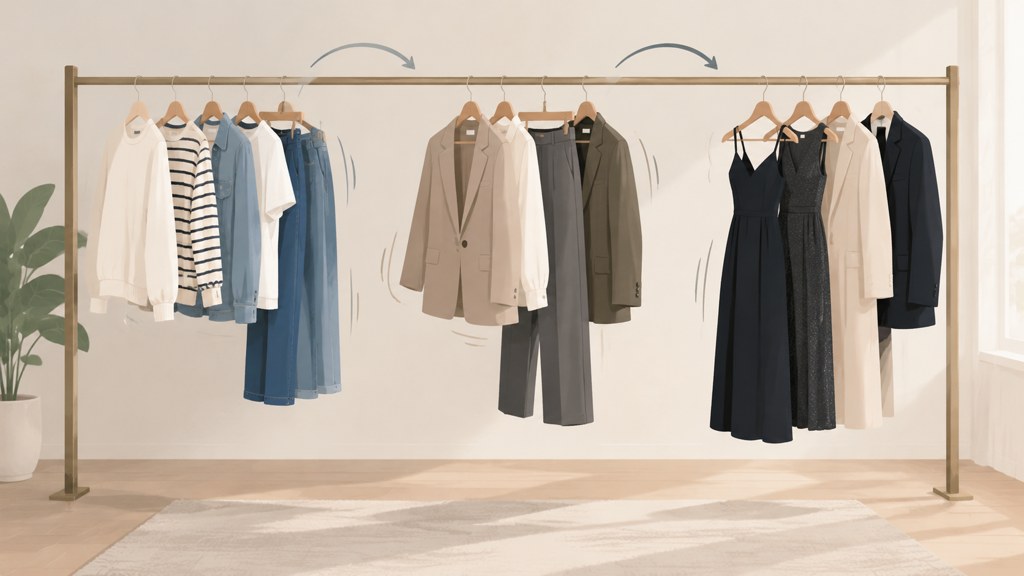
An AI stylist is one of three unrelated products wearing the same label: a wardrobe catalogue you photograph yourself, a recommender that runs on top of one, or a generator that draws look boards and owns nothing. Most tools are the third kind, because it asks nothing of you, and the third kind is the one that cannot tell you what to wear on Tuesday. Below: five questions that sort the field, the apps compared on published capability against three briefs, with free tiers read on their own pages today, a look-board run showing what generation does and does not answer, and the four constraints every one of them missed.
What does an AI stylist actually do?
Three unrelated products sit behind the phrase, and picking the wrong one is why people conclude the whole category is useless.
- 1
Wardrobe cataloguing
You photograph what you own, the app tags it, and everything afterwards runs against that catalogue. The work is entirely up front, and it is more work than anyone expects.
- 2
Outfit recommendation
Given a catalogue and an occasion, it proposes combinations. This is the part people mean when they say styling, and it is only as good as the tagging underneath it.
- 3
Generated look boards
No catalogue at all. It draws a look you might buy or copy. Useful for direction, useless for getting dressed on Tuesday with what is in the wardrobe.
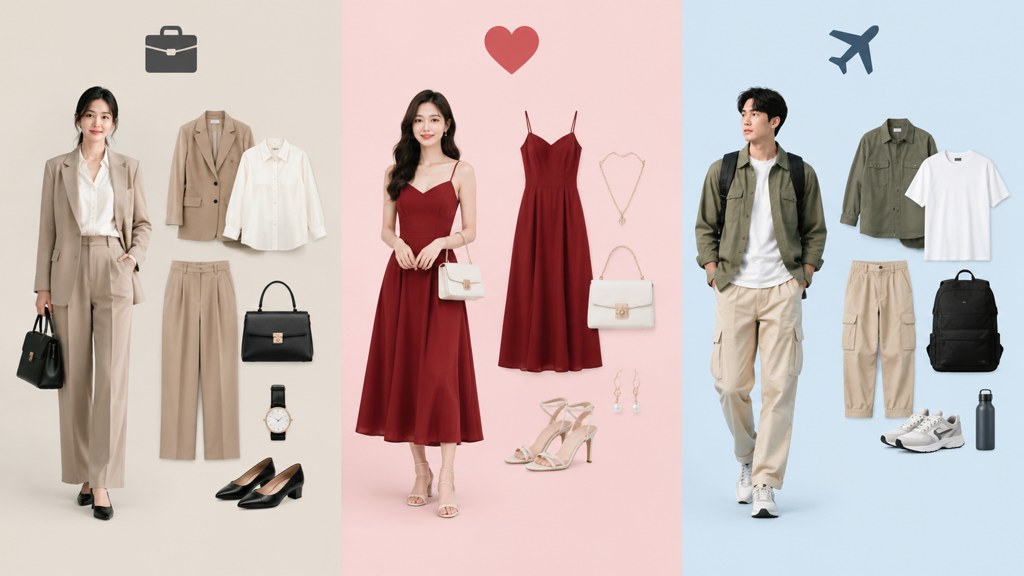
The third kind is the one most tools actually are, because it needs nothing from you. The first kind is the one that would genuinely help, and it is the one that asks for an evening of photographing jumpers.
A note on search intent, because it collides here: results for what is stylist haircut are about hairdressing rather than wardrobe. Two professions, one word, and no app covers both.
How should you judge one of these apps?
Five questions, in the order that eliminates the most candidates fastest.
- Does it work from your real wardrobe, or from a catalogue you cannot buy from? If it recommends items you do not own and cannot afford, it is a shopping feed.
- Does it understand occasion? Interview, funeral, first date and site visit are different problems, and a tool that treats them as a colour palette is not doing the job.
- Does it handle body and climate? Fit and weather are the two constraints that decide whether an outfit is wearable, and they are the two most often ignored.
- What does it cost, and what does the free tier actually let you do? Free tiers here tend to cap generations rather than features.
- Where do your photographs go? You are uploading pictures of yourself and the inside of your home. Read the privacy policy before the wardrobe upload, not after.
Test with a brief, not a vibe
Give every candidate the same three jobs and compare the answers side by side. Vague browsing makes every tool look competent; a specific brief makes the differences obvious within two minutes.
AI stylist tools compared one by one
Three briefs are the ones worth judging this category against: a first-round interview at a mid-sized company, a dinner where the other person chose the restaurant, and a week of travel in changeable weather with hand luggage only. What follows is published capability, read on each vendor own page on 7 September 2026, plus the one look-board run I made myself in the workbench further down.
| Tool | Category | Free tier as published | Handles your own wardrobe |
|---|---|---|---|
| FitRoom | Try-on plus wardrobe | 10 credits a month, watermark, standard quality | Yes, up to ten items on the free tier |
| Perfect Corp | Enterprise try-on and beauty | Demo store, then contact sales | No, it is built for brands |
| Style.me | Retail fitting integrations | Site did not load for me today | No, retailer-side |
| LazyKiwi | Outfit generation and garment transfer | 40 credits on signup, 13 cr per 1K image | Only what you upload per run |
| General chat assistants | Advice, no images of you | Varies by assistant | Only what you describe in words |
FitRoom comes closest to a personal stylist app here, for one reason: it keeps a wardrobe at all. Its free plan, as published today, buys ten monthly credits, a ten-item wardrobe, ten custom models, and output stamped with the vendor watermark at the lower of its two quality settings. Plan prices did not render as numbers when I looked, so there are none in this post.
Perfect Corp is not aimed at you at all. Its own page sells try-on for clothes, shoes, jewellery, eyewear, makeup and hair to brands, with a demo store and a sales conversation rather than a price list. Style.me sits in the same enterprise bracket. Its site never finished loading during my session, so nothing about it is quoted beyond what the category implies.
The honest summary is that nothing in this list does the full job. The wardrobe products want an evening of setup, the enterprise products are not sold to individuals, and the generative products draw clothes rather than pick them.
Can an AI stylist dress you for an interview?
The interview brief is the one that separates useful advice from pattern matching, because the right answer depends on information no app has.
What this category can tell you, and tells you reliably, is the generic part: neutral over bold, structure over drape, one point of interest rather than three, shoes matching the formality of the trousers. That is sound advice and it is what a competent human would open with too.
What none of it can know is how formal that specific company is. The right outfit for a first round at a law firm and at a fourteen-person software company differ completely, and the only route to that information is photographs of the actual team, which is a research task rather than a styling one. Nothing in this category goes and looks.
| Interview brief | What the category answers | What it cannot see |
|---|---|---|
| Company formality | Default to smart | The actual dress code, visible on the team page |
| Fit | Choose well-fitting pieces | Whether yours fit, which is a tailoring question |
| Colour | Neutrals, one accent | What suits your colouring in the room's lighting |
| Comfort | Not mentioned | That you will be sitting for an hour and may be nervous |
So use one for the shortlist and do the research yourself. The single most valuable thing you can do before an interview is look at four photographs of people who work there, and no app in this category does that for you.
Can one of them plan a travel capsule?
The packing brief plays to the technology's strengths in two places and exposes it in two more.
- Item count: handled well, because it is arithmetic against a rule. Asked for a week in hand luggage, this is the kind of constraint these tools respect rather than a taste judgement they have to make.
- Colour coherence: also handled well, for the same reason. Two neutrals plus one accent is a rule, and rules are what this technology applies consistently.
- Weather: missed unless you supply it. Nothing here reads a forecast, so what comes back is a capsule for the destination's season in the abstract, and changeable weather is the exact case that decides what you pack.
- Laundry: absent from the model entirely. A seven-day capsule that assumes no washing is a different list from one that assumes a sink on day four, and you have to raise that yourself.
The colour advice is where a fixed reference actually helps. Pantone's current Color of the Year is PANTONE 11-4201 Cloud Dancer for 2026, and a near-white accent is a genuinely awkward travel choice however fashionable it is, which is the sort of trade-off a tool optimising for current taste will not raise with you.
Magazine style desks are still better than any of this on the seasonal question. The wardrobe coverage at GQ, Esquire, Cosmopolitan and Self is written by people who know what a fortnight of rain does to a packing list.
How do you generate outfit ideas from what you already own?
This is the version of the job that pays off, and it starts with photography rather than software.
- 1
Shoot the wardrobe flat
One garment per frame, laid flat in even daylight, no hanger, no shadow. An hour of this makes everything downstream work and no amount of clever tooling substitutes for it.
- 2
Tag by function, not by name
Warm layer, structured top, comfortable trousers, waterproof. Naming by function is what lets a recommendation engine substitute one item for another.
- 3
Record what does not fit
The single biggest source of bad recommendations is items you own but never wear. Mark them or remove them.
- 4
Generate against the real thing
Feed a flat-lay into a template and see the piece styled rather than described.
I ran that last step twice through the outfit showcase template to see what a generated look board does with a flat-lay and with a person.
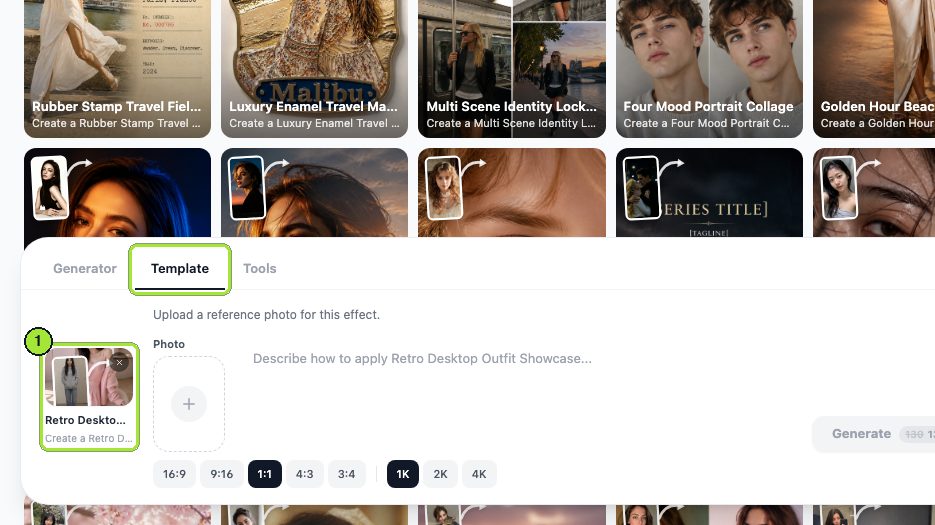
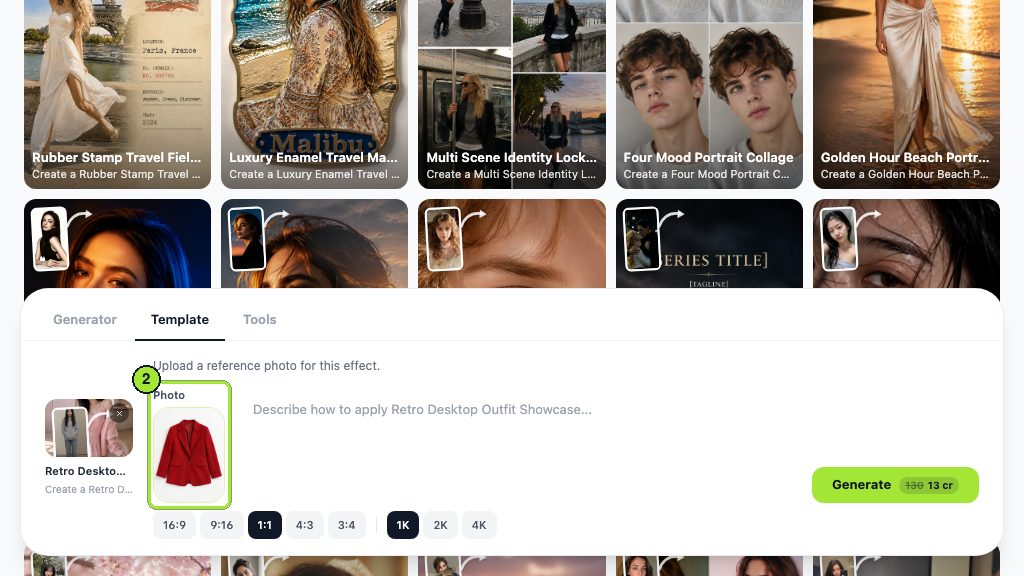
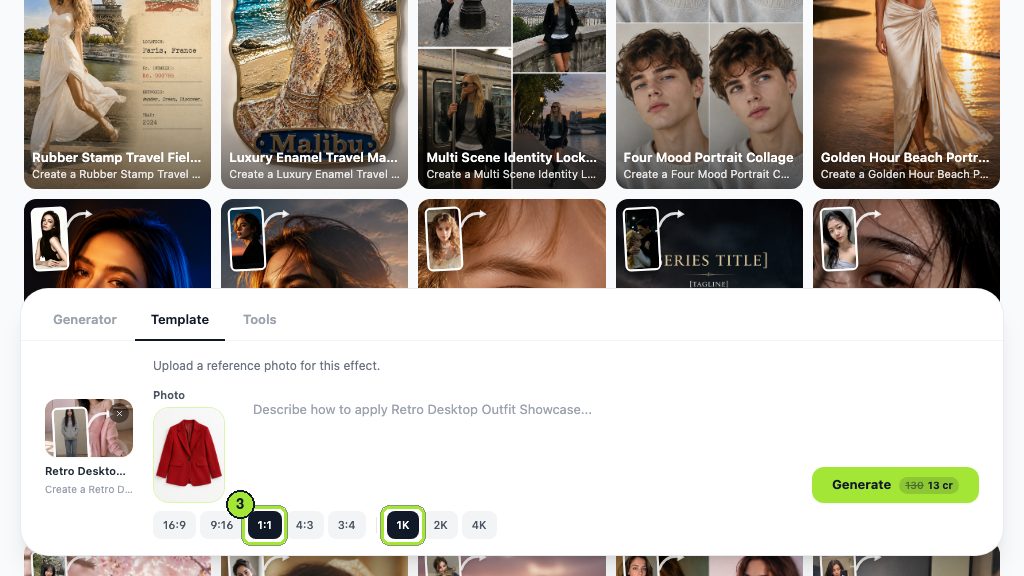
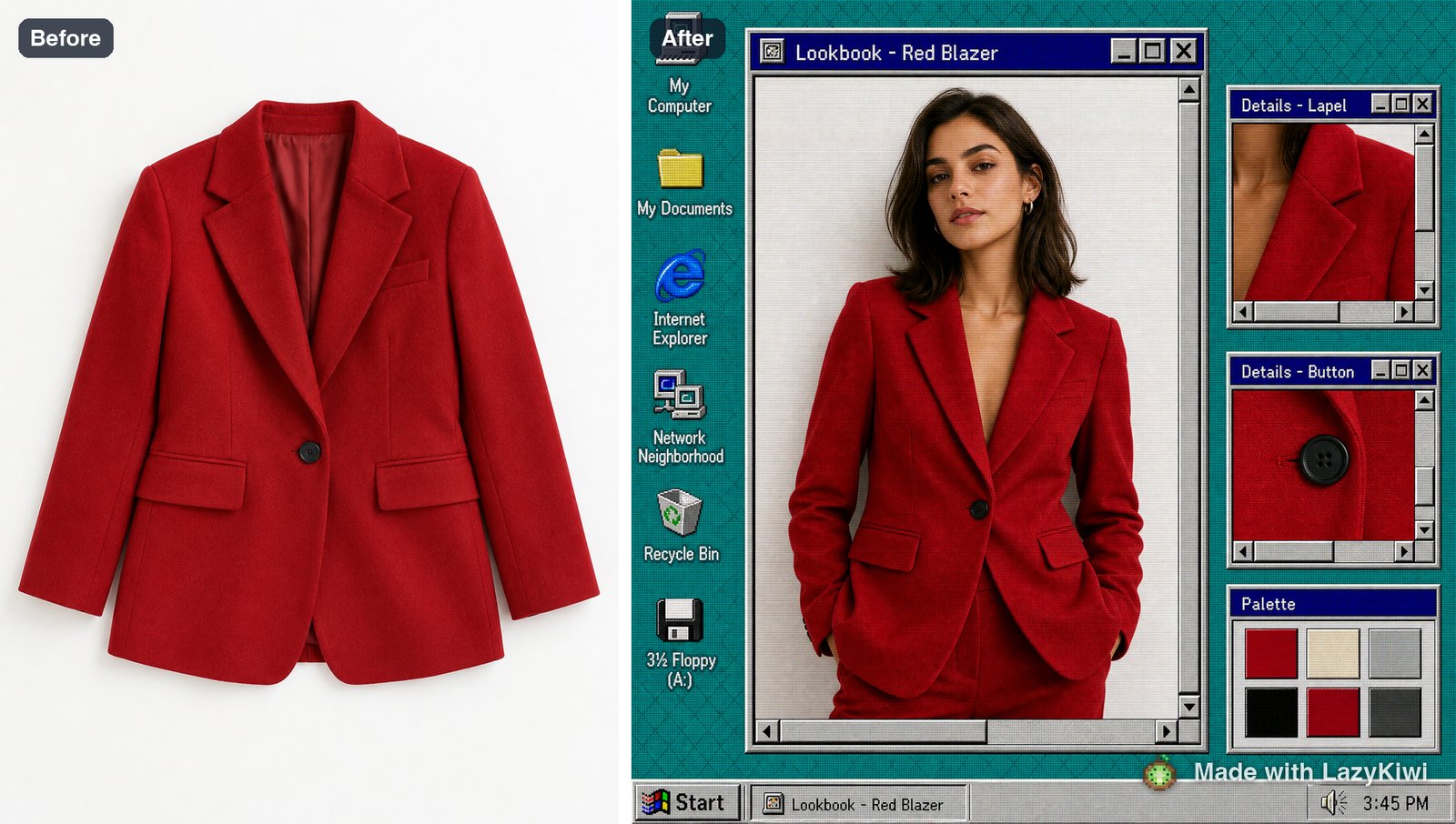
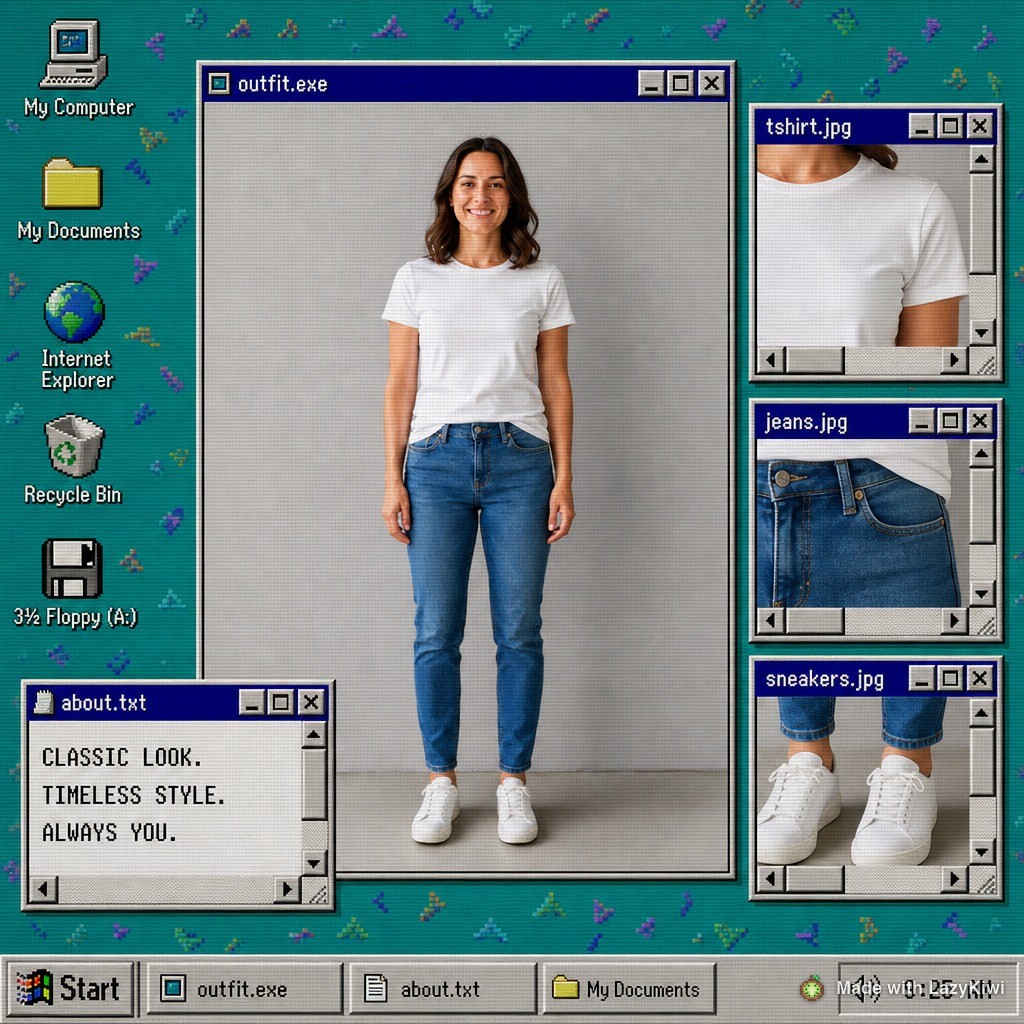
The useful finding is what changes between the two. From a flat-lay you get a presentation of the garment; from a person you get a presentation of the person. Neither is a recommendation, and that is the honest limit of generated look boards: they show a thing well, they do not decide whether you should wear it. Both runs were served by GPT Image 2, and in LazyKiwi's workbench data (August 2026) square 1:1 is the dominant image ratio at 124 of 143 external image jobs, which suits a look board well.
For the transfer job rather than the presentation job, the AI clothes changer puts a specific garment onto a specific photograph of you, which is the closest this category gets to answering does this suit me.
Is there a free AI stylist worth using?
Yes, with limits that are worth reading before you invest an evening in a wardrobe upload.
- FitRoom: ten credits monthly, a small wardrobe allowance, and a watermark on whatever comes out.
- LazyKiwi: 40 credits on a new account and 13 cr per 1K image, so three look-board or transfer runs, without a watermark.
- A general chat assistant: free advice, no images of you, and no memory of your wardrobe unless you describe it every time.
- Enterprise products: no free tier for individuals at all, only demo experiences.
A caution that applies to every free tier here, and to the paid ones. The asset you are handing over is a photographic catalogue of your clothes and, usually, of your home. Whether that is retained, and for how long, is a question the privacy policy answers and the marketing page does not. I have not quoted a retention period for any product here, because that claim has to come from the policy document itself and I did not open one today.
Can AI replace personal stylists?

No, and the reason is specific rather than sentimental. A human stylist does four things none of these tools attempt.
- Fit judgement. Seeing that a shoulder seam sits two centimetres wide and knowing whether a tailor can move it is a physical assessment made in a room.
- Shopping. Knowing what is actually in stock in your size, in shops you can reach, this month.
- Negotiating taste. A stylist talks you out of the thing you like and into the thing that works, which requires a relationship.
- Editing what you own. The most valuable session is usually the one where things leave the wardrobe, and no app is motivated to tell you to buy less.
Questions like do ai stylists work and can ai replace hair stylist services get the same answer for the same reason: the parts that scale are advice and inspiration, and the parts that do not are physical judgement and touch. Hairdressing is even further from automation, because the assessment and the execution are the same act.
Where an ai fashion stylist genuinely helps is the middle of the process: narrowing options, keeping a palette consistent, and producing a look board you can react to. Reacting to a specific bad suggestion is far more productive than staring at a full wardrobe.
What do AI stylists consistently get wrong?
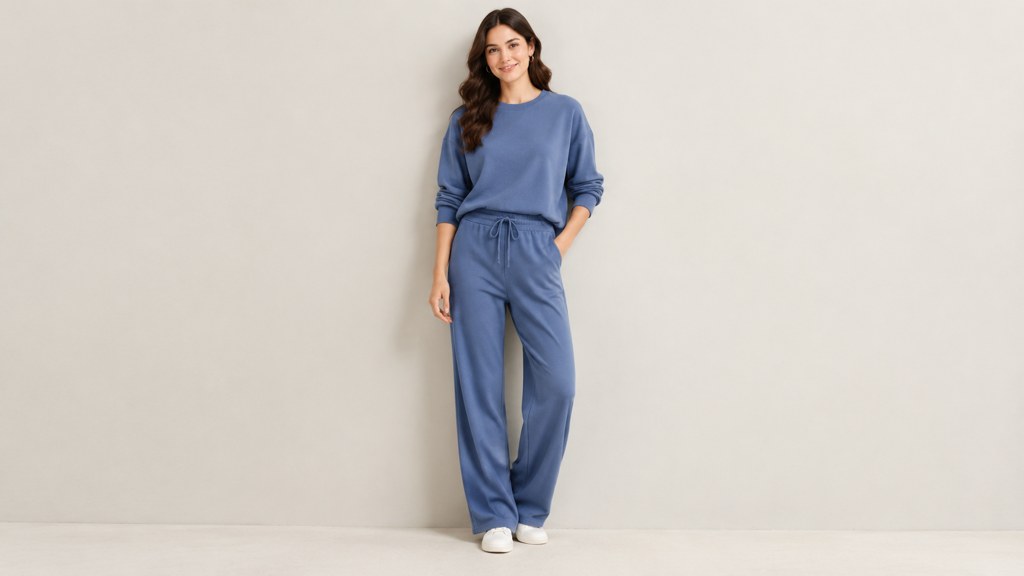
Four failures are structural to how these products work, which is why better prompting only fixes two of them.
| Failure | What happens | Why |
|---|---|---|
| Fit over fashion | Recommends silhouettes without asking about your proportions | Nothing about your body is known |
| Climate | Suggests the destination's season, not the forecast | No live weather input |
| Repeat outfits | Proposes a fresh combination every day | Optimised for variety, not for how people dress |
| Items you do not own | Recommends buying | The catalogue it draws from is not yours |
Two of those are avoidable by how you ask. State your constraints as facts rather than preferences: the trousers I own are these three, the temperature will be between eight and fifteen degrees, I will wear this twice. Constraints improve the output far more than any amount of style vocabulary does.
The other two are not avoidable, and they are the reason this category is a starting point rather than an answer. Use it to narrow, then use your own eyes in a mirror, which remains the only tool in this whole comparison that has actually seen you.
Key takeaways
- Three products, one label: wardrobe catalogue, recommender, look-board generator. Most tools are the third.
- Judge on five things: your real wardrobe, occasion, body and climate, cost, and where your photographs go.
- The interview brief exposes the gap: nothing knows how formal a specific company is.
- The travel brief works on item count and colour, and misses the forecast and the laundry.
- Generated look boards present a garment well; they do not decide whether you should wear it.
- State constraints as facts, not preferences. That fixes two of the four recurring failures.
Tools & Reviews Editor
Marcus Tan
Marcus tests creative software against the same brief until something breaks, then writes down where. He covers tool comparisons, free tiers and the gap between a feature list and a finished file.
FAQ
Common questions
Do ai stylists work for everyday outfit choices?
They work as a narrowing tool. Given constraints stated as facts, they produce sensible combinations and keep a palette consistent. They do not know what fits you, what the weather will do, or what is actually in your wardrobe unless you have catalogued it first.
What is the best personal stylist app for a real wardrobe?
The one you are willing to photograph your clothes for. Every wardrobe-based product depends on that upload, and the tools differ far less than the quality of the catalogue underneath them does. Expect an evening of flat-lay photography before anything useful happens.
Can ai replace hair stylist appointments?
No. Hairdressing is further from automation than wardrobe advice, because the assessment and the execution are the same physical act. A tool can show you a style on your face; it cannot judge your hair's texture, growth pattern or condition, or then cut it.
How do I get useful ai outfit ideas from what I own?
Photograph each garment flat in even daylight, tag by function rather than by name, mark the pieces that do not fit, and then give the tool constraints as facts: these three pairs of trousers, this temperature range, worn twice.
Is an ai fashion stylist safe with my photos?
That depends on the product's privacy policy, not its marketing page. You are uploading pictures of yourself, your clothes and usually your home. Read the retention terms before the wardrobe upload, because deleting a catalogue afterwards is harder than never creating one.
Start with one garment you already own
Photograph it flat, run it through the outfit generator, and react to a specific suggestion instead of staring at a full wardrobe.
Related reading
Virtual Try On: What Actually Works in 2026
Virtual try-on tools compared on fit realism, garment types they handle and what the free tiers allow — plus the cases where the technology still fails.
8 min read
How to Look Better in Photos: 5 Things That Work
Angle, posture, light, wardrobe and edit — in that order. The five variables that actually change how a photo of you reads, and how to test each one.
8 min read
What Is an AI Influencer? Definition, Examples, How-To
An AI influencer is a synthetic creator with a persistent identity. Named examples, how it differs from avatars and UGC, the tools, the rules and the build.
9 min read